Bengali Agricultural Advisory System KRISHOKTECH: Explicit Authorization Control Before and After Generation
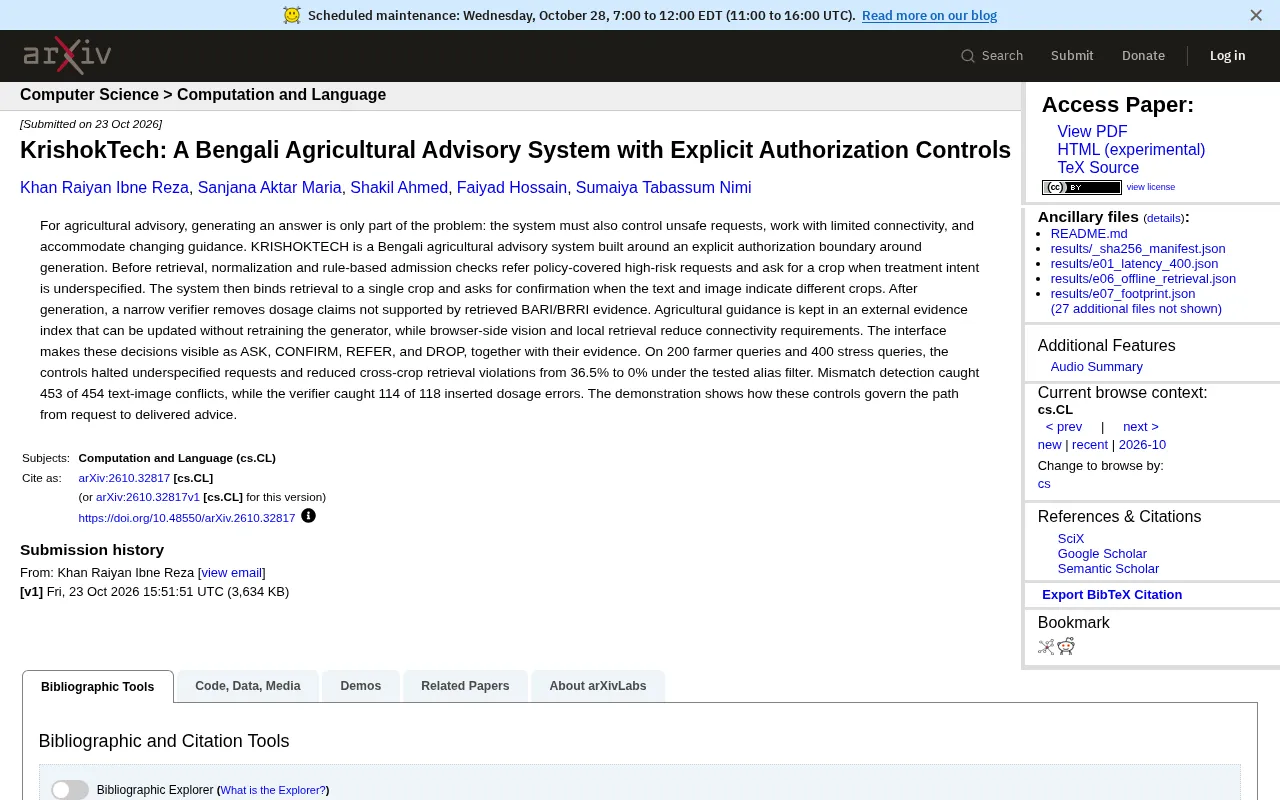
KRISHOKTECH reduces unsafe outputs in agricultural AI consultation through three layers of authorization boundaries: pre-retrieval admission, crop binding during retrieval, and post-generation dosage validation.
The Bengali agricultural advisory system KRISHOKTECH addresses harmful advice from generative AI by setting explicit authorization boundaries before and after generation rather than relying solely on model capabilities. It has three control gates: pre-retrieval normalization and rule-based admission checks that refer or ask about high-risk requests; binding retrieval to a single crop during retrieval with multimodal conflict detection and confirmation; and post-generation narrow-scope validation removing dosage claims lacking BARI/BRRI evidence. Tests on 200 farmer and 400 stress queries showed cross-crop retrieval violations dropping from 36.5% to 0%, text-image conflict detection capturing 453/454, and dosage error validation capturing 114/118. The interface presents decisions as ASK, CONFIRM, REFER, DROP states with evidence, enhancing transparency. This provides a reference architecture for layered control in high-risk AI advisory domains.
Why Agricultural Advisory Systems Need "Authorization Boundaries"
Generative AI faces a key tension in agricultural advisory scenarios: models may generate plausible but actually harmful advice, such as unsupported dosage recommendations or cross-crop misuse. According to a study from an RSS source, the core design approach of the Bengali agricultural advisory system KRISHOKTECH is to set explicit authorization boundaries before and after the generation process, rather than relying solely on the capabilities of the generative model.
The system's starting point is straightforward: generating answers is only part of the problem; the system must also control unsafe requests, adapt to limited network connectivity, and accommodate evolving agricultural guidance.
How the System Works: Three Control Gates
Pre-Retrieval Admission Check
Before retrieval, the system performs normalization and rule-based admission checks. For high-risk requests covered by policy, the system refers them (REFER); when the treatment intent description is insufficient, the system proactively asks (ASK) for the specific crop. The key here is not rushing to generate, but first determining whether the request meets the prerequisites for a safe answer.
Crop Binding and Conflict Detection During Retrieval
The system binds retrieval to a single crop, and when text and images indicate different crops, it requires user confirmation (CONFIRM). This multimodal consistency check is particularly important in agricultural scenarios—a farmer might upload an image of one crop but describe another in text, and direct generation would lead to incorrect advice.
Multimodal consistency check refers to the system simultaneously processing user-input text and images, verifying whether both point to the same entity (in this case, crop species). In agricultural consultation, a farmer might upload a photo of rice leaves but describe it in text as "tomato disease," or a blurry image might cause the model to misidentify. Without checks, retrieval would mix knowledge bases from different crops, generating cross-crop misuse advice. This check uses independent crop recognition modules to extract crop labels from text and images separately; if they are inconsistent, a CONFIRM state is triggered, requiring the user to explicitly confirm, thereby blocking potential incorrect binding before retrieval.
Post-Generation Dosage Validator
After generation, a narrow-scope validator removes dosage claims not supported by retrieved BARI/BRRI evidence. Agricultural guidance is stored in an external evidence index that can be updated without retraining the generator, which addresses the issue of timeliness in agricultural knowledge.
BARI/BRRI evidence index refers to the public guidance document repositories maintained by two authoritative agricultural research institutions in Bangladesh: BARI (Bangladesh Agricultural Research Institute) and BRRI (Bangladesh Rice Research Institute). These institutions publish standardized recommendations on crop cultivation, pest and disease control, fertilization dosages, etc., serving as the official basis for local agricultural extension. Binding generated content to such external evidence indices means the system does not rely on implicit knowledge in model parameters but explicitly references traceable authoritative sources. This has two benefits: first, key figures such as dosages are verifiable; second, when evidence updates, only the index needs modification without retraining or fine-tuning the generative model, thereby adapting to timeliness changes in agricultural guidance.
Quantitative Results: Actual Performance of Control Mechanisms
The study tested these control measures on 200 farmer queries and 400 stress queries. Results showed:
- The control mechanism successfully intercepted requests with insufficient descriptions;
- Under the tested alias filters, cross-crop retrieval violations dropped from 36.5% to 0%;
- Mismatch detection caught 453 out of 454 text-image conflicts;
- The validator caught 114 out of 118 inserted dosage errors.
These numbers demonstrate that explicit authorization boundaries have measurable effects in reducing specific types of errors, with the complete elimination of cross-crop retrieval violations being particularly noteworthy.
Interface Design: Making Decisions Visible
The system interface presents the decision process as four states—ASK, CONFIRM, REFER, and DROP—along with corresponding evidence. This transparency design lets users understand why the system asks, refers, or refuses, rather than facing a black-box answer. Browser-side visuals and local retrieval reduce dependence on network connectivity, adapting to the actual conditions of rural areas.
ASK, CONFIRM, REFER, DROP are four decision states defined by the system, corresponding to different safe handling paths: ASK indicates insufficient request information (e.g., crop not specified), and the system proactively asks; CONFIRM indicates detected multimodal conflicts or ambiguous matches, requiring user confirmation; REFER indicates the request falls under policy-covered high-risk situations (e.g., involving banned pesticides), and the system refers to human or official channels; DROP indicates the request violates safety rules and cannot be remedied, and the system directly refuses. Each state comes with evidence snippets (such as triggered rules or retrieved documents), enabling users to understand the basis for decisions rather than facing unexplained refusals or answers.
Limitations and Implications
This study is a demonstrative work with limited testing scale. The dosage validator uses a narrow-scope design targeting only dosage claims; other types of errors (such as crop disease misidentification or deviations in application timing advice) are not covered. Additionally, the system is built for Bengali and the BARI/BRRI evidence system, and migrating to other languages and agricultural systems requires redesigning evidence indices and rules.
However, its core approach—setting admission before generation, binding constraints during retrieval, and validating after generation—provides a reference architecture pattern for AI advisory systems in high-risk domains. Beyond agricultural consultation, medical and legal scenarios also face challenges in generated content safety, and this layered control design logic has cross-domain reference value.
One-line Summary
KRISHOKTECH significantly reduces unsafe outputs in agricultural AI consultation through three layers of authorization boundaries: pre-retrieval admission, crop binding during retrieval, and post-generation dosage validation.
Paragraph Summary
The Bengali agricultural advisory system KRISHOKTECH addresses the problem of generative AI potentially producing harmful advice in agricultural scenarios by proposing explicit authorization boundaries before and after the generation process, rather than relying solely on model capabilities. The system includes three control gates: pre-retrieval normalization and rule-based admission checks, referring or asking for high-risk requests; binding retrieval to a single crop during retrieval, detecting multimodal conflicts between text and images and requiring confirmation; and post-generation use of a narrow-scope validator to remove dosage claims lacking BARI/BRRI evidence support. Tests on 200 farmer queries and 400 stress queries showed cross-crop retrieval violations dropped from 36.5% to 0%, text-image conflict detection caught 453/454, and the dosage error validator caught 114/118. The interface presents decisions as four states—ASK, CONFIRM, REFER, DROP—with evidence, enhancing transparency. The system provides a reference architecture for layered control in high-risk domain AI consultation.
Related articles
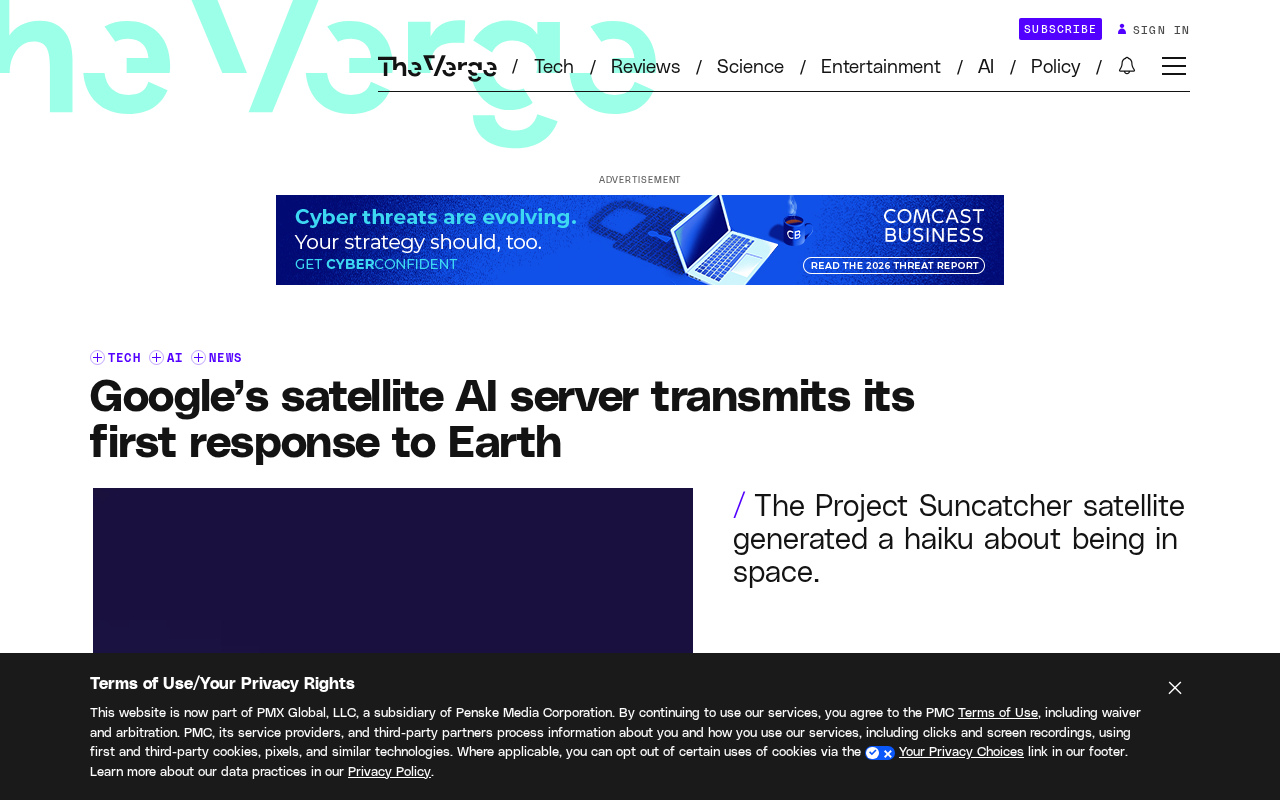
Google's Satellite AI Server Reaches Orbit: Gemma Model Generates First Reply in Space
Google's TPU-equipped satellite powers up in orbit, with the onboard Gemma 4 model generating the first reply from space. This article analyzes the technical path, real-world constraints, and implications for edge computing and satellite remote sensing.
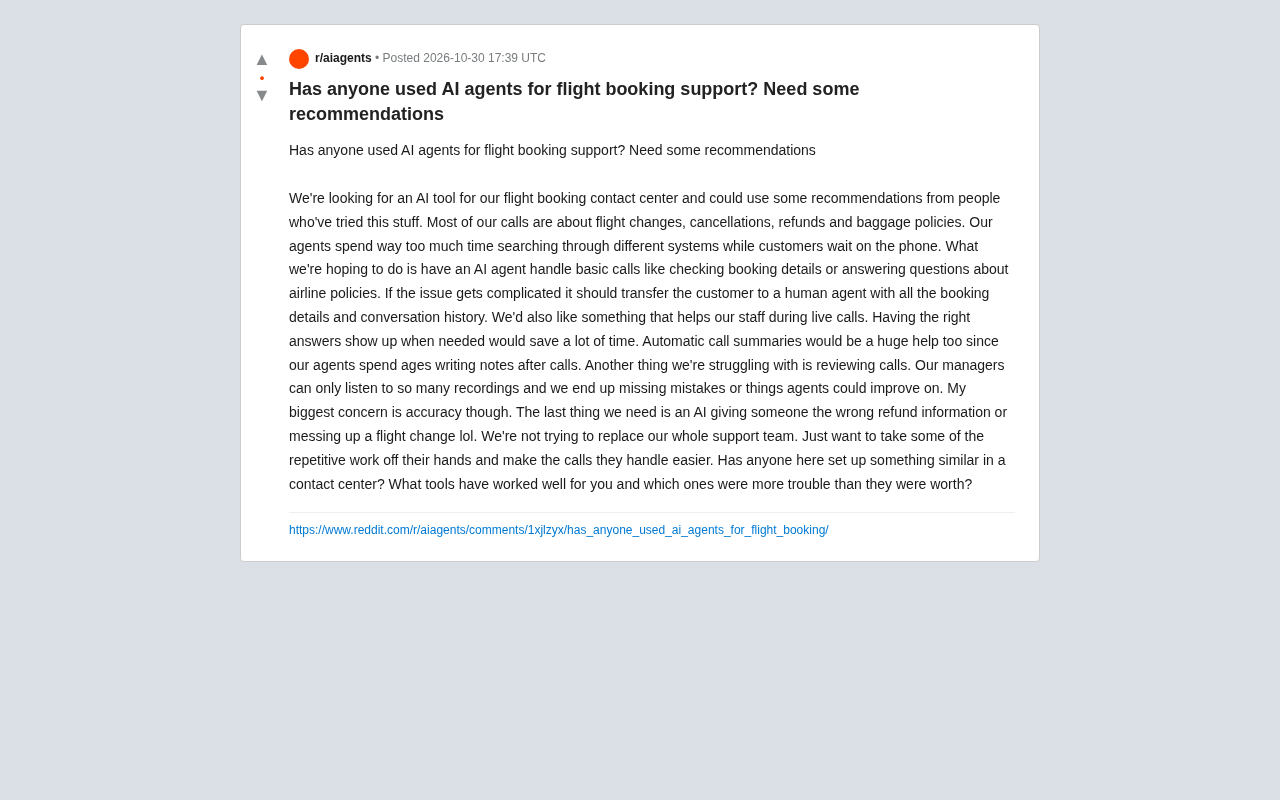
AI Agents for Flight Booking Customer Support: Real Needs and Implementation Challenges
Starting from a real Reddit question, this article breaks down four needs for introducing AI Agents into flight booking call centers: basic Q&A, agent assist, call summarization, and quality inspection, and analyzes accuracy concerns and handoff boundary design.
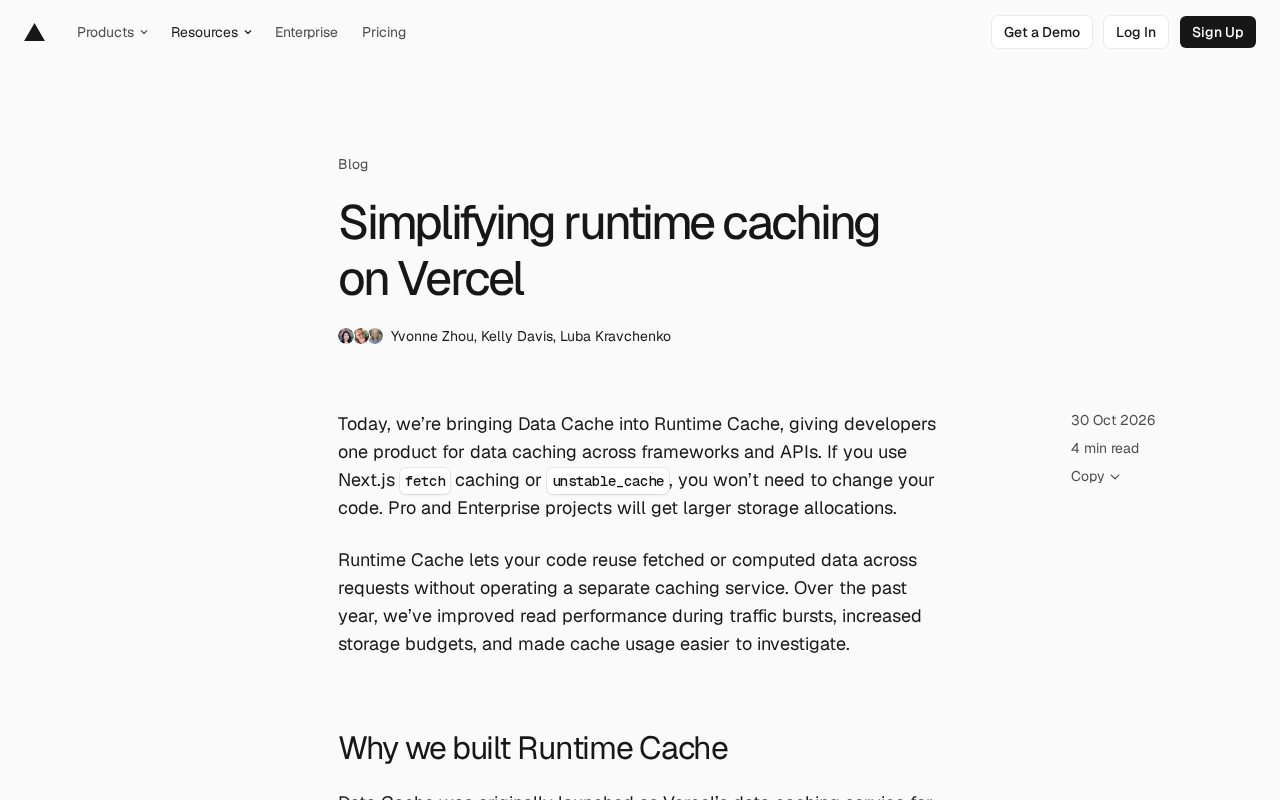
Vercel Unifies Runtime Cache: Data Cache Merges into Runtime Cache
Vercel merges Data Cache into Runtime Cache, unifying storage quotas and billing for Next.js fetch cache, unstable_cache, getCache, and use cache: remote. Pro and Enterprise projects get more storage, and cache reads/writes are now billed at Runtime Cache pricing.