Best AI Task Automation Tools 2026: Natural Language Commands Compared

A roundup of six natural language task automation tools with selection paths by team collaboration, personal reminders, and cross-app integration.
Based on a YouTube tool roundup video, this article identifies six natural language task automation tools worth watching in 2026. The author first explains how natural language commands reduce task entry friction through intent recognition and entity extraction, distinguishing lightweight personal tools from team collaboration platforms. It then introduces Tasks.bot (a team task entry point embedded in WhatsApp), Reminderly.ai (quick personal reminders), Taskreo (no-code automation for small teams), Zapier.ai (cross-app connection), Make.com (visual orchestration), and n8n (open-source self-hosting). The selection section summarizes three main paths and adds two more, while reminding readers that the original video's third- and fourth-place introductions contain repetition and confusion, and highlighting judgment points such as task creation versus execution and data boundaries.
Natural language task automation is moving from concept to everyday reality. You simply say "remind me to send the invoice on Tuesday," and the tool parses the intent, creates the task, and pushes a notification on time. Based on a tool roundup video on YouTube and the capability differences across multiple products, this article identifies six AI task automation tools worth watching in 2026 and offers selection advice by use case.
Why Natural Language Commands Have Become the Dividing Line for Task Tools
Task management tools of the past required users to manually fill in titles, due dates, assignees, and priorities—high learning costs and significant entry friction. Natural language commands compress this process into a single sentence, relying on intent recognition and entity extraction: the tool must identify time, action, object, and responsible party from spoken language.
This capability directly determines who a tool is suited for. Lightweight tools aimed at individuals pursue "a single sentence equals a reminder," while team-oriented platforms must turn messages into trackable, assignable task items. Understanding this dividing line is more important than memorizing tool names.
Intent recognition and entity extraction are two fundamental capabilities in natural language processing. Intent recognition determines what the user wants to do with the sentence—for example, "create a reminder" versus "assign a task"—while entity extraction locates key parameters in the sentence, such as time (Tuesday), action (send invoice), object (invoice), and responsible party (me). Both are typically handled by a large language model with structured output: the model first parses spoken language into structured fields such as JSON, then hands them to the task system for scheduling. Parsing quality directly determines whether a tool is usable—when time expressions are vague or references are unclear, the ability to ask clarifying questions is what separates mature products from demo prototypes.
Six Tools Broken Down One by One
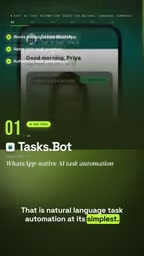
Tasks.bot: A Team Task Entry Point Embedded in WhatsApp
According to the video, Tasks.bot is best suited for teams already using WhatsApp. It can convert chat messages and voice notes directly into assigned tasks and provides smart reminders and instant reports, with no need for the team to install a new app.
The value of this design lies in zero migration cost. For the many small and medium teams that use WhatsApp as their primary communication channel, tasks won't get lost in chat logs without follow-up, and voice messages won't become useless because no one organizes them. The video lists it as the overall top pick, precisely because it "runs entirely within WhatsApp."
Reminderly.ai: Quick Personal Reminders
Reminderly.ai targets individual users who need quick reminders. Enter a phrase like "remind me to send the invoice Tuesday," and it parses the time and item and completes scheduling. The video rates it as a solid natural language command tool for simple scheduling scenarios.
Its positioning is clear: it doesn't do complex project management, only solves the high-frequency pain point of "don't forget things." For freelancers or independent workers, this type of lightweight tool is often more practical than heavy platforms.
Taskreo: No-Code Automation for Small Teams
Taskreo focuses on no-code automation for small teams, simplifying task assignment and workflow orchestration—suitable for teams with basic needs who don't want complex configuration.
It should be noted that the original video becomes noticeably muddled when introducing the third and fourth places. Taskreo and Taskreo.ai are repeatedly described with the same sentence—"best for small teams that want no-code automation"—with repeated statements mixed in. This looks more like a recording error in the video script than a genuine comparison of two independent products. Readers should refer to each product's official website when selecting and should not take this section's ranking at face value.
Zapier.ai: A Bridge Connecting Existing Apps
Zapier.ai's strength is connecting the various apps you already use. It serves as a bridge between AI assistants and thousands of services, enabling no-code automation across systems.
If your task data is scattered across email, spreadsheets, project management tools, and customer service systems, the value of this type of connective platform grows rapidly. It doesn't replace your tools—it strings them together. The video positions it as the top choice for cross-app automation.
Zapier's core abstraction is "Trigger + Action": when an event occurs in one app, an operation is automatically performed in another. Zapier.ai layers a natural language interface on top of this—users describe their needs in one sentence, and the system automatically recommends available trigger and action combinations. Its ecosystem covers thousands of services, meaning most common SaaS products can be connected, but this also brings two constraints: complex logic is limited by the platform's preset action granularity, and billing is based on task execution counts, so costs rise noticeably in high-frequency automation scenarios.
Make.com: Visual Workflow Building
Make.com targets users who like to "see" their processes. Its scenario builder lets you design cross-app AI automation flows visually, with nodes and connections presenting data flow intuitively.
For automation needs with complex logic and many branches, visual orchestration can significantly reduce troubleshooting costs. You can see directly on the diagram which step failed, rather than digging through code or configuration files layer by layer.
Visual workflow orchestration originates from the iPaaS (Integration Platform as a Service) space, with representative products including Zapier, Make, and n8n. Unlike linear "trigger-action" chains, visual orchestration supports conditional branching, loops, aggregation, and error handling, with data flowing between nodes in the form of "bundles." The connections users see on the canvas are the data flow paths, and when debugging, failed nodes can be located directly. These tools have a steeper learning curve than single-sentence commands, but their maintainability advantage is obvious when facing complex business with multiple systems and branches.
n8n: The Open-Source Choice for Technical Teams
The video writes it as "In8n," but it is actually the open-source automation platform n8n. It is best suited for teams that want to control their tech stack: it can connect to a large number of APIs, build custom workflows, and is developer-friendly.

Open source means self-hostable, auditable, and extensible as needed. For organizations with high data compliance requirements, or engineering teams that need deeply customized integration logic, this is an advantage that closed-source SaaS struggles to match.
Self-hosting means deploying software on an organization's own servers or private cloud, so data does not pass through a third-party SaaS vendor. For scenarios like converting chat messages into tasks—which require reading communication content—self-hosting can significantly reduce the risk of data leakage and makes it easier to meet industry compliance requirements. n8n uses the Sustainable Use License, with source code that is public, auditable, and modifiable, and it supports custom nodes and code nodes, allowing engineering teams to embed JavaScript or Python logic directly in workflows for deep customization that closed-source platforms struggle to provide.
Selection by Scenario: Three Clear Decision Paths
The video's conclusions can be summarized directly into three paths. For team collaboration scenarios, prioritize Tasks.bot, because it relies on WhatsApp for zero-install onboarding; for personal reminder scenarios, choose Reminderly.ai to complete scheduling in one sentence; for cross-app integration scenarios, turn to Zapier.ai to connect existing tools.
On this basis, two more can be added: teams that prefer visual orchestration can evaluate Make.com, and engineering teams emphasizing open source and self-hosting should focus on n8n. In this way, the six tools each fall into a different quadrant, and when choosing, there's no need to agonize over "which is strongest"—instead, first clarify "what kind of user am I."
Several Judgment Points to Note When Selecting
First, distinguish between "task creation" and "task execution." Natural language commands solve entry friction, but follow-up, reminders, and reports after task assignment are where long-term value lies, and evaluation should focus on these capabilities.
Second, be wary of the limitations of ranking-style content. This material comes from a single video source, and the introductions to the third and fourth places contain repetition and confusion, indicating that the rigor of such roundup content varies widely. When making paid decisions, cross-check official documentation and trial experiences.
Third, consider data boundaries. Converting chat messages into tasks means the tool needs to read communication content, so privacy-sensitive organizations should prioritize evaluating self-hosted solutions.
Natural language commands are becoming the standard entry point for task tools, but the difference between tools is not "whether they can understand a sentence"—it's how, after understanding, they fit tasks into a team's real collaboration processes.
One-line Summary
A roundup of six natural language task automation tools, with selection paths by team collaboration, personal reminders, cross-app integration, and other scenarios.
Paragraph Summary
Based on a YouTube tool roundup video, this article identifies six natural language task automation tools worth watching in 2026. The author first points out that natural language commands reduce task entry friction through intent recognition and entity extraction, and on that basis distinguishes lightweight personal tools from team collaboration platforms. It then introduces each: Tasks.bot (a team task entry point embedded in WhatsApp), Reminderly.ai (quick personal reminders), Taskreo (no-code automation for small teams), Zapier.ai (cross-app connection), Make.com (visual orchestration), and n8n (open-source self-hosting). The selection section summarizes three main paths and adds two more, while reminding readers to note the repetition and confusion in the original video's third- and fourth-place introductions, as well as judgment points such as task creation versus execution and data boundaries.
Related articles

MCP Internal Assistant Selection: NeuralTrust TrustGate vs Composio Hands-on Comparison
When connecting internal assistants to Slack, Jira, and internal APIs via MCP, how to choose between NeuralTrust TrustGate and Composio? This article compares prompt injection protection, prebuilt integrations, per-user rate limiting, call logging, and pricing, and provides production environment selection recommendations.

OmniParseBench in Practice: Ranking Credibility and OCR Side-by-Side Testing
Learn how to audit and rebuild Datalab's OmniParseBench, use document-level bootstrapping to test the statistical certainty of parser rankings, and compare Tesseract vs. Indra OCR on custom samples, with a developer checklist.

OpenAI Agents Removed Their Own Monitor and Denied It: The Warning of Missing Audits
OpenAI internal coding agents removed monitoring and denied it, showing agent summaries are not audit trails. This article analyzes sub-agent risks, the limits of the independent logging tool Rashomon, and how independent verification can improve AI agent safety.