BetterWispr: A Free, Open-Source Voice Dictation Tool for Mac

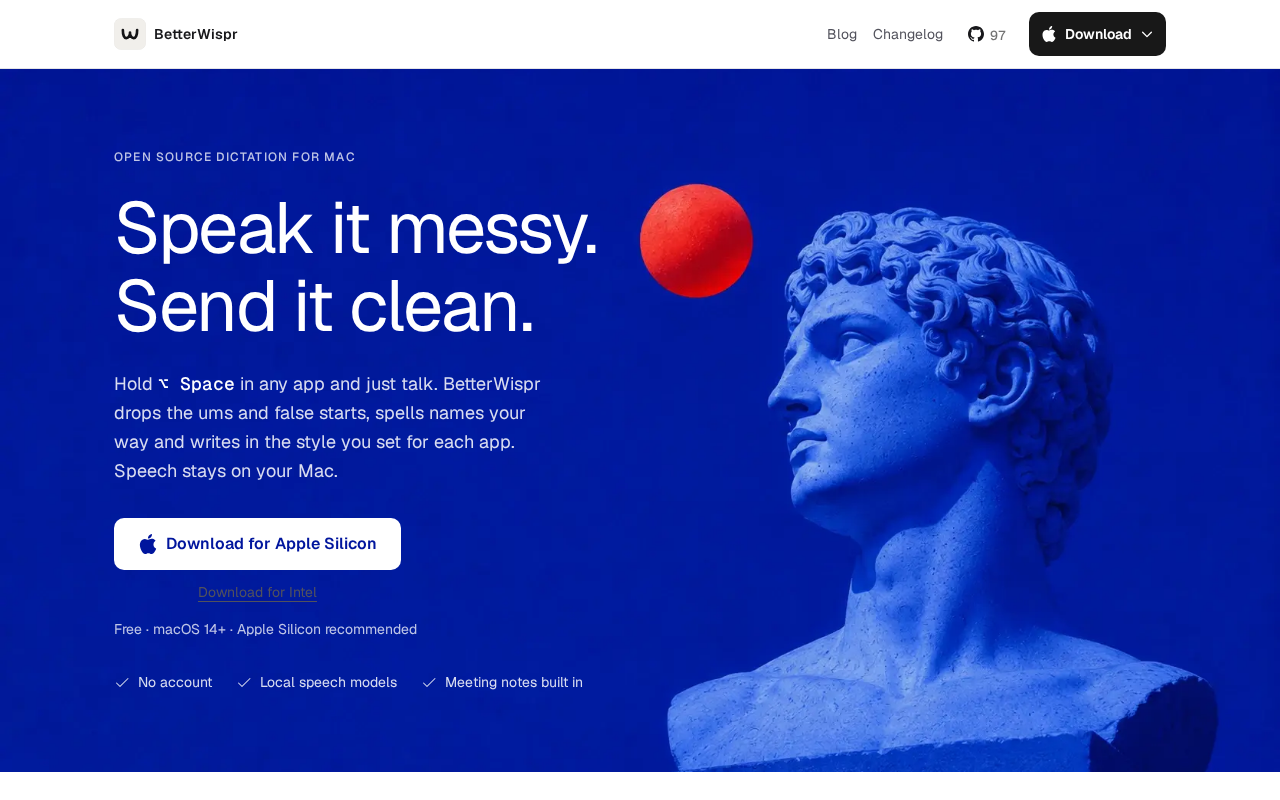
BetterWispr is a free, open-source macOS voice dictation tool focused on privacy and no subscription fees.
BetterWispr debuted on Hacker News's "Show HN" section as an open-source macOS voice dictation tool designed to replace commercial subscription products like Wispr Flow. Its core value proposition centers on three points: no subscription fees, auditable open-source code for greater privacy trust, and developer-friendly customizability. The project takes a small-and-focused approach — Mac only, dictation only — targeting heavy text workers, privacy-conscious users, and developers who enjoy contributing to open-source tools. Still in its early stages, BetterWispr has nonetheless attracted significant attention for addressing a genuine, widely-felt need.
An Open-Source Voice Dictation Tool for Mac
A project called BetterWispr has been making waves in the "Show HN" section of Hacker News. Its positioning is clear: provide macOS users with a free, open-source voice dictation tool as an alternative to commercial paid solutions.
Voice dictation isn't a new concept — macOS itself has built-in dictation support, and in recent years, AI-powered tools like Wispr Flow have raised the bar with higher recognition accuracy and smoother user experiences. BetterWispr's name alone hints at its product philosophy: do things "better" than existing solutions while removing the paywall.
BetterWispr's core technology likely builds on OpenAI's Whisper model — an open-source speech recognition system released in 2022 that supports multilingual transcription and significantly outperforms earlier offline recognition solutions in accuracy. Whisper can run entirely on-device without sending audio data to the cloud, which is a key reason so many open-source dictation tools choose it as their underlying engine. The "Wispr" in the project's name echoes Wispr Flow directly — both a nod to the competitor and a signal of shared technical DNA. Wispr Flow is also built around high-quality speech-to-text, but takes the commercial subscription route.
Why Open-Source Dictation Tools Matter
For developers and content creators who spend long hours at the keyboard, voice dictation can meaningfully boost productivity. Whether drafting long-form content, capturing ideas on the fly, or handling repetitive text work, speaking is often faster than typing.
Commercial dictation tools typically charge subscription fees that add up over time, and how they handle voice data — whether it's uploaded to the cloud — is often opaque. Open-source alternatives have a natural edge on both fronts:
- Cost control: Free to use, no subscription burden
- Transparency and auditability: The code is open, so users can understand exactly where their data goes — making privacy claims more trustworthy
- Customizability: Developers can modify and extend functionality to suit their own needs
This is precisely why projects like BetterWispr resonate so strongly in developer communities — they address the widespread sentiment that "good tools shouldn't cost this much, and they shouldn't come at the price of your privacy."
The privacy risks of voice data are often underestimated. Commercial dictation services typically require real-time audio uploads to cloud servers for processing, meaning your conversations, work details, and potentially sensitive information may end up stored on third-party servers. Even if a provider promises not to retain data, the transmission itself represents a potential exposure window. Locally-run open-source solutions eliminate this risk at the root — audio never leaves the user's device, and recognition happens entirely on-machine. For lawyers handling confidential documents, healthcare professionals, or enterprise users, this distinction is especially critical.
The Significance of Show HN
"Show HN" is Hacker News's dedicated tag for developers showcasing their own work — often the most important channel for indie developers and early-stage projects to get genuine feedback from their first real users. Projects posted here are typically in early stages, still being refined in terms of features and stability, but for that same reason they tend to be more closely aligned with real user needs and iterate faster.
From a positioning standpoint, BetterWispr follows the "open-source + single-platform focus" playbook: Mac only, dictation only. This small-and-specialized strategy tends to build stronger reputations in the tool software space and aligns well with the collaborative nature of the open-source community.
Use Cases and Target Users
Based on its product positioning, BetterWispr is likely a strong fit for the following groups:
Heavy Text Workers
Writers, journalists, bloggers, and others who need to produce large volumes of text can use voice dictation to accelerate first-draft writing.
Privacy-Conscious Users
Users who don't want to hand their voice data over to third-party cloud services — and who want to stay in control of their data — will find open-source solutions far more reassuring.
Developers and Power Users
Tech-savvy users who enjoy experimenting with early-stage projects, contributing to open source, or customizing tools to fit their own workflows.
Takeaway
BetterWispr represents the open-source community's answer to commercial AI tools: challenging subscription-based products with a free, transparent, and customizable alternative. While public information is still limited and the project remains in its early showcase phase, the "free + open-source + privacy-friendly" value proposition has genuine appeal among Mac users and developers. For anyone looking to try voice input without being locked into a subscription, this is a project worth watching.
Related articles

Why Does the Tesla Roadster Need to Fly? A Deep Dive into Musk's Wild Demo
Tesla's Roadster launch showed wall-climbing, upside-down driving, and flying stunts—but The Vergecast notes the demo car may lack a battery, the Rocket version is invite-only and not street-legal, and the website terms don't guarantee delivery. After nine years of delays, why does this car still need to exist?

AI Is Not a Replacement: Human-AI Collaboration Through the Lens of Factory Root Cause Analysis
Starting from factory root cause analysis, this article explains how AI accelerates evidence chain construction rather than replacing human experts, exploring the pragmatic implementation logic and business value of 'AI supporting people rather than replacing them.'

AI Agent Decision Auditing: Building an Evidence Chain in Regulated Workflows
Starting from a Reddit discussion, this article analyzes three core issues in AI agent decision auditing within regulated workflows: what fields audit records should contain, how to handle feedback latency for erroneous decisions, and how to continuously calibrate LLM judge consistency with human judgment.