Beware of Discounted Cursor Account Schemes: Breaking Down the Risks Behind Pay-As-You-Go Claims

Exposing the shared-account reality and hidden risks behind viral discounted Cursor subscription services.
Promotional content offering "Cursor Pro at 25% off" has proliferated on platforms like Bilibili. This article dissects a typical example, revealing that the so-called dedicated Pro accounts are actually bulk-purchased shared account pools rotated via plugin — directly contradicting the sellers' own claims. Pricing figures are internally inconsistent, and the marketing language is unverifiable. These services violate Cursor's Terms of Service, exposing users to sudden bulk bans and total balance loss, while third-party plugin involvement creates real code and data leakage risks. Developers are advised to use official subscriptions or open-source tools like Cline and Continue with their own API keys.
A Low-Price Cursor Subscription Ad That Reveals an Industry Problem
Recently, platforms like Bilibili have seen a surge of promotional content using hooks like "Official Cursor subscription at 25% off" and "Grok 4.6 dramatically boosts productivity." These videos typically claim to help users save money while accessing the latest models, and often insist their product is fundamentally different from the common "shared/resold" account tools on the market. Based on one representative promotional piece, this article breaks down how these third-party Cursor account services operate — and the risks they carry — to help developers make informed decisions.
It's worth noting upfront: the repeated claim in the original material that "Grok 4.6 destroys GPT 5.6 and Claude" is little more than clickbait. The actual content is almost entirely focused on sales pitches for third-party Cursor accounts, with zero real-world benchmark data or model performance comparisons provided.
Breaking Down the Core Selling Points
The promotional logic for these services typically revolves around a few key phrases: pay-as-you-go billing, balances that never expire, dedicated official Pro accounts, and 25% of official pricing.
The sellers claim that — unlike the common 7-day trial accounts, auto-rotation schemes, or monthly/quarterly card models in the industry — they match each user with a dedicated, stable, long-term Pro account. They use a pay-per-use model billed at 25% of the official price (later described as 10% in the same material — a contradiction we'll return to), with 100 RMB in top-ups supposedly getting you the equivalent of ~1,000 RMB worth of official credits.
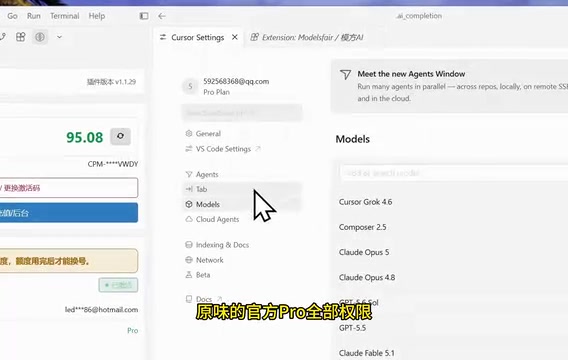
The sellers also emphasize that every model officially supported by Cursor is fully unlocked, with no model downgrading, feature restrictions, or incomplete outputs — because, as they put it, "only the billing model is changed, not the underlying code." This framing is designed to convince users they're getting a genuine, unaltered official experience.
The Technical Spin: "Transparent Billing" and "Smart Rotation"
A significant portion of the promotional material is devoted to describing its billing and statement system: every consumption event is precisely recorded, including remaining balance, the model used per request, the official billing rate, output token count, and transaction timestamp — all claimed to be fully transparent and verifiable against official records.

On the technical side, the sellers say the plugin retains only two core functions: smart account rotation and billing record tracking. Their so-called "smart billing system" automatically releases idle accounts when no user interaction is detected for an extended period; when the user resumes activity, a new account is instantly matched and billing begins. When the current account's quota runs out, the system automatically switches to a new account — all without any manual intervention.
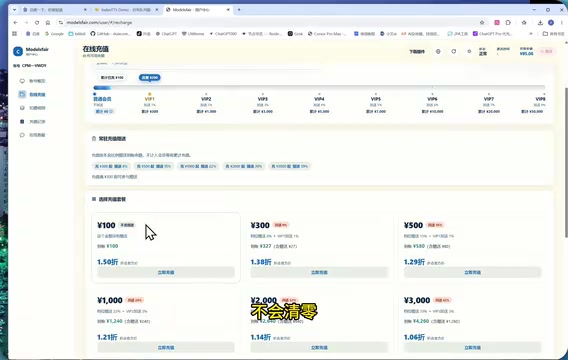
This description actually exposes the core contradiction: "dedicated official Pro accounts" and "automatic account pool rotation" are mutually exclusive. If each user truly had their own fixed, dedicated account, there would be no such thing as "the system automatically switching to a new account." What's actually being described is far closer to a bulk-purchased pool of shared accounts, with requests distributed across multiple accounts through rotation.
The Price Tag: Risks You Need to Understand Clearly
The sellers do their own math: at a 10% unit price and a 7.3 exchange rate, topping up 100 RMB supposedly equates to $137 worth of official credits. They compare this to "buying a Pro account on Xianyu for 50–60 RMB," and emphasize that their credits never expire and that account ban risk is borne by the platform.

From a developer's perspective, however, these services carry several unavoidable risks:
Account Compliance and Ban Risk
Bulk-purchasing accounts and rotating through them is, by definition, a violation of Cursor's official Terms of Service. Once Cursor detects abnormal sharing behavior, the affected accounts are typically banned in bulk — and any balance you've topped up can disappear instantly. The "never-expiring" balance guarantee depends entirely on the third-party platform continuing to operate; if they shut down or disappear, your balance is gone.
Cursor's Terms of Service explicitly prohibit account sharing, reselling, and any form of proxy use. In recent years, Cursor has continuously strengthened its anomaly detection, including identifying concurrent requests from different IPs on the same account within a short time window, abnormally high-frequency calls, and geographic location jumps. Once triggered, bans are typically immediate and applied in bulk, with no refunds on remaining balances. Critically, these third-party platforms are light-asset operations with no official authorization and no regulatory oversight — users have virtually no legal recourse in disputes. Multiple similar services have historically shut down within weeks following coordinated enforcement actions by Cursor, leaving large numbers of users with unrecoverable losses.
Data Security Risks
Using accounts and plugins distributed by a third party means your code, prompts, and other sensitive information pass through intermediary infrastructure that isn't under official control. Even if the sellers claim "the underlying code is unchanged" and "there's no API relay," users have no independent way to verify this — leaving a real potential for code leakage.
Inserting third-party billing and account rotation logic at the IDE plugin level inherently introduces at least one man-in-the-middle layer from an architectural standpoint. Even if the plugin claims not to relay API calls, account credentials (tokens/cookies) are still allocated and managed by third-party servers — meaning the third party retains the ability to make requests using that account identity at any time. Code snippets, system prompts, project structure, and other information you write in Cursor all exist in plaintext within the request context during model inference. For projects involving business logic, unpublished algorithms, or customer data, the risks introduced by this pipeline far outweigh the cost savings on a subscription. Teams and organizations with stricter compliance requirements should treat this as an unacceptable security risk.
Contradictory Marketing Claims
As already noted, the promotional material uses both "25% off" and "10% of official price" — two incompatible figures in the same pitch. "Dedicated fixed accounts" and "automatic account pool rotation" are logically irreconcilable. The material is saturated with emphatic phrases like "genuinely effective," "fully transparent," and "absolutely not" — while providing zero third-party-verifiable evidence. This is a textbook example of marketing rhetoric with no substance behind it.
Recommendations for Developers
For developers who genuinely rely on AI coding tools to boost productivity, stability and data security matter far more than short-term savings. An official Cursor Pro subscription costs more, but delivers account stability, data protection, and compliance — without the risk of getting banned mid-session or losing access when a platform disappears.
If cost is a real concern, consider the official free tier, student discounts, or open-source alternatives like Cline and Continue used with your own API keys. That approach keeps billing and security entirely in your own hands — transparent, compliant, and under your control.
As for the claim in the video title that "Grok 4.6 destroys GPT and Claude" — since the source material provides no actual benchmarks or comparisons, rely on official evaluations from each model provider and your own hands-on experience. Don't let marketing headlines distort your judgment.
Cline and Continue are currently among the most mature open-source AI coding assistant plugins available. Both support user-configured API keys for any OpenAI-compatible endpoint, including OpenAI, Anthropic, Google Gemini, and locally deployed open-source models. The key advantage of this approach: billing happens directly between you and the model provider, with no need to trust any intermediary; you hold and manage your own API keys and can rotate or revoke them at any time; the request path is auditable, and sensitive code never passes through uncontrolled third-party nodes. For individual developers with variable usage, a pay-per-token model with your own key is often more cost-flexible than a fixed monthly subscription.
Related articles

Reinforcement Learning Takes On Getting Over It: Distributed Training Strategies Behind 63% Progress
A developer uses deep reinforcement learning to tackle Getting Over It. The agent climbs from the bottom to 63% progress but gets stuck at the anvil. The project is open-sourced, using divide-and-conquer training and CPU-only training, seeking community collaboration to break the bottleneck.

Sigma FP2 Released: The World's Smallest Full-Frame Camera Gets Sensor and Screen Upgrades
Sigma launches the FP2 full-frame camera, retaining its smallest-and-lightest design with three key upgrades: improved sensor, articulating LCD screen, and longer battery life—built for portable video creators.

AAAI 2027 Phase 2 Decisions Imminent: Community Debates Review Fairness and Submission Ecosystem
AAAI 2027 phase 2 review results are imminent, with the Reddit community debating reviewer consistency and process transparency. This article examines pre-decision sentiment, structural tensions in top conference review, and practical strategies for authors.