Beyond Vibe Coding: A Practical Guide to Enterprise-Level AI Programming

A practical guide to evolving from Vibe Coding toys to enterprise-grade AI programming with SDD workflows.
This guide examines why pure Vibe Coding hits a ceiling for enterprise projects and presents three progressive AI programming modes: basic Vibe Coding, Plan Mode, and SuperPower plugin with Specification-Driven Development (SDD). It covers tool selection between Claude Code and Codex, backend model choices including GLM and DeepSeek, and demonstrates the approach through e-commerce and AI model aggregation platform projects.
From Vibe Coding to Engineering-Grade AI Programming
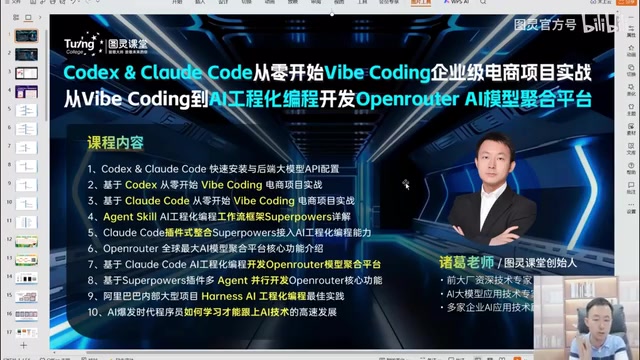
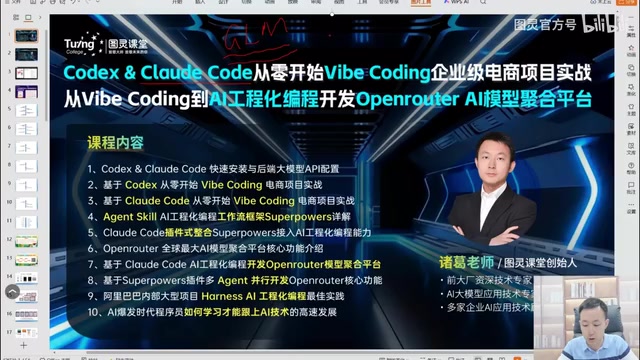
A recent tutorial series on Bilibili focused on enterprise-level AI programming has been gaining significant attention. The course addresses a clear and compelling question: how can developers leverage mainstream AI coding tools like Claude Code and Codex to break free from the "Vibe Coding is only good for toy projects" trap and truly deliver enterprise-grade software?
Vibe Coding originated overseas, first coined by OpenAI co-founder Andrej Karpathy in February 2025. He described an entirely new programming paradigm: developers fully immerse themselves in the "vibe," embrace the exponential growth of code complexity, and even forget that code exists — transforming programming from "writing precise instructions" to "expressing intent." The idea is that developers or product managers only need to clearly describe what's in their heads, and AI tools will generate clean, working code. This approach is genuinely efficient at the demo stage — you can scaffold an e-commerce project prototype in minutes. But the instructor doesn't mince words: Vibe Coding is becoming "outdated" because it has a clear ceiling.
Where Vibe Coding Hits Its Ceiling
When projects scale up and business and technical complexity increase, pure Vibe Coding often falls apart. The instructor identifies two core pain points:
First, poor code maintainability. Code generated by AI in one shot can be a tangled mess — lacking sound architectural design, making it nearly impossible to maintain or extend. The root cause is that in Vibe Coding mode, AI has no awareness of the project's overall architecture. It generates locally optimal code snippets at the granularity of individual prompts, rather than systematically developing based on unified design standards.
Second, bug fixing spirals into an infinite loop. Once issues appear in production, a non-technical product manager can't effectively direct AI to locate and fix bugs, potentially stalling the entire project. Even worse, AI may introduce new bugs while fixing existing ones, creating a so-called "fix-regression cycle" that leads to a downward spiral in code quality.
The instructor sharply critiques the early wave of "AI will replace programmers" rhetoric — pointing out that those influencers typically built nothing more than simple cross-border e-commerce sites, Pomodoro timers, or ring light mini-apps. These are worlds apart from enterprise projects that require high concurrency, distributed systems, and microservice architectures. Enterprise projects typically involve complex permission systems, distributed transactions, message queues, caching strategies, database sharding, and other technical challenges that no simple prompt can cover.
Three Progressive AI Programming Development Modes
The course is designed as a step-by-step practical path. For students at different skill levels, each project is demonstrated using three modes:
Mode 1: Pure Vibe Coding
Targeted at complete beginners. Describe requirements in natural language, and let AI quickly generate an e-commerce project demo. The advantage is speed; the drawback, as discussed above, is that it stays at the toy level.
Mode 2: Plan Mode
Both Claude Code and Codex have built-in Plan Mode. In this mode, AI first plans out the development steps, then implements them incrementally. Plan Mode works by decomposing a complex task into multiple atomic sub-tasks, each with clearly defined inputs, outputs, and acceptance criteria. Developers can review the entire plan before AI executes it, adjusting or rejecting unreasonable steps. This "plan first, execute second" mechanism significantly reduces the unpredictability of AI programming. For relatively simple requirements, it produces projects that are slightly more complex and better structured than pure Vibe Coding.
Mode 3: SuperPower Plugin & SDD (Specification-Driven Development)
This is the course's main event, and it's the approach many small and medium-sized enterprises are currently adopting. The instructor introduces a Claude Code plugin called SuperPower, which is essentially a comprehensive collection of AI engineering programming skills.
SuperPower contains over a dozen — sometimes dozens — of skills that span the entire workflow from requirements analysis, development, testing, deployment, to launch. This aligns closely with the popular Spec Kit approach (based on SDD, or Specification-Driven Development).
The core idea behind SDD is: before letting AI write code, use structured specification documents (Specs) to explicitly define system architecture, module interfaces, data models, error handling strategies, and other key design decisions. These spec documents serve as both "precise instructions" for AI and maintainable project documentation. A Spec Kit typically includes requirements specification templates, architecture design templates, API interface specifications, test case specifications, and other standardized files — ensuring that AI-generated code meets predefined engineering standards. Only with this kind of engineering-grade workflow can you truly develop maintainable enterprise-level projects.
AI Programming Tool Selection: The Model Matters Most
The instructor emphasizes a crucial point: The most important factor in AI programming isn't the tool itself — it's the backend model.
At the tool level, Claude Code is considered the most widely used and most capable tool among professional programmers. Built on Anthropic's Claude series of large language models, Claude Code differs from typical chat-based AI by deeply integrating code comprehension, project context awareness, and multi-file editing capabilities — it can read an entire repository's structure, understand inter-file dependencies, and maintain project-wide consistency when modifying code. It has an internal engineering system extensively optimized for professional programming.
Codex lagged behind early on, but with the latest GPT version releases and internal optimizations, it has rapidly caught up. The 2025 version of Codex has evolved from a simple code completion tool into an autonomous programming agent, supporting repository cloning in sandbox environments, running tests, and submitting PRs — a qualitative leap forward. Domestic tools like CodeBuddy also perform well.
Practical Considerations Around Claude Account Bans
The instructor candidly acknowledges that due to Anthropic's restrictions on non-US users and the risk of account bans, he has increasingly shifted toward Codex. Regarding backend model selection, he shares his hands-on experience:
- GLM (Zhipu AI): Currently the best overall experience among tier-one domestic large models. Zhipu AI's GLM-4 series has been continuously optimized for code generation and logical reasoning, performing well across multiple programming benchmarks with more accurate understanding of Chinese-language requirements. Its stock price trajectory also reflects market recognition.
- DeepSeek: Best value for money — affordable with solid capabilities. Its unique MoE (Mixture of Experts) architecture offers significant advantages in inference efficiency, delivering code generation quality close to top-tier models at a fraction of the computational cost.
- Kimi, MiniMax, MiMo (Xiaomi), Tongyi (Alibaba), Hunyuan (Tencent): All viable backend options.
The rise of these domestic models provides Chinese developers with important alternatives, avoiding both the network stability issues of accessing overseas APIs and the risk of account bans due to regional restrictions.
The instructor's actual setup: Codex with the latest GPT version as the backend, and Claude Code connected to China's GLM as the backend — mitigating account ban risks caused by network environment issues.
The Development Environment Revolution: VS Code Replaces Traditional IDEs
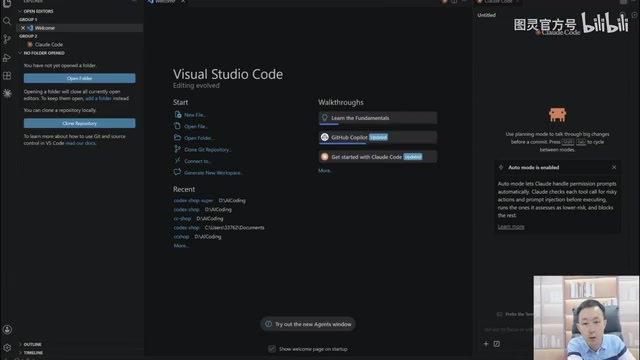
The course's environment setup also reflects the times. The instructor recommends Microsoft's VS Code, with Claude Code, Codex, and other plugins installed for development, while also demonstrating Claude Code and Codex's CLI (command-line interface) workflows.
He makes a bold prediction about traditional IDEs: tools like IntelliJ IDEA, which dominated during Java's golden age, could be completely replaced by AI programming tools within two to three years if they don't undergo major transformation. The core value of traditional IDEs lies in code completion, refactoring tools, debuggers, and project management features — capabilities that dramatically improved development efficiency over the past 20 years. However, in the AI programming era, code completion is replaced by AI's full-text generation, refactoring by AI's holistic rewriting, and debugging by AI's automatic error localization. VS Code, with its lightweight architecture and open plugin ecosystem, has become the preferred platform for AI programming tools. Cursor itself is built as a secondary development wrapper on top of VS Code, and emerging AI programming IDEs like Windsurf follow a similar approach. While this prediction is aggressive, it reflects the dramatic restructuring of the development tool ecosystem in the AI era.
Two Hands-On Projects: E-Commerce & AI Model Aggregation Platform
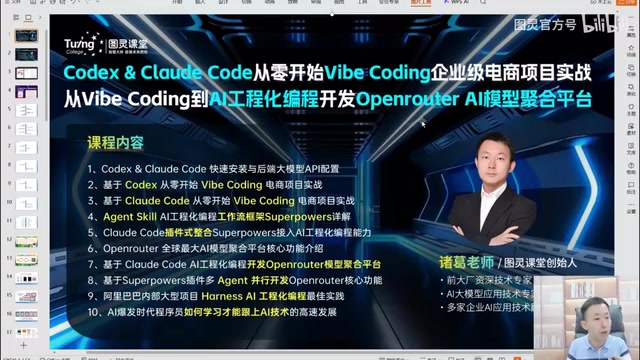
The course selects two projects for full-cycle demonstration:
Project 1: Enterprise-Level E-Commerce. This is a classic scenario familiar to developers across Java, Python, and other tech stacks, used to showcase the complete journey from toy demo to enterprise architecture. An enterprise e-commerce project typically involves coordinating dozens of subsystems — product management, order processing, payment integration, inventory management, user permissions, search and recommendations — making it an ideal litmus test for AI engineering programming capabilities.
Project 2: An OpenRouter-Style AI Model Aggregation Platform. OpenRouter is the world's largest AI large model aggregation platform, unifying models from dozens of companies including OpenAI, Anthropic, Google, and Meta into standardized API interfaces. Developers only need to connect to one platform to call virtually all mainstream models, without registering for each provider's service separately, and it even offers generous free tiers.
The instructor specifically highlights the business logic behind this type of "wrapper" site — in the current AI landscape, C-end AI applications (like Doubao and Yuanbao) are mostly burning cash, while the real money is in selling compute power and selling tokens. This "token economy" business model charges a percentage-based service fee (typically 5%-20%) on top of the underlying model API costs, while leveraging economies of scale for better bulk pricing. It's essentially infrastructure services for the AI era, similar to CDN distribution in the early days of cloud computing. He reveals that teams in his circle focused on overseas markets have achieved hundreds of millions in annual revenue with just a dozen people running these token aggregation sites.
Conclusion: Embracing the Era of Engineering-Grade AI Programming
The core message of this course is clear and pragmatic: Vibe Coding is the first step for beginners, but enterprise-level development must evolve toward engineering-grade AI programming — using standardized workflows like SuperPower and SDD to keep AI working within a controllable, maintainable framework.
For developers riding the AI wave, tool changes are just surface-level. The real challenge lies in building an engineering mindset for collaborating with AI. As the instructor puts it, whether you're building an e-commerce platform or an AI aggregation service, the AI programming workflow is fundamentally the same. Mastering this methodology may be the key to avoiding costly detours.
Related articles

grill-me: Let AI Interrogate You for 45 Minutes Before Coding — Save Countless Hours of Rework
grill-me is a viral open-source skill that has AI interrogate your technical plan before coding. Learn its 4-phase workflow, installation, and best practices.

OverMCP: Transparent Bidding + Real Clicks, Redefining Product Exposure for Developers
OverMCP is a transparent bidding marketplace for developers, using real click tracking and open auctions to help builders gain fair product exposure.

PaymentKit: Multi-Processor Billing Platform That Keeps Revenue Flowing Even When Your Payment Processor Goes Down
PaymentKit is a multi-processor billing platform for SaaS and e-commerce that uses smart routing and independent token vaulting to keep billing running even when a payment processor goes down.