Big Model or Small Model? The Qwen 4 Community Debate Exposes the Reality of Local AI Deployment
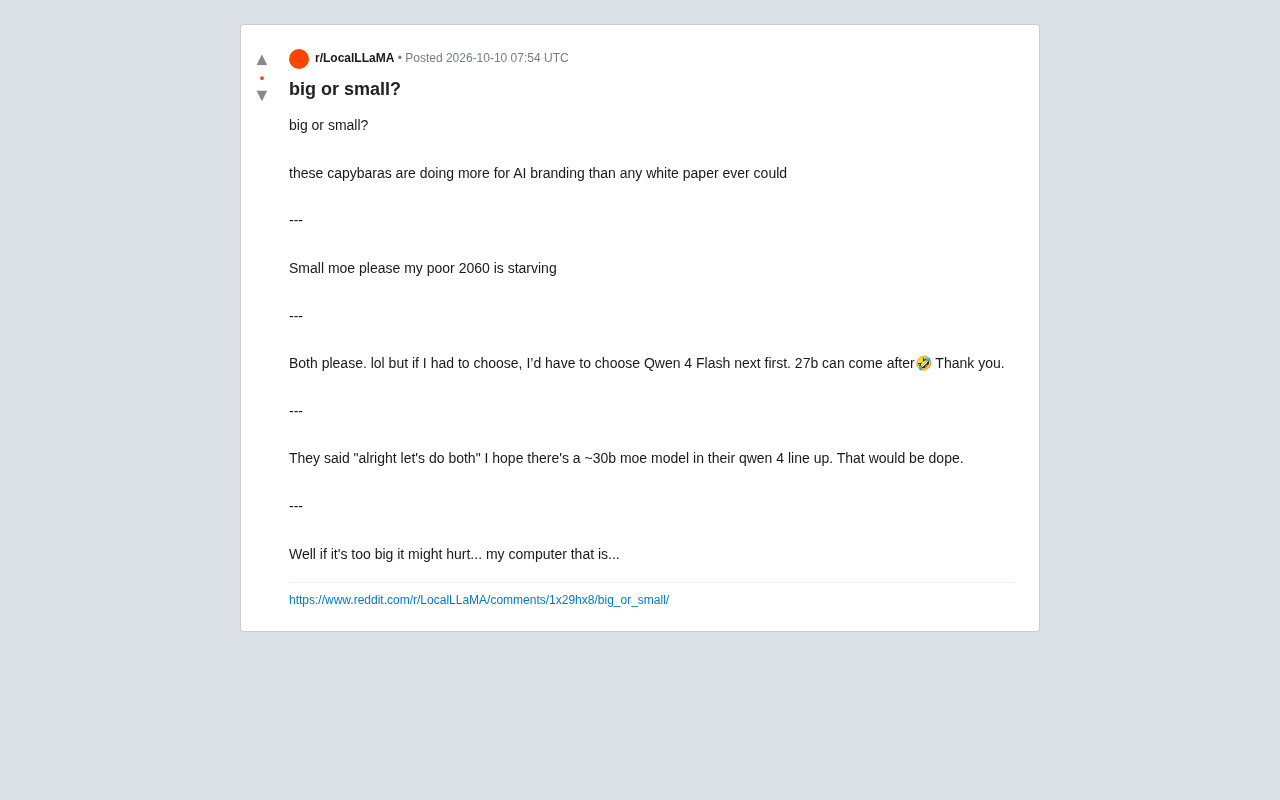
A capybara meme reveals open-source AI users' real priority: models they can actually run, not just bigger ones.
A capybara-themed Reddit poll became an unexpected barometer for open-source AI community needs. RTX 2060 users spoke in unison: rather than chasing top-of-leaderboard mega-models, they want MoE-architecture models that run on 6 GB of VRAM. MoE's ability to activate only a fraction of parameters per inference makes it the practical compromise between capability and deployability. Community hopes for the Qwen 4 lineup center on two things: a lightweight Flash variant and a ~30B MoE model. The takeaway: successful open-source model teams need a full product matrix — flagship, mid-range consumer, and lightweight — not just an arms race for parameter scale.
A Community Poll and the Real Need Behind It
A seemingly tongue-in-cheek Reddit thread — featuring a photo of capybaras and a three-word title, "big or small?" — unexpectedly hit on one of the most pressing pain points in the open-source AI community: do users want bigger, more powerful models, or smaller ones they can actually run?
One commenter quipped: "These capybaras have done more for AI branding than any whitepaper." Behind the joke lies a genuine win for open-source model teams — a relaxed community vibe lowers the barrier to entry and encourages everyday users to weigh in on model selection.
"My RTX 2060 Is Starving"
The most common request in the thread was strikingly consistent: please give us a smaller MoE model. One user put it bluntly: "Small MoE please, my poor 2060 is starving." Another added, half-jokingly: "If the model is too big, it might hurt… I mean, hurt my computer."
These jokes reflect a very real problem: the vast majority of local deployment users don't have enterprise-grade GPUs. Consumer cards like the NVIDIA RTX 2060 — with just 6 GB of VRAM — simply can't handle models with tens or hundreds of billions of parameters. For these users, whether a model can actually run matters far more than a few extra percentage points on a leaderboard.
Why MoE Has Become the Go-To Compromise
The repeated mentions of "MoE" (Mixture of Experts) in the discussion are no coincidence. MoE architecture works by keeping the total parameter count high while only activating a subset of "experts" during each inference pass — maintaining capability while reducing actual compute and VRAM usage. This perfectly addresses the community's conflicting desires: high performance and deployability.
One user expressed it clearly: "Hoping the Qwen 4 lineup includes a ~30B MoE model — that would be amazing." A model with roughly 30B total parameters but far fewer active parameters per inference is widely seen as the sweet spot between performance and runnability.
The core idea behind MoE traces back to Jacobs et al.'s "mixture of experts" framework from 1991, but it didn't gain widespread attention in the LLM space until Google's Switch Transformer in 2022. Take Mixtral 8x7B as an example: its total parameter count is around 47B, but only about 13B parameters are activated per token — meaning actual VRAM usage and compute cost are far lower than an equivalent dense model. For users with 6–8 GB of VRAM, this difference is the deciding factor in whether the model loads at all. That said, MoE comes with trade-offs: model files are still large (all expert weights must be stored), the routing mechanism (which decides which experts to activate) introduces latency, and efficiency advantages narrow in high-throughput batch inference scenarios. As a result, MoE is better suited for personal local deployment with high inference frequency but small batch sizes, rather than high-concurrency cloud services.
"Both" — Imagining the Qwen 4 Product Lineup
A second thread in the discussion centered on the Qwen 4 series product roadmap. One user cited a team response along the lines of "fine, we'll do both," sparking enthusiasm about a multi-size model lineup.
One user laid out their own priorities: "Both, lol. But if I had to choose, I'd want Qwen 4 Flash first — the 27B can come later." Two notable signals emerge from this:
- Lightweight "Flash" versions are the higher priority: Models with "Flash" in the name typically imply faster, lighter, and better suited for frequent everyday use. These tend to be more popular with real users than flagship models.
- Mid-range models (~27B–30B) are in high demand: Not ultra-compact mobile models, and not multi-GPU cluster behemoths either — this range squarely targets the large community of developers and enthusiasts with a single mid-to-high-end consumer GPU.
The "Flash" naming convention comes from Google's Gemini series (e.g., Gemini 1.5 Flash), referring to lightweight versions derived from flagship models through distillation or architectural simplification, with lower latency and reduced resource consumption as the core value proposition. The Qwen series has followed similar tiering logic: Qwen-Turbo for speed and cost efficiency, Qwen-Plus in the middle, and Qwen-MaxAd for peak capability. The addition of a "Flash" tier signals an extension toward finer-grained hardware targeting — essentially a deepening of the strategy: train one large model, deploy it in N different configurations.
What Community Feedback Tells Open-Source Model Teams
This lighthearted discussion actually provides open-source model teams with invaluable user insight. It makes clear that a successful open-source model series shouldn't just chase a parameter-count arms race — it needs to build a complete product matrix that spans different hardware tiers:
- Large flagship models for maximum performance;
- Mid-size MoE models for mainstream consumer GPUs;
- Lightweight small models for low-spec devices.
Only when users with a 2060, a 3060, or a multi-GPU workstation can each find a model that fits their setup does the ecosystem truly thrive. The capybara charm is just surface appeal — what actually keeps the community engaged is precisely meeting the needs of users at every level.
Final Thoughts
From a capybara photo sparking a "big or small" debate, to eager anticipation of Qwen 4 Flash and a ~30B MoE model, this thread is lighthearted but delivers a clear message from open-source AI users: don't just give me a bigger model — give me a model I can actually run and use. For any model team hoping to build a presence in the open-source community, that's a more honest product roadmap than any whitepaper.
(Note: This article is based on publicly available Reddit community discussions. Model specifications and release plans are subject to official announcements.)
Related articles

OpenAI Partners with Shield: How the Astra Agent Revolutionizes IT Troubleshooting
OpenAI and Shield launch the Astra agent, which autonomously logs into computers and legacy systems to fix IT issues in real time, 35-40% faster than traditional models, with humans involved only when judgment is needed.

iPhone Duo Battery Life Tested: One Charge a Day Is Unavoidable, and the Large Screen Is the Culprit
iPhone Duo battery test: heavy use needs at least one charge a day, and about 30% remains after 6.5 hours of screen-on time. How often the large screen is unfolded is key; a MagSafe battery pack helps, and long-term degradation is also worth watching.

Kimi K3.1 Pro Open-Sourced: 2.8 Trillion Parameters Close In on Opus
Moonshot releases the open-source MoE model Kimi K3.1 Pro, with 2.8T total parameters and 104B activated, trailing Opus 5.5 by under 1 point on Terminal Bench 4.0.