Bigger Content Library, Worse Search? How a Smart Discovery Layer Solves the Problem

Why larger content libraries degrade search quality, and how smart discovery layers fix it.
As learning platform content libraries scale, traditional keyword search returns increasingly noisy results. This article explores how smart discovery layers — combining semantic search, intent recognition, and personalized recommendations — can replace keyword matching with true intent understanding, dramatically reducing the time learners spend finding the right content.
A Scaling Problem Hiding in Plain Sight
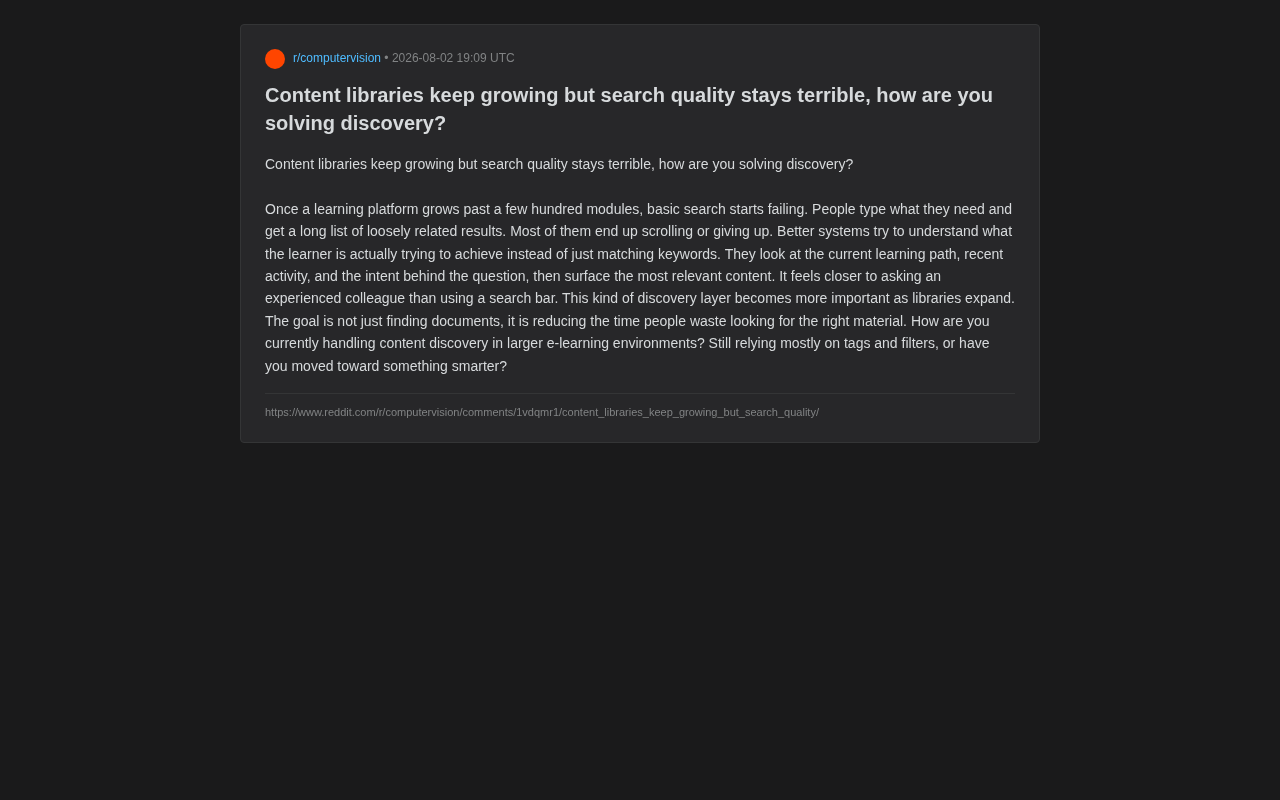
When a learning platform's content library grows from dozens of modules to hundreds or even thousands, a deceptively fundamental problem emerges: search quality actually gets worse as content grows. This issue recently sparked a lively discussion in Reddit's tech community.
The original poster nailed the core pain point: users type in what they need, only to get a long list of "loosely related" results. Most people scroll endlessly and eventually give up. This isn't just a UX problem — it's a massive waste of content value. Your carefully crafted materials might as well not exist if they can't be effectively discovered.
This reveals a deeper pattern: content library size and traditional search effectiveness are naturally inversely correlated. The larger the library, the more noise keyword-based search returns, and the signal-to-noise ratio keeps deteriorating.
Why Keyword Search Fails at Scale
The Ceiling of Keyword Matching
Traditional search systems are essentially doing "string matching." Most rely on statistical algorithms like TF-IDF (Term Frequency-Inverse Document Frequency) or BM25 — ranking results by how frequently and uniquely query terms appear in documents. These methods work reasonably well with small corpora. When the content library is small, there are limited candidates to match against, so even crude algorithms let users quickly find what they need among a handful of results. But once the library crosses a critical threshold (the "hundreds of modules" mentioned in the original post is a typical tipping point), problems explode.
The fundamental flaw of keyword search: it understands words, not intent. When a learner searches for "how to handle customer complaints," the system mechanically matches every document containing those words, but can't determine whether this person is a newly hired support agent or a team lead preparing a management training — two roles that need entirely different content.
The Limits of Tags and Filters
Many platforms respond by beefing up tagging systems and filters. This helps to a degree, but has two hard limitations:
First, tags depend on manual maintenance. As content grows, tag consistency and coverage gradually spiral out of control — synonymous tags proliferate and classification standards become chaotic. In information architecture, this is known as "taxonomy entropy" — ungovern classification systems naturally tend toward disorder.
Second, filters require users to already know what they're looking for. They shift the cognitive burden onto users — you have to figure out which filters to check, which is exactly what many learners can't do. They often have only a vague goal, not precise search terms.
The Smart Discovery Layer: From Keyword Matching to Intent Understanding
The original post proposed an inspiring direction — building a smart discovery layer. Its core philosophy: stop settling for keyword matches and start understanding what learners are "actually trying to accomplish."
Three Key Contextual Dimensions
A mature discovery layer considers at least three types of signals:
- Current learning path: What stage is the user at? What have they already mastered? What's the logical next step?
- Recent activity: What content have they recently browsed, completed, or revisited? These behaviors reveal true needs.
- Intent behind the question: The deeper motivation behind a query, not just its literal meaning.
By combining these signals, the system can "surface" the most relevant content instead of dumping a pile of results for users to sift through.
Search That Feels Like Asking a Senior Colleague
The original post used a perfect analogy: good content discovery "feels more like asking an experienced colleague than using a search box."
This captures the essential difference in experience. When you ask a veteran colleague a question, they draw on their knowledge of you and the context to give you the most fitting answer — they don't dump the entire knowledge base on you. This is exactly what the fusion of semantic search, intent recognition, and personalized recommendation can achieve.
With the maturation of large language models and Vector Search technology, this kind of "understanding-based discovery" is moving from concept to reality. The core principle of vector search: pre-trained embedding models (such as OpenAI's text-embedding or open-source sentence-transformers) convert text into high-dimensional mathematical vectors, then measure semantic distance by calculating cosine similarity between vectors. This means the system no longer relies on literal overlap to judge relevance. Semantic embeddings let the system understand that "customer complaint handling" and "after-sales dispute resolution" are essentially related, even when the wording is completely different. Purpose-built vector databases like Pinecone, Milvus, and Weaviate have already made this technology production-ready.
Redefining Success: The Goal Isn't Finding Documents — It's Saving Time
One line from the original poster deserves special attention: "The goal isn't just to find documents, it's to reduce the time people waste looking for the right materials."
This redefines what success means for content discovery. Traditional search KPIs focus on "how many relevant results were returned," but a smart discovery layer should measure "how quickly users found what they actually needed" — or even "whether users received the right content without searching at all."
This shift in perspective is especially important for enterprise e-learning environments. In these settings, employee learning time is a precious cost, and every minute spent "looking for content" is pure waste. Improving discovery efficiency directly translates to improving organizational learning efficiency.
Practical Advice for Content Platform Builders
If you're managing a growing content library, consider a phased evolution:
- Short-term: Audit your existing tagging system, clean up redundancies, and establish tag governance standards — the lowest-cost improvement available.
- Mid-term: Introduce semantic search capabilities, replacing or supplementing pure keyword matching with vector search so that content with similar meaning can also be discovered. In practice, many teams adopt a Hybrid Search strategy — running BM25 keyword search and vector semantic search simultaneously, then merging results through methods like Reciprocal Rank Fusion to combine the strengths of exact matching and semantic understanding.
- Long-term: Build a complete discovery layer that integrates user profiles, learning paths, and behavioral data to deliver proactive, personalized content recommendations. This essentially brings mature recommendation system methodologies — collaborative filtering, content profile matching, knowledge graph reasoning — into the learning platform domain.
A word of caution: smart discovery is no silver bullet. It's highly dependent on data quality and how well-structured your content is. If the underlying content is chaotic and metadata is missing, even the smartest algorithms can't make bricks without clay.
Conclusion
Content library growth is an inevitable milestone for every successful learning platform, and declining search quality is the "growing pain" that comes with it. Moving from keyword matching to intent understanding, from passive search to proactive discovery — this isn't just a technology upgrade, it's a shift in product philosophy: transforming "let users find it themselves" into "help users find it."
As this Reddit discussion reveals: when your content becomes too vast to be effectively discovered, the extra content becomes a burden rather than an asset. The real value lies in "getting the right content to the right person at the right time."
Related articles

Opus 5 First Impressions: The LLM Iteration Dilemma Behind 'One Try and Done'
A Reddit user's 'That was the last time I used Opus 5' sparks debate. We analyze experience traps in LLM upgrades, capability regression, and how to rationally evaluate community feedback on new AI models.

Qwen 3.8 Max Tops Agentic Benchmark: Is the Tipping Point for Local Deployment Approaching?
Qwen 3.8 Max tops the Artificial Analysis Agentic Index ahead of Opus 5. Reddit debates the gap between benchmark scores and real-world agent performance, and what it means for local deployment.

Is Apple's AI Strategy Really a Misstep? A Deep Dive into Industry Skepticism and Apple's Hidden Playbook
Is Apple falling behind in AI? We analyze the criticism of Apple's cautious strategy, the potential of on-device intelligence, and whether its ecosystem integration can deliver a late-mover advantage.