Bilibili AI Large Model Tutorial: RAG Practical Guide from Beginner to Mastery
Bilibili's 109-episode RAG practical tutorial, from basics to industrial applications, helps you systematically learn AI large models.
Bilibili creator "A Shui" has launched a 109-episode "AI Large Model RAG Practical Tutorial," addressing AI learners' anxiety of "never finishing learning" by designing a structured course from beginner to mastery based on over a decade of data algorithm experience. Centered on RAG, the tutorial covers Transformer, pre-training, distributed training, and extends to multimodal generation and tools like DeepSeek. The course is divided into four major modules: warm-up, development trajectory, industrial practice, and frontier outlook, emphasizing both foundations and practice, and reminding learners to beware of scams and maintain continuous learning.
Bilibili AI Large Model Tutorial: RAG Practical Guide from Beginner to Mastery
Amid the surge of AI large model learning, Bilibili creator "A Shui" has launched a 109-episode "AI Large Model RAG Practical Tutorial," claiming to take learners from beginner to mastery with all substance and no fluff. The course attempts to address the widespread anxiety of "never finishing learning" and emphasizes RAG (Retrieval-Augmented Generation) as the key technology for the leap from AIGC to AGI.
Pain Points and Breakthrough Strategies in Learning AI Large Models
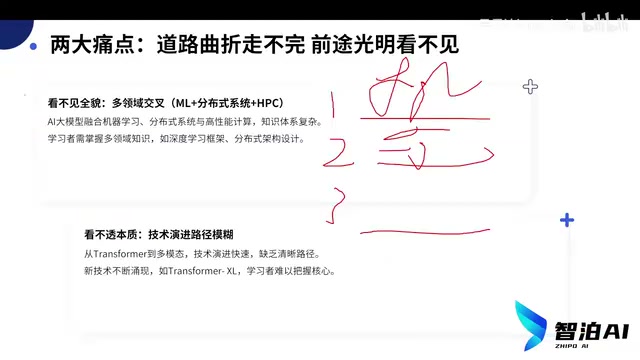
In the opening, creator A Shui points out that knowledge in the AI field updates extremely fast, and learners often feel that "the path is winding and endless, the future is bright but out of sight." Drawing on his 10+ years of experience in data algorithms at Alibaba and his current role as an AIGC team consultant at a major tech company, he analyzes the current situation where demand for AI talent is strong but training is difficult.
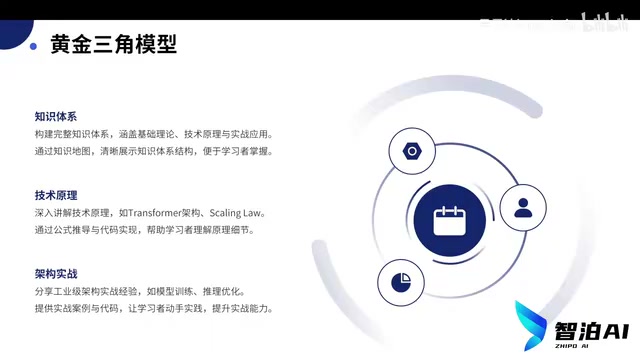
A Shui believes the breakthrough requires tracing back to origins from a historical perspective, understanding technological accumulation and paradigm shifts, while solidifying foundations such as Transformer, pre-training, and distributed training, with emphasis on practice. The course design revolves around knowledge systems, technical principles, and industrial practice, aiming to plan a progressive learning path for learners.
Transformer is a neural network architecture based on the self-attention mechanism proposed by Google in 2017, and has become the foundation of most current large language models (such as GPT, BERT, ERNIE, and Qwen). Its core is the self-attention layer, which can process relationships among all positions in a sequence in parallel, overcoming the RNN's difficulty in capturing long-distance dependencies. Transformer typically includes an encoder and decoder, with large language models mostly adopting the decoder structure. Understanding Transformer is a prerequisite for mastering subsequent technologies such as pre-training, fine-tuning, and inference, and is one of the key reasons the course emphasizes solid foundations.
Course Core: The Leap from RAG to AIGC
The core goal of this tutorial is to help learners master large model technology and achieve the leap from RAG to AIGC. A Shui emphasizes that RAG, as Retrieval-Augmented Generation, is the bridge connecting traditional recommendation systems and generative AI. The course will cover knowledge graphs from pre-trained models to multimodal, including L1 to L4 level content, as well as the use of open-source tools and practical cases.
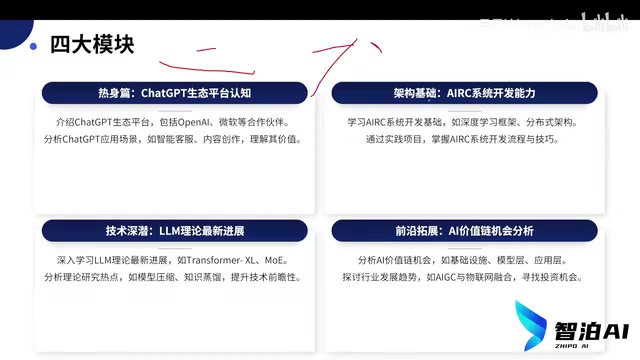
The course is divided into four major modules: a warm-up section to understand ecosystem platforms like ChatGPT; a review of the development trajectory and key technologies of large models; an in-depth look at industrial-grade large model technology implementation; and a frontier exploration looking at future trends. A Shui specifically mentions that major domestic companies can quickly launch products like ERNIE and Qwen precisely because they stand on the shoulders of over 20 years of excellent AI design paradigms.
RAG (Retrieval-Augmented Generation) is a technical architecture that combines information retrieval with text generation. Its core idea is: when a large model needs to answer a question, it first retrieves relevant passages from external knowledge bases (such as document libraries, databases, and web pages), then inputs these passages as context to the large model, which generates an answer based on the retrieved evidence. The benefits are: 1) alleviating the "hallucination" problem of large models since answers are verifiable; 2) breaking through the timeliness limitations of model training data by incorporating the latest knowledge; 3) reducing fine-tuning costs by adapting to vertical domains without retraining the model. RAG typically includes a retriever (such as dense retrieval based on vector similarity), a generator (large language model), and a fusion module, and is one of the mainstream paradigms for enterprises implementing large model applications today.
AIGC (AI-Generated Content) refers to the collective term for technologies that use AI models to automatically generate text, images, audio, video, and other content. Unlike traditional AI discriminative tasks (such as classification and recommendation), AIGC emphasizes generative capability, mostly built on generative architectures such as large language models and diffusion models. AIGC applications include ChatGPT-style dialogue, AI painting, speech synthesis, and code generation. RAG can be viewed as an enhanced implementation of AIGC in knowledge-intensive scenarios—improving the accuracy and reliability of generated content by retrieving external knowledge. Understanding the relationship between AIGC and RAG helps grasp the technological evolution from content generation to knowledge-driven approaches.
Industrial Practice and Future Layout
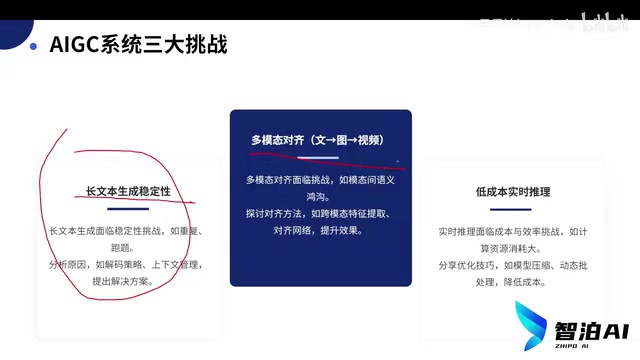
In the industrial practice section, the course will discuss frontier technologies such as long text processing and multimodal generation. A Shui warns learners to beware of "teach you to make money" scams, emphasizing that the course only shares knowledge. He mentions that multimodal generation is currently costly but has promising prospects.
Regarding the future, A Shui believes that large models are developing extremely fast and may reshuffle within half a year, so learners need to plan ahead for opportunities in the industry chain. He encourages everyone to maintain their passion, keep up with the trends of the times, and avoid being left behind.
Multimodal generation refers to technology that enables models to process and generate multiple types of data (such as text, images, audio, and video). Unlike unimodal models, multimodal models achieve cross-modal understanding and generation through joint learning of representations across different modalities, for example generating images from text descriptions (text-to-image) or generating descriptions from images (image-to-text). Currently, multimodal generation is widely applied in creative design, content production, and human-computer interaction, but faces challenges such as high computational costs, difficult data alignment, and unstable generation quality. The course's mention that multimodal generation is costly but promising is based on these technical realities.
Application of Multimodal and Tools like DeepSeek
The course will also cover the use of tools like DeepSeekAd and the transformation of multimodal content generation. A Shui points out that personnel related to AI large models at major tech companies almost all come from recommendation systems and multimodal fields, so the course will arrange knowledge in conjunction with developments in these areas.
Although the tutorial title emphasizes RAG practice, the content covers a wide range of topics from basic theory to frontier trends, suitable for learners who want to systematically study AI large models. However, the creator also admits that he is just a "primary school student" in the AI field and cannot see the whole picture, but is willing to share experience to help those who come after.
Summary
This 109-episode tutorial provides a structured learning framework for AI large model learners, especially suitable for those interested in RAG and AIGC. The course emphasizes both foundations and practice, and reminds learners to maintain a continuous learning mindset to cope with the rapidly changing technological wave.
One-line Summary
Bilibili's 109-episode RAG practical tutorial, from basics to industrial applications, helps you systematically learn AI large models.
Paragraph Summary
Bilibili creator "A Shui" has launched a 109-episode "AI Large Model RAG Practical Tutorial," addressing AI learners' anxiety of "never finishing learning" by designing a structured course from beginner to mastery based on over a decade of data algorithm experience. Centered on RAG (Retrieval-Augmented Generation), the tutorial covers foundations such as Transformer, pre-training, and distributed training, and extends to multimodal generation and tools like DeepSeek. The course is divided into four major modules: warm-up, development trajectory, industrial practice, and frontier outlook, emphasizing both foundations and practice, and reminding learners to beware of scams and maintain continuous learning to cope with the rapidly changing technological wave.
Related articles

Nothing Ear 3A headphones drop to $79, all four colors at historic low
Nothing Ear 3A wireless earbuds drop to $79 at Amazon, Walmart, and Best Buy — all four colors get a $20 discount, matching the historic low. With ANC and rich features, they're a strong entry-level contender.

Vercel Sandbox Adds stdin Support: Opening Interactive Command Channels for AI Agents
Vercel Sandbox now supports stdin, letting running commands receive standard input. This article explains TypeScript and Python SDK usage, and what it means for stdio MCP servers, agent-browser, and other Agent toolchains, plus caveats.

The RealReal Upgrades Anti-Bot System to Block AI Agents From Snapping Up Secondhand Luxury Goods
The RealReal upgrades its bot defense system to limit AI agents from exploiting item reservations to snap up secondhand luxury goods. This article analyzes the cause, the platform's countermeasure logic, and implications for AI agent developers.