Bilibili's 748-Episode AI Agent Course: A Five-Step Guide to Choosing High-Quality Courses and Avoiding Pitfalls

A mechanical engineering career changer summarizes five criteria to help you screen out Agent courses that let you actually build projects.
The article recounts how a Bilibili uploader who transitioned from mechanical engineering into large model development reviewed his predicament of "learning a pile of concepts but being unable to build a project," and proposed five criteria for selecting high-quality AI Agent courses: the course must cover the complete delivery chain from requirement decomposition, model selection, API and tool calling, RAG, and memory state to evaluation, monitoring, and deployment; projects must be resume-worthy with clear input and output, tool chain or retrieval integration, and quantitative metrics; the course should include a real development perspective such as Token cost, preventing tool calls from going off the rails, and data security; update frequency and code repository maintenance must keep pace with technological iteration; and there should be coaching and feedback mechanisms such as assignment grading, Q&A, and resume guidance. The author ultimately landed a 30K large model role through systematic learning and hands-on project practice, emphasizing the use of this framework to proactively screen courses rather than blindly bookmarking them.
Amid the AI Agent development boom, a large number of tutorials have sprung up on Bilibili, among which a course titled "AIAgent Intelligent Agents" claiming to have "all 748 episodes" has drawn attention. Drawing on his own experience transitioning from a mechanical engineering background into large model development, the uploader summarizes five methods for selecting high-quality Agent courses, directly addressing a pain point among today's learners: they learn a pile of concepts but can't actually build a project.
Why have you taken so many courses yet still can't build an Agent project?
The uploader originally studied mechanical engineering. When sending out resumes, he found that the positions available were either on-site factory roles with shift work or paid so little it made him question his life. He realized that many seemingly advanced AI applications are essentially about getting model APIs working and engineering them into a runnable product. The logical decomposition and process delivery skills from an engineering background are transferable; all that was missing was a path into AI application development.
But the process of systematically filling in the gaps didn't go smoothly. He watched a ton of public videos and understood concepts like Prompt, Drag, Agent, and Function Calling. He followed scattered tutorials and wrote code—today building a chat box, tomorrow connecting a database, and the day after getting stuck on deployment and polishing his resume. With no project on his resume he could explain clearly, finding an internship was also hard. This state of "feels like I learned something but I didn't" is a common predicament for many career changers.
Five criteria for selecting high-quality Agent courses
1. Check whether the course covers the complete delivery chain
A course that only teaches you to write Prompts is not an Agent development course. A high-quality Agent course should cover at least this chain: requirement decomposition, model selection, API calls, tool calling (Function Calling/Tools), RAG retrieval, memory and state, evaluation and monitoring, and finally deployment. The uploader suggests directly checking whether the course outline contains these keywords: Function Calling, Tools, RAG, evaluation and observability, and engineering deployment. If a course only teaches you to make the model play a certain role, that's more like a Prompt course.
Function Calling (tool calling) is the key mechanism that takes large models from "chatting" to "doing things." It allows developers to describe a set of external functions (such as querying a database, sending email, or calling a weather API) using JSON Schema; during a conversation, the model outputs structured call requests based on user intent, and the host program executes them and passes the results back to the model to continue reasoning. Without Function Calling, an Agent can only generate text; with it, the model can proactively obtain real-time information and operate business systems. When learning, focus on: how to write tool descriptions, parallel calls to multiple tools, parameter validation and error retries, and observability of the call chain. These are exactly the connecting link in the "complete delivery chain."
RAG (Retrieval-Augmented Generation) is the standard paradigm for enabling an Agent to answer questions based on external knowledge. The process is usually: split documents and vectorize them into a store → when a user asks a question, retrieve the most relevant chunks → splice the chunks into the Prompt as context → the model generates an answer with citations. It solves the problems of outdated knowledge, hallucinations, and invisibility of private data in large models. From an engineering perspective, you need to pay attention to chunking strategies, Embedding model selection, recall quality of vector databases (such as FAISS and Milvus), reranking, and citation tracing. Enterprise knowledge base question answering is the most typical RAG deployment scenario and also a frequent topic for resume projects.
2. Can the project be written into a resume?
A project that can go on a resume should have three things: clear input and output (what the user inputs and what the system outputs); tool chain or retrieval integration (at least one of a database, API, spreadsheet, web page, or enterprise system); and metrics or a closed loop (accuracy, hit rate, response time, experiment cost). For example, an enterprise knowledge base Q&A Agent (RAG + full pipeline + citation tracing + backend management), or a multi-tool office Agent (reading email, reading spreadsheets, generating weekly reports, automatic archiving). If it's just a chatbot interface plus some talk about planning and reflection, its value is limited.

3. Does the course include a real development perspective?
The truly hard part of an Agent isn't getting it to run, but getting it to run stably. A reliable course will cover practical issues such as Token cost control, reranking retrieval, preventing tool calls from going off the rails, and data security. It doesn't need to go extremely deep, but at least it should let you know where the pitfalls are; otherwise, the project is likely to blow up once it goes into production.
Token cost control is the first engineering problem to surface after an Agent goes live. Large models bill by input and output Tokens, and Agents often require multiple rounds of looping, carrying historical conversations and retrieved chunks, so the context easily balloons. Common optimization methods include: streamlining system prompts, summarizing historical conversations or using a sliding window, caching repeated system prefixes (Prompt Caching), using small models for routing and intent classification, and limiting the length of tool return content. If a course only teaches "getting it to run" without covering these trade-offs between cost and latency, learners will be caught off guard when they go to production.
4. Does the update frequency keep up with technological iteration?
Large models iterate quickly, and old courses easily become outdated by the time you finish them. Check two things: whether the outline includes new content from recent months (such as new tool calling methods, framework updates, and iterative evaluation methods); and whether the assignment code repository is continuously maintained rather than a one-time deal.
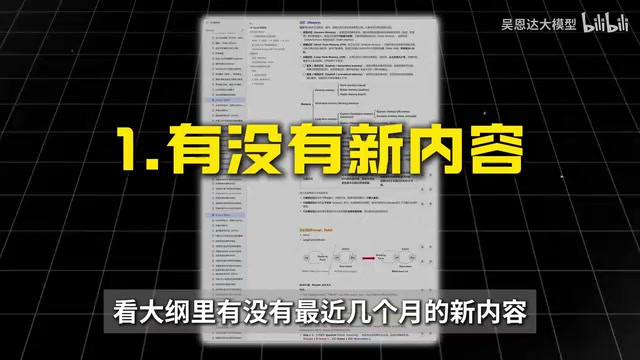
Agent frameworks and evaluation methods iterate far faster than traditional software. Mainstream frameworks such as LangChain, LlamaIndex, AutoGen, and CrewAI have frequently refactored their APIs over the past two years; on the evaluation side, the shift has moved from manual eyeballing to automated metrics such as Ragas and TruLens (e.g., faithfulness, context recall). To judge whether a course is outdated, see whether it covers structured output, multi-agent collaboration, and trajectory-based evaluation. If the code repository has commits and Issue replies within the past three months, it usually means the author is still following changes in the ecosystem.
5. Is there a coaching and feedback mechanism?
Prioritize courses that offer assignment grading, project Q&A, a community where classmates compare progress with each other, and access to resume advice or project packaging ideas. What career changers lack isn't videos to watch, but someone to pull them out of the pit.
From mechanical engineering to a 30K large model role: advice for career changers
The uploader ultimately landed a 30K large model position through systematic learning and hands-on project practice. His experience shows that choosing the right course and following it to build projects is the key to transitioning into AI application development. For learners who feel lost, he advises not to tough out the anxiety alone—having someone guide you makes efficiency take off directly. He currently offers a free resource package and welcomes people to leave their situation in the comments, where he helps sort out a roadmap according to the standard of being able to submit applications.
Whether this 748-episode tutorial itself is worth watching depends on whether it meets the five criteria above. But more importantly, learners should proactively use this framework to screen any course, rather than blindly bookmarking them.
One-line Summary
A mechanical engineering career changer summarizes five criteria to help you screen out Agent courses that let you actually build projects.
Paragraph Summary
The article tells the story of an uploader who transitioned from mechanical engineering into large model development, reviewing his predicament of "learning a pile of concepts but being unable to build a project," and proposing five criteria for selecting high-quality AI Agent courses: the course must cover the complete delivery chain from requirement decomposition, model selection, API and tool calling, RAG, and memory state to evaluation, monitoring, and deployment; the project must be resume-worthy, with clear input and output, tool chain or retrieval integration, and quantitative metrics; the course should include a real development perspective such as Token cost, preventing tool calls from going off the rails, and data security; update frequency and code repository maintenance must keep up with technological iteration; and there should be coaching and feedback mechanisms such as assignment grading, Q&A, and resume guidance. The author ultimately landed a 30K large model role through systematic learning and hands-on project practice, emphasizing the use of this framework to proactively screen courses rather than blindly bookmarking them.
Related articles

OpenAI Partners with Shield: How the Astra Agent Revolutionizes IT Troubleshooting
OpenAI and Shield launch the Astra agent, which autonomously logs into computers and legacy systems to fix IT issues in real time, 35-40% faster than traditional models, with humans involved only when judgment is needed.

iPhone Duo Battery Life Tested: One Charge a Day Is Unavoidable, and the Large Screen Is the Culprit
iPhone Duo battery test: heavy use needs at least one charge a day, and about 30% remains after 6.5 hours of screen-on time. How often the large screen is unfolded is key; a MagSafe battery pack helps, and long-term degradation is also worth watching.

Kimi K3.1 Pro Open-Sourced: 2.8 Trillion Parameters Close In on Opus
Moonshot releases the open-source MoE model Kimi K3.1 Pro, with 2.8T total parameters and 104B activated, trailing Opus 5.5 by under 1 point on Terminal Bench 4.0.