Bilibili's 748-Episode AI Agent Course for Beginners: A Breakdown of the Six-Week Learning Path

Bilibili's 748-episode AI Agent course analyzed: Is the six-week path from cognition to monetization reasonable?
This article breaks down the content framework and six-week learning path of a Bilibili AI Agent course claiming 748 episodes for beginners. The course emphasizes progressive learning, covering foundational cognition and the ReAct paradigm in Weeks 1-2, hands-on agent building and RAG integration in Weeks 3-4, and monetization thinking with complete project deployment in Weeks 5-6. The author finds it suitable for complete beginners or semi-beginners, advises rational expectations about job readiness, and recommends not skipping content, prioritizing hands-on practice, and seriously completing the final project.
AI Agent is one of the hottest tech directions right now, but most tutorials on the market are either too shallow or too scattered, making it hard for ordinary people to find a clear entry path. A tutorial series recently appeared on Bilibili claiming to be a "complete 748-episode" AI Agent course for beginners, promising full coverage from foundational understanding to project deployment. What is the actual content framework of this course? Is its proposed six-week learning path reasonable? This article breaks down and analyzes the course based on its official introduction.
The Biggest Mistake Beginners Make When Learning AI Agent: The More They Learn, the More Confused They Get
The course opens by pointing out a common phenomenon: a large number of learners chase new models and new tools every day, hoard tutorials, and obsess over prompts. They appear to be improving, but in reality they have no systematic approach.

This problem is real. The tech stack in the AI Agent space updates extremely fast — from LangChain to AutoGPT, from single-agent to multi-agent collaboration, new concepts emerge every few months. Without a systematic framework, learners easily fall into "tool collection syndrome" — knowing a little bit about everything but unable to actually implement anything.
The course attributes this phenomenon to "never having systematically studied a step-by-step tutorial," and uses this as the starting point for its course design. This diagnosis is basically accurate, but it's worth noting that "systematic learning" and "chasing new trends" are not mutually exclusive. The reasonable approach is to establish core understanding first, then selectively follow up on new tools.
Six-Week Learning Path: A Progressive Design from Cognition to Monetization
The course provides a six-week learning plan with an overall progressive structure from theory to hands-on practice to commercial deployment.
Weeks 1-2: Building Foundations and Advancing Principles
The goal of Week 1 is to establish beginner-level foundational understanding, grasp the core logic of AI Agent, and learn to filter tools. Week 2 moves into principles, requiring an understanding of how Agents work and their challenges, mastering the ReAct paradigm and key implementation points, while also learning multi-agent collaboration and output optimization.

ReAct (Reasoning + Acting) is indeed one of the foundational paradigms in current Agent design, so arranging it as the core content of the principles advancement phase is reasonable. Multi-agent collaboration is a more advanced capability, and placing it in Week 2 feels a bit tight, but for a learning objective that only requires "understanding" at a basic level, it's still within acceptable range.
ReAct Paradigm Overview: ReAct is a combination of Reasoning and Acting, proposed by Google's team in 2022. Its core idea is to have large language models alternate between reasoning and acting: the model first reasons based on the current context, generates an action instruction (such as calling a search tool), obtains observation results after execution, then continues reasoning based on new information, looping until the task is complete. This pattern effectively mitigates the hallucination problem of pure reasoning models on factual tasks, and also breaks through the limitation of pure action models lacking planning capabilities. ReAct has become the default Agent design pattern in mainstream frameworks like LangChain and AutoGPT, and is a foundational concept that must be understood when learning AI Agent.
Weeks 3-4: Core Hands-On Practice and Technology Integration
Week 3 enters the hands-on phase, learning Agent basic configuration, instruction building, and scenario debugging, independently building practical agents like copywriting assistants and intelligent customer service. Week 4 connects the RAG and Agent building process, learning lightweight tool combinations, and adapting to real business scenarios.

The combination of RAG (Retrieval-Augmented Generation) and Agent is currently one of the most commonly used technical solutions for enterprise deployment. Arranging it in Week 4 means the theory from the first two weeks and the hands-on practice from Week 3 are all laying groundwork for this integration. Copywriting assistants and intelligent customer service as practice projects are moderate in difficulty and suitable for validating learning outcomes.
RAG (Retrieval-Augmented Generation) and Agent Integration: RAG is a technology that combines external knowledge base retrieval with large model generation. The basic process is: after a user asks a question, the system first retrieves relevant document fragments from a vector database, then inputs the retrieval results as context along with the question into the large model, generating more accurate and factually consistent answers. When RAG is combined with Agent, the Agent can proactively decide when to retrieve, what content to retrieve, and autonomously determine the next action based on retrieval results. This greatly expands the Agent's knowledge coverage and reliability in real business scenarios, and is currently the most mainstream deployment solution for enterprise-level AI applications.
Weeks 5-6: Monetization Thinking and Closed-Loop Practice
Week 5 focuses on monetization, combining real cases to enrich resumes and filter quality side-business tracks. Week 6 requires integrating all content, deploying a complete AI Agent project from scratch, completing requirement breakdown, debugging and optimization, and producing a finished product that can be demonstrated, delivered, and used for taking on client work.
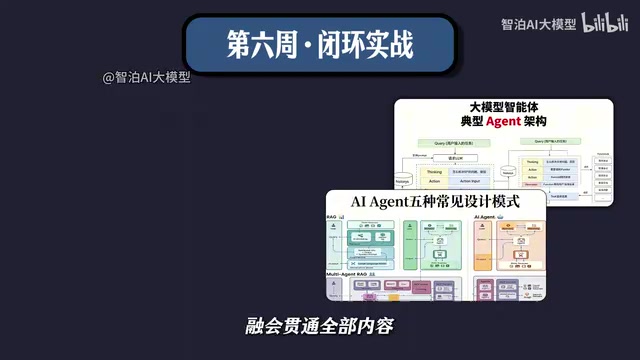
From a learning path design perspective, emphasizing "deliverability" in the last two weeks is valuable — it forces learners to complete projects under real constraints rather than staying at the demo stage. However, claims like "job-ready upon completion" need to be viewed rationally. Six weeks is enough to build foundational Agent development capabilities, but there's still a gap before independently taking on complex commercial projects.
Multi-Agent Collaboration: A Multi-Agent System refers to multiple AI Agents working together through division of labor, negotiation, or competition to complete complex tasks. Each Agent is typically assigned a specific role (such as product manager, programmer, tester), and they interact through message passing or shared memory. Typical frameworks include Microsoft's AutoGen and OpenAI's Swarm. Multi-agent collaboration can handle complex workflows that a single Agent cannot complete, but it also brings challenges such as coordination costs, error propagation, and debugging difficulty. For beginners, it's recommended to first master single-Agent development before gradually diving into multi-Agent collaboration.
Who This Course Is For, and Who It's Not For
According to the course's self-positioning, the target audience includes three types: people with zero foundation who want to systematically learn AI Agent, people with some foundation who want to break through bottlenecks and achieve deployment and monetization, and people who want to build AI side-business projects.
Frankly speaking, this course is more suitable for the first type and "semi-beginners" among the second type. If you already have relatively rich experience in LLM application development, the first two weeks of the six-week path may seem too basic. And if you expect to immediately get a high-paying offer upon completion, you also need to adjust your expectations — Agent development positions usually also require engineering skills, business understanding, and project experience. What the course can provide is an introductory framework and practice projects.
Learning Advice: How to Maximize This Course
Based on the course's content framework, here are a few usage suggestions:
Don't skip around. The course emphasizes "order and method." The cognition and principles from the first two weeks are the foundation for subsequent hands-on practice, and skipping ahead easily leads to getting stuck in Week 3.
Hands-on practice takes priority over watching everything. The volume of 748 episodes easily leads people into the illusion of "finishing equals learning." Each week's knowledge points should be reinforced with actual building, especially the hands-on content after Week 3.
Take the Week 6 project seriously. A complete demonstrable project proves your ability more than watching all the videos, and is the most persuasive material when job hunting or taking on client work.
Learning AI Agent indeed requires a clear path, and this course's six-week framework provides a referenceable structure. But a course is just a map — the actual road still needs to be walked by yourself.
One-line Summary
Bilibili's 748-episode AI Agent course breakdown: Is the six-week learning path from cognition to monetization reasonable?
Paragraph Summary
Based on the official introduction of a Bilibili AI Agent course claiming 748 episodes for beginners, this article breaks down its content framework and six-week learning path. The article points out that the biggest mistake beginners make when learning AI Agent is blindly chasing new trends without systematic learning, while this course uses progressive learning as its design principle. The six-week path is divided into: Weeks 1-2 for building cognition and learning the ReAct paradigm and multi-agent collaboration; Weeks 3-4 for hands-on agent building and RAG technology integration; Weeks 5-6 for monetization thinking and complete project deployment. The author believes this course is suitable for complete beginners or semi-beginners, while experienced learners may find the first two weeks too basic. The article also reminds readers to view "job-ready upon completion" rationally, and suggests not skipping around, prioritizing hands-on practice, and seriously completing the final project.
Related articles

Should U.S. College Fraternities Be Banned? A Researcher's Incisive Observations
Why not just ban U.S. college fraternities? A researcher finds the key resistance comes from decision-makers' own fraternity identities and schools' "willful ignorance."

Microsoft Discovery: Accelerating Scientific Discovery with AI Agents
Microsoft's Discovery platform runs specialized AI agents to help researchers screen and prioritize the most promising compounds and experimental paths, reducing experiments and accelerating scientific discovery.

Cambridge Heavy Industries Secretly Develops Desktop-Scale Nuclear Fusion Device
Cambridge Heavy Industries is secretly developing a desktop-scale laser-driven nuclear fusion device, targeting the equipment supply market for fusion power plants. This article analyzes its miniaturization technology path, commercialization logic, and unique positioning in the fusion startup wave.