Bilibili's Most Complete AI Comic Drama Production Tutorial: Full Workflow Breakdown from Script to Final Cut

Bilibili AI comic drama tutorial breaks down the full workflow from script to final cut, emphasizing systematic workflow and director thinking.
This article introduces a Bilibili AI comic drama production tutorial aimed at helping zero-foundation newcomers run through the complete production chain from script to final cut. The tutorial points out that single-point tool tricks cannot support narrative content, and creators need to build a systematic workflow. The course is divided into three stages: basics, advanced, and practical. The basics section builds awareness of the full workflow, the advanced section tackles character consistency and scene control, and the practical section involves director-level project practice. The script stage needs to solve three core problems: original story generation, novel adaptation, and agent review. The tutorial specifically proposes "AI director thinking," emphasizing that thinking about character motivation, shot sizes, and connection logic is more important than prompts. Suitable for zero-foundation newcomers and creators whose workflow doesn't run, but requires repeated practice to internalize.
Bilibili's Most Complete AI Comic Drama Production Tutorial: Full Workflow Breakdown from Script to Final Cut
AI comic dramas are becoming the new hot trend in short video. But many creators get stuck at the same place: they know how to use the tools, but can't get the workflow to run. This tutorial on Bilibili, billed as the "most complete and detailed," tries to solve exactly that problem—not teaching the specific buttons of any one tool, but breaking open the entire production chain from script setup to final cut for you to see.
According to the tutorial, the entire course has only one core goal: to enable newcomers with zero foundation and zero experience to truly run through a complete AI comic drama production workflow. This hits the biggest pain point in AI video creation today—what stops newcomers is never not knowing how to use a particular AI tool, but not knowing what to do first, second, and third.
Why Many People Use the Same Tool but Can't Produce a Final Cut
The tutorial opens with a sharp question: clearly everyone uses the same AI tool, so why can others succeed on the first try while your videos keep failing?
The answer isn't in the tool itself. The tutorial argues that no matter how many tools you know, without a complete systematic workflow, you'll still be stuck at the "playing with tools" stage. What truly helps creators build side businesses, create content, and grow accounts isn't memorizing how many prompts, but whether they've formed a complete AI content production system.
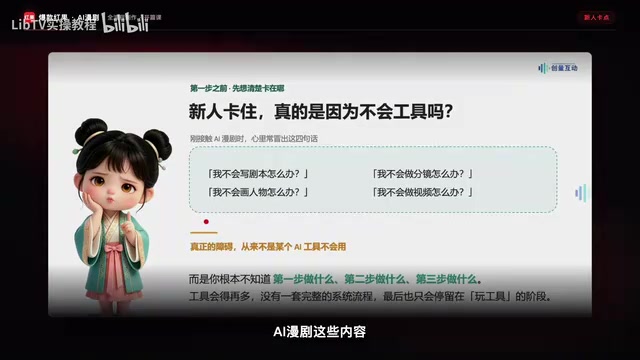
This judgment deserves attention. A large number of AI video tutorials on the market today remain at the level of single-point tricks—teaching you to generate a scene with a certain tool, teaching you to write a set of prompts. But comic drama is narrative content; it requires consistent characters, coherent scenes, logical shots, and progressive emotions. Single-point tricks can't support a complete work.
Three-Stage Course Structure: Basics, Advanced, Practical
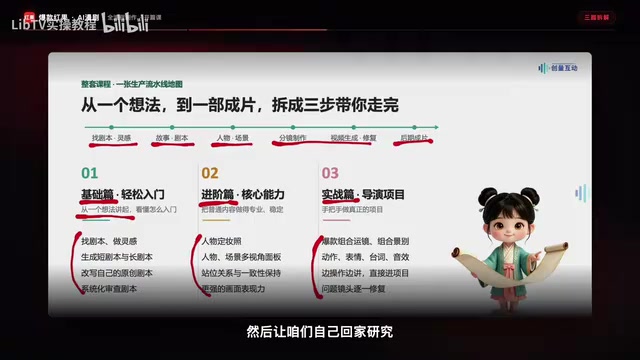
The tutorial divides the entire learning path into three major directions, and this layered design itself reflects the capability gradient of AI comic drama production.
Basics: How to Get Started from Zero
The basics section solves the entry problem—starting from an idea, using easy-to-understand methods to bring newcomers into AI comic drama video production. The focus is on building awareness of the full workflow, not digging deep into any single stage.
Advanced: Character Consistency and Scene Control
The advanced section is the technical core of the entire course. The tutorial explicitly states the need to master character costume reference photos, multi-angle character and scene panels, and multiple methods for maintaining consistency in character positioning relationships. Character consistency has always been one of the most troublesome issues in AI comic drama production—whether the same character's appearance, clothing, and temperament can be unified across different shots directly determines the professionalism of the work.
Character consistency is a core challenge in AI video generation, referring to maintaining stable visual features such as appearance, clothing, and hairstyle for the same character across different shots and scenes. In traditional animation, character design sheets and model libraries ensure consistency; while AI generation samples independently each time, easily producing "face-changing" problems. Common solutions include: using character costume reference photos as reference images (technologies such as IP-Adapter, ReferenceNet), providing visual anchors from different angles through multi-angle panels, and fixing detailed appearance descriptions in prompts. In addition, maintaining consistent character positioning relationships requires scene layout diagrams or depth map control to ensure reasonable relative positions and perspective of characters in the frame. These technical means together form the foundation of professional AI comic drama production.
Practical: Director-Level Project Practice
The practical section walks you hand-in-hand through director-level projects, involving viral combination shots, shot size design, and elements in storyboards including actions, expressions, dialogue, and sound effects. The tutorial emphasizes a hands-on approach: explain while doing, click where you point, explain why you input what you input, and after AI generation results come out, analyze what's right, what's wrong, and how to continue.
This "click wherever you look" teaching method is much more effective than finishing theory and letting students study at home. Many details of AI video production—how to adjust parameters, how to modify prompts, how to fix unsatisfactory results—are exactly what theory can't explain clearly and must be understood by watching the operation.
Lesson One Focus: Three Core Problems to Solve in the Script Stage
The tutorial positions finding a script as the first step of the entire AI comic drama production workflow, and points out that this step truly needs to solve three core problems.
First, when there's no story, how to quickly generate an original story that can be further developed. Second, when you have materials such as novels, how to rewrite the novel into a script suitable for AI comic drama production. Third, after the script is generated, how to further hand it to an agent for systematic review and creation.
These three problems progress layer by layer, corresponding to three real scenarios: creation from zero, material adaptation, and quality control. The tutorial specifically explains that once this lesson is understood, the subsequent characters, scenes, storyboards, and video generation have a real foundation. In other words, the script is not an optional prerequisite step, but the foundation that determines whether all subsequent steps can proceed smoothly.
AI Director Thinking: A Capability More Important Than Prompts
There's a concept in the tutorial worth highlighting separately: AI director thinking.
According to the tutorial's definition, so-called AI director thinking means no longer just telling AI "help me generate a character," but thinking about why this character appears, what plot it serves, what the action should be, how close the shot should be, what the emotion is, where the scene is, and how this shot connects to the next one, why this scene uses this shot size, why this place needs a close-up, why this character must remain consistent.
This view touches the watershed of AI content creation. Those who know how to use tools produce materials; those with director thinking produce works. When AI lowers the threshold of image generation low enough, creators' competitiveness shifts to narrative judgment and shot design—exactly the part AI cannot replace currently.
Shot size is a basic element of film language, referring to the range the subject occupies in the frame, usually divided into long shot, full shot, medium shot, close shot, and close-up. Shot size determines the psychological distance between the audience and the character: long shots establish the environment and scale, full shots show the full action, medium shots balance character and background, close shots highlight expressions and emotions, and close-ups reinforce details or dramatic tension. In AI comic dramas, shot size design directly affects narrative rhythm and emotional transmission. For example, dialogue scenes often alternate medium shots and close shots, conflict climaxes use close-ups to emphasize expressions, and transitions use long shots. Director thinking requires creators to choose shot sizes based on plot needs, rather than random generation. At the same time, viral combination shots refer to assembling shots of different sizes according to specific logic to form smooth visual narrative, such as the classic three-part pattern of "long shot establishes scene → medium shot advances dialogue → close-up reveals emotion." Mastering these shot languages is the key to upgrading AI comic dramas from material stacking to works.
Who This Tutorial Is For
From the content design, this tutorial targets zero-foundation newcomers who want to enter the AI comic drama and AI short drama fields, as well as creators who already know how to use tools but can't get the workflow to run. The tutorial repeatedly emphasizes "usable after learning" and "make videos without asking for help," with a clear goal: to enable students to independently complete an AI comic drama.
It should be noted that the tutorial itself has high information density, involving multiple stages including script, characters, scenes, storyboards, video generation, and voiceover editing, and it's hard to absorb everything by watching once. To truly form your own production system, you still need to practice repeatedly along with hands-on operations. Tools will iterate, but workflow awareness and director thinking are transferable abilities—this is perhaps the most noteworthy aspect of this tutorial.
One-line Summary
Bilibili's AI comic drama tutorial breaks down the full workflow from script to final cut, emphasizing systematic workflow and director thinking.
Paragraph Summary
This article introduces a Bilibili AI comic drama production tutorial aimed at helping zero-foundation newcomers run through the complete production chain from script to final cut. The tutorial points out that single-point tool tricks cannot support narrative content, and creators need to build a systematic workflow. The course is divided into three stages: basics, advanced, and practical. The basics section builds awareness of the full workflow, the advanced section tackles character consistency and scene control, and the practical section involves director-level project practice. The script stage needs to solve three core problems: original story generation, novel adaptation, and agent review. The tutorial specifically proposes "AI director thinking," emphasizing that thinking about character motivation, shot sizes, and connection logic is more important than prompts. Suitable for zero-foundation newcomers and creators whose workflow doesn't run, but requires repeated practice to internalize.
Related articles

macOS Is No Longer UNIX: Apple Didn't Renew Certification, But the Technology Is Unchanged
Apple did not renew macOS's UNIX certification, and the Open Group has removed Apple's entry. This article analyzes the technical reality behind the expiration, Apple's possible intentions, and the practical impact on developers.

Building Stateful Multi-Agent Systems with Azure Cosmos DB
Based on the official Azure Cosmos DB tutorial, this article explains how to use the Agent Memory Toolkit to add shared persistent memory to a multi-agent travel planner, covering short-term, long-term, episodic, and semantic memory plus cross-session state continuity.

Production AI Agent Operations: A Three-Step Framework for Observing, Evaluating, and Optimizing
Azure Cosmos DB team proposes a three-step framework for production AI Agent operations: observe trace tracking, evaluate with LLM as a judge and regression testing, optimize cost across RU, retrieval, memory, and LLM layers.