BingoCode: An Open-Source AI Coding Tool for Offline Deployment — A Claude Code Alternative

BingoCode is an open-source, offline-deployable AI coding tool and Claude Code alternative with MIT license.
BingoCode is an MIT-licensed open-source harness agent for AI-assisted coding that supports offline intranet deployment and integrates with DeepSeek, Claude, OpenAI, and Gemini. Its pure CLI design, four-step setup, and near-perfect cache hit rates on DeepSeek make it a cost-effective, security-friendly alternative to cloud-based tools like Claude Code.
When AI Coding Tools Meet "Availability Anxiety"
As AI coding tools like Claude Code and Cursor gain popularity, more and more developers are delegating their daily coding work to these "intelligent assistants." But a nagging concern persists: what happens if the service goes offline, your account gets banned, or company policy prohibits internet access? Relying on closed-source, cloud-based tools always carries the risk of "suddenly becoming unavailable one day."
Behind this "availability anxiety" lies a new manifestation of a long-standing problem in software engineering: Vendor Lock-in. The risk of service interruptions with traditional SaaS tools has precedent — in 2023, several AI services suspended operations in certain regions due to regulatory pressure or business adjustments, forcing developers to halt their workflows. For enterprise users, this risk is compounded by compliance pressures. Regulations like GDPR and China's Data Security Law impose explicit restrictions on cross-border transfer of code data. Using cloud-based AI coding tools means source code may pass through overseas servers — a line that is nearly impossible to cross in industries like finance, defense, and government services.
Vendor lock-in has long been studied in traditional software. Economists describe it as a market structure with extremely high "Switching Costs" — when users become deeply dependent on a proprietary tool's API format, keyboard shortcuts, or workflow integrations, the friction of migrating to an alternative often exceeds the risk of staying. The lock-in effect of AI coding tools is particularly insidious: developers rely not only on the tool's features, but gradually come to depend on its "memory" of specific codebases (conversation history, project context indexes). This data is typically stored in proprietary formats on the vendor's cloud and is difficult to migrate. When a service suddenly goes down, you lose not just access to the tool, but all the accumulated work context embedded within it.
BingoCode was born specifically to address this pain point. It positions itself as "a stable, open-source alternative to Claude Code," with its core selling point being support for one-click offline deployment with no dependency on any external services. As an open-source harness agent licensed under MIT, it takes the idea of "putting control back in developers' hands" to the extreme.
This article walks through BingoCode's core features, model compatibility, and the complete onboarding process to help you decide whether it belongs in your toolbox.
Core Features: Open Source, Offline, No Back Doors
BingoCode's biggest differentiator lies in its complete openness and controllability, reflected across several dimensions.
Fully Open Source, No Paywalls
The project is licensed under MIT, with all code publicly available and continuously iterated across 190+ versions. There are no hidden back doors and no paid feature restrictions.
The MIT license is one of the most permissive open-source licenses available, allowing anyone to freely use, modify, and distribute the software — even for commercial purposes — with the only requirement being to retain the original copyright notice. For enterprise security teams, the core value of open source is not just the zero cost, but auditability — the internal logic of closed-source tools is a black box, making it impossible to verify whether data is being sent back, telemetry is being reported, or hidden network requests are being made. An open-source codebase allows teams to run security scans on every commit and integrate them into a DevSecOps pipeline, mitigating supply chain security risks at the source.
It's worth noting that software supply chain security has become a major industry focus in recent years. The 2021 SolarWinds incident and the Log4j vulnerability made the industry realize that even widely trusted tools can become attack vectors. For AI coding tools, the risk is especially unique — such tools are often granted high-level permissions to read and write the filesystem and execute terminal commands. If malicious logic exists, the consequences could be severe. The 190+ version iteration history itself serves as a trust endorsement: the more transparent the version history, the lower the likelihood of malicious code being inserted. For teams that prioritize code security auditing, this is especially critical — every line of code can be reviewed in-house, and the security boundary is completely transparent.
Offline Deployment, Permanently Available
This is BingoCode's most compelling feature. The tool supports offline installation in an intranet environment, meaning it will continue to function normally even if the original author stops maintaining it.
AI coding tools that support offline deployment differ fundamentally from cloud-based tools in architecture. Once installed globally via npm, BingoCode's runtime logic executes entirely locally, with no dependency on the tool vendor's cloud infrastructure. The "zero external dependencies" claim refers to the tool layer — it's important to note that when calling APIs for models like DeepSeekAd or Claude, requests still go to the corresponding model provider's servers. True "fully offline" operation requires pairing BingoCode with locally deployed open-source models (e.g., Llama or Qwen running via Ollama), at which point the entire inference chain becomes network-isolated.
Ollama is currently one of the most popular open-source frameworks for running large language models locally. It supports one-click pulling and running of dozens of open-source models including Llama, Mistral, Qwen, and CodeLlama, and provides a local interface compatible with the OpenAI API specification (listening on localhost:11434 by default). This means any tool that supports a custom API endpoint can theoretically connect seamlessly to a locally running Ollama model, enabling a complete offline inference chain. BingoCode supports custom API endpoint configuration and can theoretically connect to any local model service compatible with the OpenAI interface specification, providing a complete private deployment path for high-security scenarios. For finance, government, and enterprise environments with strict data security and network isolation requirements, this "zero external dependency" architecture is extremely attractive.
Minimalist Pure CLI Design, Harness Agent Architecture

BingoCode sticks to a pure command-line interface (CLI) design — no web UI, no unnecessary abstraction layers. This minimalist architecture delivers two direct benefits: low resource consumption and fast startup response; plus low understanding and maintenance overhead, with configuration logic that's immediately transparent.
Technically, BingoCode is a harness agent — a term borrowed from the software testing concept of a "test harness," meaning "an agent layer that wraps and orchestrates a core capability." In the context of AI coding tools, a harness agent plays the following role: receive user intent → schedule the underlying LLM API → parse model output → execute code operations (read/write files, run commands, execute tests) → feed execution results back to the model → loop until the task is complete.
This loop structure corresponds academically to the ReAct (Reasoning + Acting) paradigm, proposed by Princeton University in 2022. The ReAct framework enables language models to alternate between "reasoning steps" and "action steps," with the result of each action (e.g., executing a terminal command) fed back as a new observation into the next reasoning cycle, forming a closed loop. Unlike simple "code completion plugins," the agent architecture has multi-step autonomous planning capability, allowing it to independently complete complex tasks like "fix a bug" or "implement a feature" that require multiple rounds of reasoning and action. This is the underlying foundation that enables the Auto mode described later to "execute fully automatically."
Model Compatibility: Deep DeepSeek Optimization, Full Coverage of Major Platforms
BingoCode demonstrates considerable flexibility in model compatibility, supporting "one CLI to connect DeepSeek, Claude, OpenAI, and Gemini," so developers don't need to maintain separate toolchains for different models.
Deep DeepSeek Optimization with Extremely High Cache Hit Rate
BingoCode has been specifically optimized for DeepSeek and fully supports its cache hit mechanism (Resonant Content). Real-world testing shows that cache hits are nearly universal on DeepSeek, which is enormously significant in long-session coding scenarios.

It's worth understanding the technical principles behind "cache hits" in depth. Prompt Caching (called Resonant Content Cache by DeepSeek) is one of the core optimization techniques in modern large model inference: when consecutive requests share identical prefix content (such as system prompts, code context, or project files), the model's server-side saves the KV Cache (key-value cache) for that content in GPU memory, allowing subsequent requests to reuse it directly without recalculating attention weights.
The principle of KV Cache stems from the self-attention mechanism in the Transformer architecture: when computing each token, the model calculates attention scores against the keys and values of all historical tokens in the sequence. For repeated prefix content, this computation can be cached and reused, significantly reducing inference latency and compute consumption. In engineering practice, caching strategies vary across providers: Anthropic's Claude requires a prefix length of over 1,024 tokens before triggering caching; OpenAI automatically caches in 128-token increments; and DeepSeek's caching mechanism is especially friendly to long system prompts and repeated context. In long-context coding scenarios, a large project's context might contain tens of thousands of tokens — if every request requires full recalculation, costs multiply rapidly. DeepSeek's cache-hit tokens are typically billed at 10–20% of the standard price, meaning a high hit rate can reduce actual API spend by 60–80%. For cost-sensitive individual developers and small teams, the DeepSeek + BingoCode combination offers exceptional value.
One-Click Model Switching
In addition to DeepSeek, the tool also supports Claude, OpenAI, Gemini, and other mainstream models. The "one config to rule them all" design lets developers flexibly switch models based on task complexity — use a low-cost model for simple tasks and switch to a more capable option for complex ones.
Four Steps to Get Started: Simple Enough to Skip the Docs
BingoCode compresses the installation and configuration process to the bare minimum — the entire setup takes just four steps.
Step 1: Install
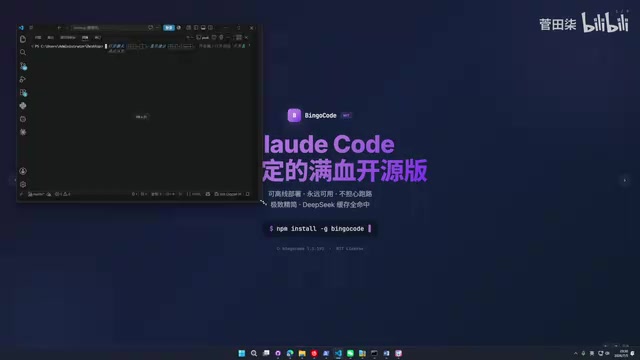
A single npm command handles the global installation. No complex environment setup, no tedious dependency management.
Step 2: Configure Your Provider
After installation, simply type bingo to launch. On first startup, the tool guides you through configuration via the App Provider setup. Built-in presets for DeepSeek and other providers are included — just select the corresponding preset, enter your API Key, and you're done. No manual config file editing required.
Step 3: Switch Models

When you need to switch models, go to the Configure Slots interface, where DeepSeek, Claude, and other options are a single click away. The interactive configuration significantly lowers the barrier to use.
Step 4: Enable Auto Mode
Once Auto mode is enabled in Settings, the tool can execute tasks fully automatically — running tests, modifying code — with no manual intervention required throughout. This capability is powered by the harness agent architecture mentioned earlier: the tool acts as a local "orchestration brain," continuously cycling through "model inference → code operation → result feedback" until the task goal is achieved. At this point, the onboarding process is complete.
Worth Trying, But Evaluate Rationally
BingoCode represents an important direction for AI coding tools: decentralized and self-controlled. Against a backdrop where closed-source cloud tools dominate the market, an MIT-licensed, offline-capable, open-source solution with deep optimization for domestic models fills a genuine gap in demand.
The following types of users should pay particular attention:
- Enterprise teams that prioritize data security: Intranet offline deployment, combined with local models, eliminates data leakage risk at the source and satisfies code security audit requirements
- Cost-sensitive developers: DeepSeek's high cache hit rate delivers a substantial cost advantage — API fees can be drastically reduced in long-conversation coding scenarios
- CLI-oriented power users: The pure CLI design integrates seamlessly with terminal-based workflows, and the harness agent architecture supports fully automated execution of complex tasks
A few caveats: the information in this article is primarily based on publicly available documentation. Actual stability, performance, and the feature gap compared to Claude Code still need to be validated through real-world project use. Claims like "full-power mode" should also be viewed with measured skepticism — open-source community tools typically need time to mature in terms of ecosystem depth and edge case coverage. Additionally, there is a technical distinction between "offline deployment" and "fully air-gapped operation": for true network isolation, you'll also need to set up a local model service compatible with the OpenAI interface.
If you're looking for an AI coding assistant that you're not beholden to anyone for, BingoCode is at least worth spending a few minutes on an npm install to try.
Key Takeaways
Related articles

What Is Vibe Coding? The AI Programming Skill Every Developer Needs
What is Vibe Coding? Learn how AI programming is reshaping dev teams, why traditional programmers face displacement, and why Cursor & Claude Code matter.
Making Rocks Think: A Philosophical Exploration of Generative AI and Information Compression
From a viral Reddit post to deep AI theory: why compression equals understanding, the Library of Babel thought experiment, semantic compression, and the Hutter Prize.
Irregular Warns: Four AI Lab Security Breaches Traced to the Same Root Cause
Irregular reveals four AI lab security breaches share a single root cause, exposing systemic risks from technology stack homogeneity across the AI industry.