Black Holes Aren't Holes: Using the Trampoline Analogy to Explain Gravitational Spacetime Curvature

Black holes are not holes but dense matter that bends spacetime extremely.
The article clarifies the misleading name "black hole": it is not a void but an object of extremely dense matter with gravity so strong light cannot escape. Using the trampoline analogy, it explains how mass bends spacetime in general relativity—ordinary bodies like a basketball sagging a trampoline, while a black hole is like an anvil creating a deep, nearly vertical depression. The substance is the matter causing the depression, not the depression itself. Imagining a black hole as an anvil is closer to the truth than a well and helps dispel romanticized misreadings.
When people hear "black hole," they often picture a pit in the ground that you can fall into. But astrophysicists will tell you that this name is highly misleading. A black hole is not an empty hole at all—it is actually a "mountain" of extremely dense matter in the universe. In a video, a science communicator offers a vivid analogy: a black hole is less like a hole and more like an anvil pressing down on a trampoline.

Where the "Hole" Misconception Comes From: Gravity Bending Spacetime
To understand why black holes are called "holes," we first need to return to how general relativity describes gravity. Massive objects cause spacetime itself to bend. The creator uses a trampoline as an intuitive analogy: place a basketball in the center of a trampoline, and the surface sags downward. If you then roll a ping-pong ball in a straight line, its trajectory will curve because of the trampoline's depression.
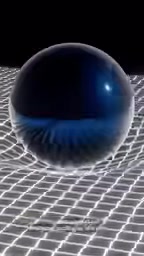
This is the essence of gravity in geometric language—not a pulling force, but the result of spacetime being bent by mass, with other objects moving along curved paths. The ping-pong ball appears to be "attracted" by the basketball, but in reality it is simply following an unavoidable curve on the sagging surface.

When an object's density becomes extreme and its gravity becomes extreme, the trampoline analogy escalates. The creator describes it as slamming an anvil onto the trampoline: the surface collapses straight down, forming an extremely deep depression with nearly vertical walls. What we call a "black hole" is precisely this extremely compressed region of spacetime.
General relativity was proposed by Einstein in 1915. One of its core ideas is that gravity is not a force in the traditional sense, but a manifestation of mass and energy causing the geometry of spacetime to curve. Mathematically, this idea is described by the Einstein field equations, which relate the curvature of spacetime to the distribution of matter and energy. In the weak-field approximation, general relativity reduces to Newtonian gravity, so everyday gravitational phenomena can still be approximated using Newtonian mechanics; but in strong gravitational fields (such as near black holes), general relativity must be used. In 1916, Schwarzschild gave the first exact solution to the field equations, describing a spherically symmetric, uncharged, non-rotating black hole, whose boundary is called the event horizon.
A Black Hole Is an Anvil, Not a Hole: The Misleading Name
The creator points out the key: a black hole is not the depression in the trampoline, but the anvil causing the depression. In other words, the substance of a black hole is a mountain of matter, not a void. Taking the word "hole" literally is as absurd as pointing at the trampoline's pit and saying it is the anvil.

"They are mountains of matter, not holes." This line from the video gets right to the point. Black holes have mass, have gravity, and even have observable indirect effects. The only thing they lack is a "hole" for someone to fall into. The "black" in the name describes the fact that light cannot escape and we cannot see it; the "hole" is entirely a historical visual metaphor.
The event horizon is an imaginary spherical boundary around a black hole. Once matter or radiation crosses this boundary, it can never return. It is not a physical surface, but a critical point in the causal structure: inside the horizon, all future light cones point toward the central singularity, and the escape velocity exceeds the speed of light. Therefore, the root of "black" is that light emitted from inside the horizon cannot reach an outside observer. A black hole's mass is concentrated near the central singularity, and the horizon radius (Schwarzschild radius) is proportional to mass. For stellar-mass black holes, the horizon radius is about a few kilometers to a few tens of kilometers; for supermassive black holes at the centers of galaxies, the horizon radius can reach billions of kilometers. These values help in understanding the physical meaning of black holes as "extremely dense mountains of matter."
Why This Analogy Deserves Serious Attention
The trampoline analogy is not a rigorous physical model, but it precisely conveys a core insight: gravity is the geometric curvature of spacetime. For a non-expert audience, imagining a black hole as "an anvil bending a trampoline" is far closer to the truth than imagining it as "a well in the universe." This conceptual replacement helps dispel the romanticized misconception of black holes—they are not portals to another dimension, but celestial objects with gravity so extreme that even light is trapped.
The next time you see the words "black hole," try replacing them in your mind with "black mountain" or "black anvil." Names are products of history, and understanding requires moving beyond the traps of names.
One-line Summary
A black hole is not a void, but a dense material object formed by gravity extremely bending spacetime.
Paragraph Summary
The article clarifies the misleading nature of the name "black hole": a black hole is not a void in the universe, but an object with extremely dense matter and gravity so extreme that even light cannot escape. Using the trampoline analogy, the author explains the mechanism by which mass bends spacetime in general relativity—ordinary celestial bodies are like a basketball sagging the trampoline surface, while a black hole is like an anvil creating an extremely deep depression with nearly vertical walls. The substance of a black hole is the matter causing the depression, not the depressed region itself. The article emphasizes that imagining a black hole as "an anvil bending a trampoline" is closer to the truth than "a well in the universe," helping to dispel the romanticized misreading of it as a dimensional portal.
Related articles

Anthropic Founding Team in Their Own Words: Why We Bet on AI Safety
Anthropic's founding team explains their original motivation: from theoretical physics to AI safety, why they chose a public benefit corporation, how clumsy early models were, and the trade-offs behind launching Project Glasswing after the Mythos model revealed risks.

Behind Genie One's Accuracy: Why Curated Agents Need Governed Context
Genie One's accuracy issues reveal the core challenge for curated Agents: without governed context, finance and underwriting give contradictory answers. This article analyzes the three layers of governed context, the accuracy trap of curated Agents, and engineering directions for building a governable context layer.

Genie ZeroOps Public Beta: How Autonomous Agents Self-Heal Data Pipelines
Genie ZeroOps enters public beta—an agent that autonomously detects, investigates, and fixes data pipelines. We analyze its core capabilities, the 80,000 customer-issue experience behind it, and the real-world challenges of autonomous agents in data operations.