Blink: Build Trades with a Single Sentence and Capture Market Signals Around the Clock

Blink builds and monitors event-driven trading strategies 24/7 via natural language, lowering the quant barrier but facing accuracy and compliance challenges.
Blink is a new Product Hunt product that lets users describe trading logic in natural language (e.g., "if Jensen returns, go long NVDA and short AMD"), automatically parses it into trade instructions with triggers, and monitors X posts, news headlines, earnings results, earnings-call remarks, and prediction-market odds 24/7, executing automatically when triggered. It aims to bring event-driven strategies to ordinary active traders, lowering coding and market-watching barriers. But it's early-stage (74 upvotes, 1 comment), and key details on NLU accuracy, data reliability, execution latency, and compliance are undisclosed—watch before committing real money.
In financial markets, news-driven price moves often happen while you're asleep or in a meeting—by the time you see the headline, the move is already over. Blink, a new product on Product Hunt, tries to solve this pain point: describe your trading logic in natural language, and it builds the strategy and monitors it 24/7, executing automatically once trigger conditions are met.
From Idea to Trade: Turning Natural Language into an Executable Strategy
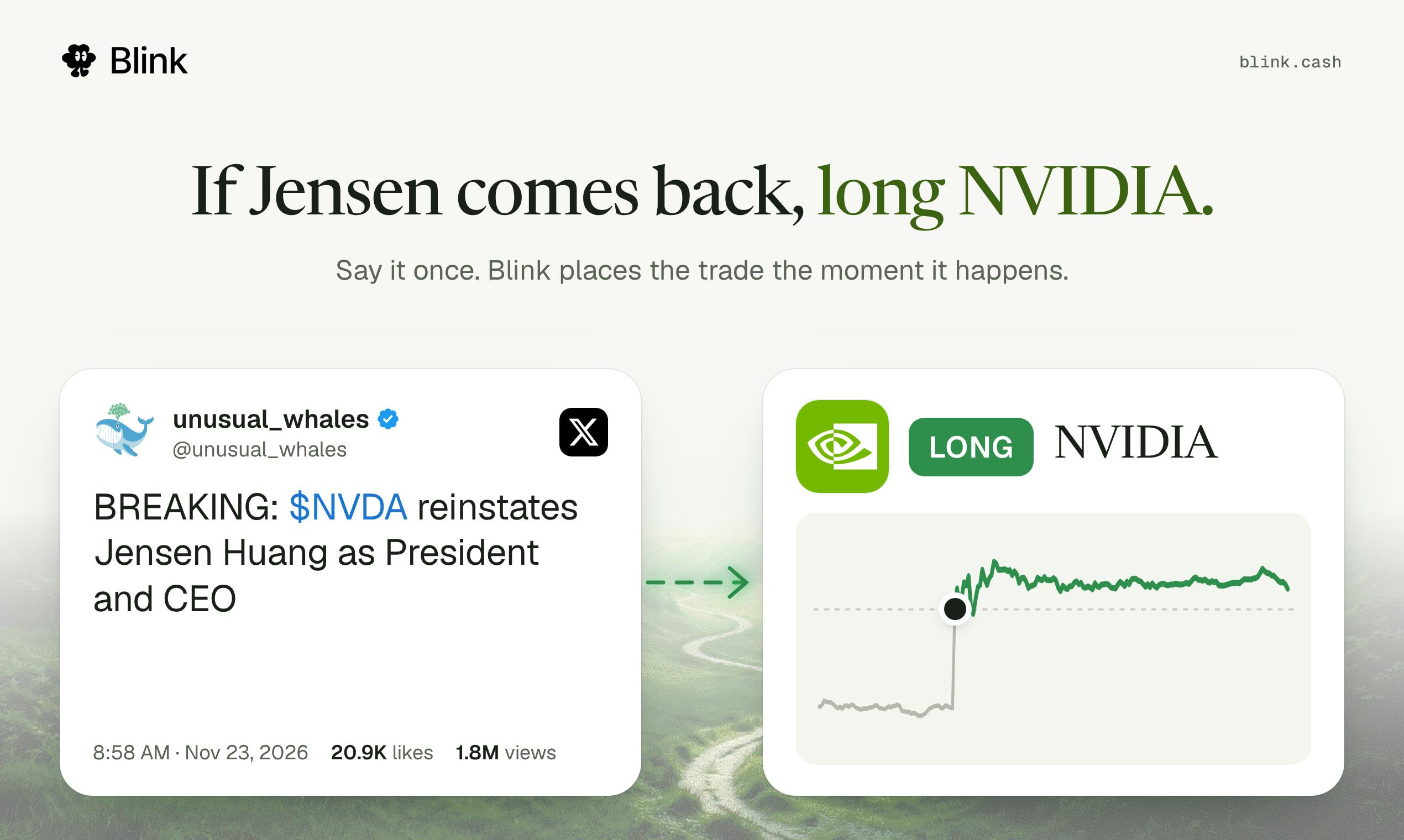
Blink's core interaction is remarkably direct—you simply state your trading intent in everyday language. For example, the example given on the product page is: "If they announce Jensen is returning, go long NVDA and short AMD." Blink parses this sentence and converts it into a trade instruction with trigger conditions.
This involves two layers of capability: first, semantic understanding, which breaks down a vague narrative into asset targets, direction, and trigger events; second, event monitoring, which scans multiple information sources in real time. Blink's supported triggers include posts on X (Twitter), news headlines, earnings results, live remarks during earnings calls, and changes in prediction-market odds.
This design lowers the barrier to quantitative trading. Traditionally, implementing similar logic requires writing code, integrating market-data APIs, and handling exceptions—Blink encapsulates all of this beneath a conversational interface.
Event-driven trading is a strategy that triggers buy or sell decisions based on specific events (such as earnings releases, news announcements, social media signals, etc.) rather than relying on continuous price-based technical indicators. Traditionally, such strategies have been dominated by quant funds and institutional traders, requiring data pipelines, event-parsing logic, and trading interfaces. Blink encapsulates this workflow into natural language interaction, effectively simplifying infrastructure that once required an engineering team to maintain into a single sentence from the user—greatly lowering the barrier to entry.
Live remarks during earnings calls refer to the conference calls public companies hold after releasing quarterly earnings, where management answers analyst questions on the spot. These impromptu remarks often contain subtler signals than the formal earnings report (such as cautious wording about the outlook), making them a source of information that event-driven traders watch. Transcribing speech to text in real time and parsing its semantics places high demands on system latency and accuracy.
Around-the-Clock Monitoring: Democratizing Event-Driven Trading
Blink emphasizes "watches around the clock," meaning uninterrupted monitoring. For individual traders, this is like having a tireless sentinel. You don't need to stay up watching the market, and you don't need to set up complex alerts—Blink executes the preset trade the moment an event occurs.
In terms of positioning, Blink targets active traders who have views on the market but lack the technical tools or time and energy. It takes "event-driven strategies" out of the institutional-only toolbox and puts them in ordinary users' phones.
Currently, Blink has 74 upvotes on Product Hunt, ranking 13th, with only 1 comment, indicating the product is still early-stage. But its concept hits a real need: information asymmetry is being flattened by technology, and whoever responds faster gains the edge.
Prediction-market odds are bet prices that aggregate the crowd's probability of a specific event occurring—for example, contract prices on platforms like Polymarket can be viewed as the market's real-time probability estimate of an event outcome. Sudden changes in odds often reflect the injection of new information, so they can serve as trading trigger signals. However, prediction markets may lack liquidity, and odds movements are not necessarily fully rational, so using them as a trigger source requires careful noise handling.
Potential Challenges and Observations
Despite the appealing concept, Blink still faces several obvious issues. First, the accuracy of natural language understanding: ambiguity in a sentence can lead to erroneous trade execution, and financial scenarios have extremely low tolerance for error. Second, the reliability of data sources: X posts, news headlines, and speech-to-text of earnings calls can all experience delays or errors, which in turn affect trigger timing. Third, regulation and compliance: automated trading tools face different rules in different jurisdictions, and it remains unclear how Blink will address this.
In addition, the product page does not disclose key information such as specific execution latency, supported brokerage interfaces, or fee structure—factors that will determine whether it can move from demo to practical use.
The ambiguity risk of natural language understanding in financial scenarios: In everyday language, "go long NVDA, short AMD" seems clear, but when it comes to key parameters such as time window, position size, and stop-loss conditions, a single sentence often cannot express them completely. Financial trading has extremely low tolerance for execution errors, and any semantic parsing deviation can lead to real financial losses. Therefore, such tools typically require user confirmation or fallback rules, and the product page does not explain how Blink handles ambiguous instructions and exceptional situations.
Regulatory compliance for automated trading tools varies by jurisdiction. In the United States, the SEC and FINRA impose record-keeping and suitability requirements on automated trading systems; in China, programmatic trading must be reported to exchanges. As a tool aimed at individual users, Blink may trigger licensing requirements if it involves executing trades on behalf of clients or providing investment advice. The product has not disclosed its legal structure or brokerage partnership model—a key gap in assessing its sustainability.
Who Should Use Blink?
If you often regret missing the news, or you have event-based ideas but can't code, Blink is worth watching. It represents a trend: AI is simplifying complex workflows into a single natural language sentence, and trading is just one such scenario.
But at this stage, a wait-and-see approach is recommended. Consider putting real money in only after the product matures further and discloses more technical details and compliance arrangements.
One-line Summary
Blink builds and monitors event-driven trading strategies 24/7 using natural language, lowering the quant barrier but facing accuracy and compliance challenges.
Paragraph Summary
Blink is a new product on Product Hunt that lets users describe trading logic in natural language (e.g., "if Jensen returns, go long NVDA and short AMD"), automatically parses it into trade instructions with trigger conditions, and monitors signal sources such as X posts, news headlines, earnings results, earnings-call remarks, and prediction-market odds 24/7, executing automatically once triggered. It aims to bring event-driven strategies from the institutional toolbox to ordinary active traders, lowering the barriers of coding and market-watching. However, the product is still early-stage (74 upvotes, 1 comment), and key information such as the accuracy of natural language understanding, data source reliability, execution latency, and regulatory compliance has not been disclosed. A wait-and-see approach is recommended before putting in real money.
Related articles

Nothing CMF Buds 2A Drops to $17.89 on Black Friday: A New Low for ANC Earbuds
Nothing CMF Buds 2A wireless earbuds Black Friday deal: just $17.89 on Amazon, about $11 off retail and a record low. ANC earbuds at an entry-level price.

When AI Creation Gets Accused of "Spitting": Hacker News Heats Up Over the Glaude Controversy
A Hacker News post, "Spitting in the Face of Glaude," sparks debate on AI creation transparency and attribution ethics. This analysis examines the blurred creator identity behind the controversy and offers practical advice for AI content production.

Akai Embraces Custom Firmware: MPC Sample 1.4 Lets Users AI-Program Their Sampler
Akai embraces the modding community with MPC Sample 1.4 firmware, supporting vibe-coded custom firmware and effects. We analyze the impact of this open strategy on music hardware and AI-assisted programming.