Bluesky Blocks Links to Leaked DHS Employee Data as Government Seeks Removal, Sparking Controversy

Bluesky blocked links to leaked DHS employee data, sparking controversy over censorship and government pressure.
Social platform Bluesky sparked controversy by blocking links to a site exposing thousands of DHS employees and ICE agents. The U.S. government seeks removal, citing privacy and national security, while critics accuse the platform of over-cooperating with censorship and harming the public's right to know. The case highlights the tension between government pressure, privacy, and free speech, and raises questions about transparency and accountability in decentralized content governance.
Bluesky Blocks Links to Leaked DHS Employee Data as Government Seeks Removal, Sparking Controversy
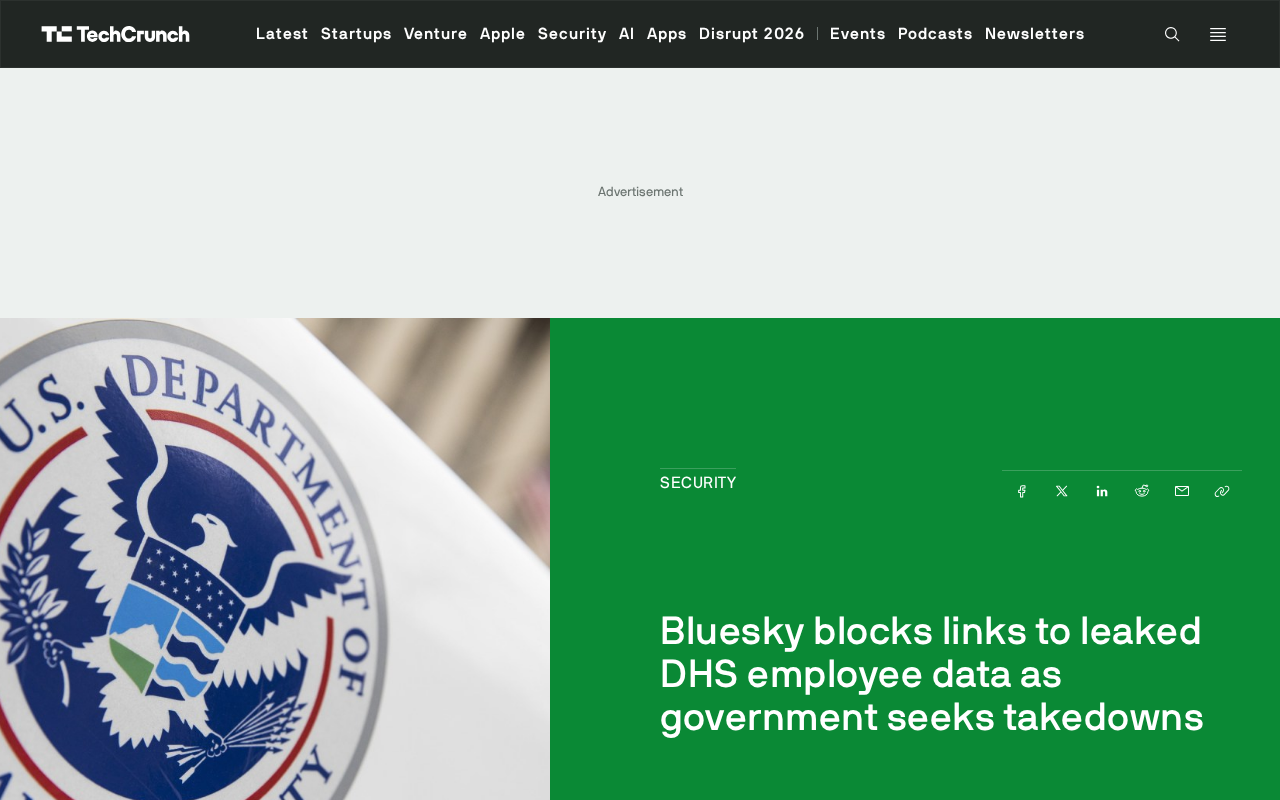
Social platform Bluesky has recently found itself at the center of a controversy after blocking links to a website that published leaked data on U.S. Department of Homeland Security (DHS) employees. The site claims to expose the personal information of thousands of Immigration and Customs Enforcement (ICE) agents and other DHS employees. Meanwhile, the U.S. government is actively seeking to remove this content, setting off a tug-of-war over platform responsibility, free speech, and privacy and security.
Background: Leaked Data and Platform Blocking
According to the original report, Bluesky blocked links pointing to the leaked-data website. The site's core purpose is to identify and publicly disclose the identities of thousands of ICE agents and other employees working for the Department of Homeland Security. Bluesky's move quickly drew criticism, with critics arguing that the platform was over-censoring under government pressure and restricting the public's access to information.
This incident is not isolated. In recent years, hacks and government data breaches have occurred frequently, and social media platforms' content moderation decisions have repeatedly become flashpoints for controversy. As an emerging representative of decentralized social networks, Bluesky's content governance strategy has long attracted attention. The link-blocking in this case has been seen by some observers as a compromise the platform made between government demands and user speech.
Background on ICE and DHS mandates: U.S. Immigration and Customs Enforcement (ICE) is a federal law enforcement agency under the Department of Homeland Security (DHS), primarily responsible for enforcing immigration law, conducting domestic enforcement beyond border control, and investigating customs-related crimes. DHS is a vast department formed after the September 11, 2001 attacks by consolidating multiple federal agencies, with functions spanning counterterrorism, border security, cybersecurity, and emergency response. As federal law enforcement officers, ICE agents' identity information is typically partially public, but once sensitive data such as home addresses and contact details are leaked, it can be used for doxxing, harassment, or retaliation. Historically, similar "doxxing" incidents have led to security threats against law enforcement officers and their families, which is one of the core bases for the government's argument that such data should be removed. Understanding the scope of ICE and DHS authority helps clarify why this leak is regarded by the government as highly sensitive.
Government Pressure and the Platform's Dilemma
The report explicitly states that the U.S. government is seeking to remove the leaked data. The government's logic is typically grounded in privacy protection and national security: once DHS employees' personal information is made public, they may face harassment, threats, or even physical danger. However, critics worry that government demands could be abused, leading platforms to over-cooperate and thereby erode the public's right to know.
Bluesky's dilemma is twofold: on one hand, it must comply with legal and regulatory requirements and avoid legal liability for hosting or disseminating illegal content; on the other hand, as a social platform, it must uphold users' freedom of expression and access to information. This tension is especially acute when government employee data is involved—is disclosing this information meant to oversee public authority, or does it constitute an invasion of individual privacy?
Governance Challenges for Decentralized Platforms
Bluesky features a decentralized architecture, and its content moderation mechanisms differ from those of traditional centralized platforms. In theory, decentralized networks are harder for a single entity to fully control, but this also means content governance is more complex. When the government issues removal demands, how Bluesky responds and by what standards it blocks links lack transparency.
The decision to block links in this case has raised questions about whether decentralized platforms are truly "decentralized." Critics point out that if Bluesky can easily block specific links, its anti-censorship capability may be overestimated. Supporters argue that any platform needs basic content governance rules, and decentralization does not equal anarchy.
AT Protocol and Bluesky's decentralization mechanism: Bluesky was initially launched with funding from Twitter (now X) and later became independent, with its underlying technology being the AT Protocol (Authenticated Transfer Protocol). This protocol allows users to host accounts and data on multiple servers (PDS) and enables cross-instance interaction through a federated network; in theory, users can migrate data and choose different frontends. However, the main app operated by the Bluesky company still carries governance functions such as content moderation and link blocking. Compared with the fully decentralized ActivityPub (the protocol used by Mastodon), Bluesky's degree of federation remains limited, and the main server has considerable discretion over content visibility. Therefore, when Bluesky blocks specific links, critics question the gap between its "decentralization" promise and its actual actions; supporters note that openness at the protocol layer is not contradictory to moderation at the application layer, and any interoperable network needs boundary rules to deal with illegal content.
The Core Dispute: Balancing Privacy, Security, and the Right to Know
The core of the controversy is how to balance conflicting values. Those supporting the block emphasize that once ICE agents' and DHS employees' personal information is leaked, they may be targeted for attacks, and platforms have a responsibility to prevent harm from spreading. Those opposing the block argue that the public has a right to know information about government employees, especially in sensitive areas such as immigration enforcement, where transparency is the foundation of accountability.
This divide is reflected in discussions across multiple sources. According to an rss source report, Bluesky was criticized for blocking access, indicating that at least some members of the public and observers believe the platform overreacted. The government's move to seek removal represents another stance: prioritizing the protection of employee privacy and national security. Both views have merit, but there is currently no clear legal or ethical framework to adjudicate such conflicts.
The legal and ethical controversy over doxxing: Doxxing refers to the act of publicly disclosing someone's identity, address, contact information, or other personal information without consent. In the United States, there is no federal criminal law specifically targeting doxxing, but state laws vary widely, with some states classifying it as cyber harassment or a hate crime. Platforms typically remove such content under community guidelines prohibiting the disclosure of personal private information. However, when the exposed individuals are government employees, the controversy becomes more complex: on one hand, public oversight of law enforcement agencies requires a certain degree of transparency; on the other hand, employees' personal safety and privacy rights are equally protected by law. In this case, the leak site claimed its purpose was to oversee ICE enforcement, but publishing the personal data of thousands of employees goes beyond ordinary oversight and approaches doxxing. When responding to government removal demands, platforms must carefully weigh community guidelines, legal obligations, and free speech, and there is currently a lack of unified judicial precedent to draw the line.
Lessons for Platform Content Governance
The Bluesky incident offers an important case study for social platform content governance. First, platforms need clearer decision-making standards and transparency when handling links related to government data leaks. Second, decentralized architecture does not automatically solve the challenges of content moderation; it may instead increase coordination costs due to fragmented governance mechanisms. Finally, when responding to government demands, platforms should establish accountable processes to avoid being accused of over-cooperation or arbitrary censorship.
For the AI and tech fields, this incident also reminds us that as data leaks and content dissemination become increasingly automated, platforms need smarter and more transparent governance tools. Relying solely on manual review or simple blocking is inadequate for complex situations, while algorithm-driven automated decisions may lack contextual judgment and cause collateral damage.
Conclusion
The incident of Bluesky blocking links to leaked DHS employee data reflects the complex interplay among platforms, government, and the public in the digital age. How platforms choose between government pressure and user expectations will directly affect their credibility. At present, the incident is still unfolding, and whether the government's removal demands and the platform's blocking actions are legal and reasonable remains to be seen. For practitioners focused on AI governance and platform responsibility, this is a case worth following closely.
One-line Summary
Bluesky blocked links to leaked DHS employee data, sparking controversy over platform censorship and government pressure.
Paragraph Summary
Social platform Bluesky has found itself in a controversy after blocking links to a website exposing the personal information of thousands of U.S. Department of Homeland Security (DHS) employees and Immigration and Customs Enforcement (ICE) agents. The U.S. government is seeking to remove the leaked data, citing the protection of employee privacy and national security. Critics accuse the platform of over-cooperating with government censorship and undermining the public's right to know. The incident highlights the platform's dilemma between government pressure, privacy protection, and free speech, and raises questions about the transparency and accountability of content governance under a decentralized architecture. At present, positions remain sharply divided, and there is no clear legal or ethical framework to adjudicate such conflicts.
Related articles
AWS AgentCore Gateway: Connecting AI A…
AWS AgentCore Gateway: Connecting AI Agents to Enterprise Backends with MCP
How AWS AgentCore Gateway acts as a primary MCP server to aggregate REST APIs, Lambda, and existing MCP services? Analyzing its AST real-time mapping, zero cold start, semantic search for tool overload, session isolation, and key injection security design, plus the architectural approach to decoupling enterprise AI agents from backends.

One Link Gives Figma AI a New Skill: Hands-On with MCP Connectors
Paste one MCP server link and the AI Agent in Figma gains new tool capabilities. We break down the setup flow, 20+ one-click apps, read/write permissions and execution policies, and the public HTTPS requirement.

Cognition SWE-2 in Practice: One Prompt to Handle the Whole Product Launch Process
Analyzing a YouTube creator's prompt for using Cognition SWE-2 to launch a product: a landing page, seven-email sequence, and non-buyer follow-up tool, plus how the 'test and report' constraint changes AI delivery quality.