Bluesky Officially Names Toni Schneider as CEO: A New Chapter for the Decentralized Social Platform

Bluesky makes Toni Schneider its permanent CEO, signaling a new, more serious phase for the decentralized social platform.
Bluesky has officially named Toni Schneider—former Automattic CEO and True Ventures partner—as its permanent CEO, dropping the 'interim' title. Schneider says he's 'all in.' The move signals Bluesky's shift from exploration to certainty, as the AT Protocol-driven open social ecosystem faces key challenges in growth, governance, and monetization.
Bluesky's Leadership Question Is Settled
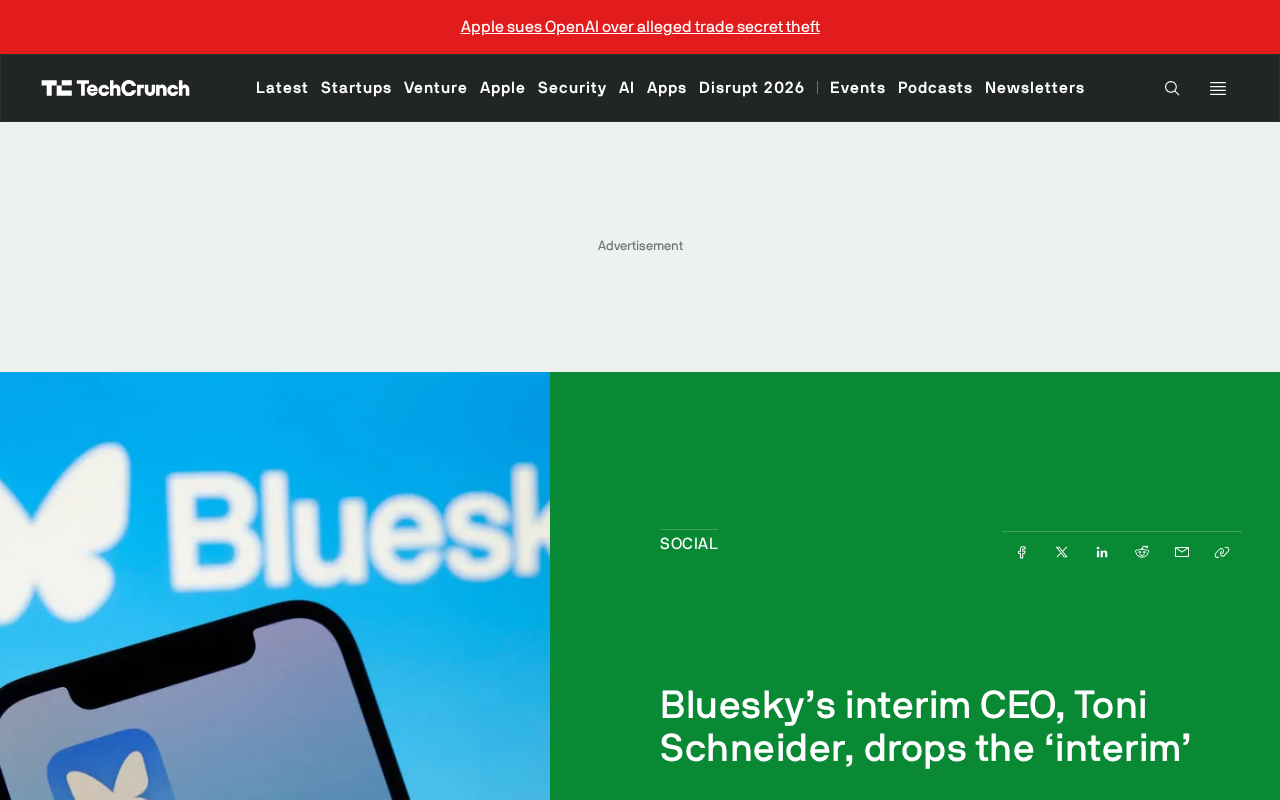
The decentralized social platform Bluesky has reached an important organizational milestone: Toni Schneider, who previously served as interim CEO, has officially dropped the "interim" from his title to become the company's full-fledged leader. Schneider himself says he is now "all in" on this unconventional social media project.
For a social platform still in its growth phase, formalizing the CEO title is more than a personnel change—it's a strategic signal. It means the company has decided to make a long-term bet on its current product direction and business path, while sending a message to the outside world, investors, and its vast user community: "We're serious about seeing this through."
Who Is Toni Schneider?
Toni Schneider's résumé carries considerable weight in the tech world. He previously served as CEO of Automattic—the parent company behind well-known internet products such as WordPress.com and Tumblr.
Founded in 2005, Automattic is the core commercial entity behind the open-source content management system WordPress. WordPress was originally released as an open-source project by Matt Mullenweg in 2003, and Automattic subsequently built a distinctive "Open Core" business model around it: the core code is fully open source and maintained by the community, while commercial value is realized through differentiated hosting services and premium features. WordPress currently powers roughly 43% of all websites worldwide, and behind this staggering market penetration lies Automattic's long-standing "open source first" strategy—the core software is free and open, while commercial value is monetized through hosting services, plugin ecosystems, and enterprise solutions.
The elegance of the "Open Core" model lies in how it resolves the fundamental paradox of commercializing open-source software: it must both maintain community trust (by not privatizing core functionality) and create sufficient commercial value (by not being entirely free). Automattic's practice has proven that this model is highly viable in the content infrastructure space—WordPress.com hosting, WooCommerce e-commerce extensions, Jetpack security tools, and more form a multi-tiered revenue structure, allowing open-source ideals and commercial sustainability to coexist. This methodology has direct relevance for Bluesky: the AT Protocol, as an open protocol, can be used for free, while the Bluesky company can build a differentiated monetization layer around hosting services, developer tools, and enterprise features.
During his tenure as CEO of Automattic (2006–2014), Schneider led the company through the critical phase from startup to scale, all while maintaining a fully distributed, remote-first workforce. This gave him invaluable experience navigating the long-term trade-offs between idealistic technology philosophies and commercial realities. The key tension in this model lies in how to strike a dynamic balance between giving back to the open-source community and maintaining commercial competitiveness—this experience gives him far deeper hands-on insight than his peers into "how to build a profitable digital infrastructure while preserving the spirit of openness." Automattic acquired Tumblr for $300 million in 2019, further expanding its footprint in user-generated content platforms. This proven experience combining open protocols with sustainable business models is exactly the skill set Bluesky needs most right now. Automattic itself is a significant practitioner of open-source and open-web ideals, which aligns closely with the decentralized, open-protocol values that Bluesky champions.
In addition, Schneider is a partner at the renowned venture capital firm True Ventures. Founded in 2005, True Ventures is a Silicon Valley VC firm focused on early-stage investment, known for its "Founder Friendly" investment philosophy, with a portfolio spanning notable consumer tech companies such as Fitbit, Peloton, and Ring. As a partner, Schneider has long been involved in incubating and growing early-stage tech companies, giving him a unique dual perspective: he can understand product and team-building with an entrepreneur's mindset while evaluating business model viability and capital efficiency from an investor's vantage point. For a social platform that must balance commercialization and idealism, this hybrid experience is especially crucial.
From Automattic to Bluesky, Schneider's choices reflect his consistent commitment to the idea that "users own their own data, and open protocols drive social networks."
What Makes Bluesky "Unconventional"
Bluesky's most striking feature is its technical foundation—the AT Protocol (Authenticated Transfer Protocol). This is a decentralized social networking protocol developed in-house by Bluesky, whose core innovation lies in completely decoupling user identity, data, and service providers.
The AT Protocol was initially funded by former Twitter co-founder Jack Dorsey, with the goal of solving the structural problems of social media at the protocol level. The protocol's three core components work together: DID (Decentralized Identifiers), based on the W3C standard, handles identity anchoring; Lexicon defines the data structures and API specifications across services, akin to a "common language" for social networks; and the Federation mechanism allows different PDS nodes to synchronize data. Notably, this architecture is fundamentally different from blockchain technology—the AT Protocol does not rely on consensus mechanisms or token incentives, but instead achieves verifiability through cryptographic signatures and distributed storage, maintaining decentralization while keeping the user experience smooth.
Why choose the "non-blockchain" path? Reflecting on the collective lessons of Web3 social projects, early decentralized social attempts (such as Steemit) that introduced token incentives often produced severe game-theoretic distortions—user behavior became driven by token rewards rather than genuine social needs, ultimately leading to declining content quality and community alienation. The AT Protocol's choice of cryptographic signatures over consensus mechanisms is essentially an engineering-philosophy trade-off: it forgoes the extreme decentralization of being "trustless" in exchange for response speeds and a user experience close to that of centralized platforms. This trade-off makes the AT Protocol more like a "verifiable federated network" than a "decentralized ledger," which has consequently sparked ongoing debate between technical purists and pragmatists.
From an architectural design standpoint, the AT Protocol actually builds a three-layer separation system: the identity layer achieves cross-platform identity anchoring through the DID system, so a user's digital identity is no longer tied to any single domain or service provider; the data layer achieves distributed self-hosting of data through the PDS (Personal Data Server), where each PDS node maintains its own copy of the data and synchronizes it network-wide via a "Relay"; and the application layer achieves differentiated presentation of the same underlying data across different clients and services through the AppView. This three-layer decoupling design gives the protocol tremendous extensibility—developers can build wildly different social products on the same underlying protocol without having to re-solve identity and data storage problems. This layered thinking is in the same vein as the design philosophy of the early internet's TCP/IP protocol stack: by clearly defining inter-layer interfaces, innovation at different layers can proceed independently without interfering with one another.
On a deeper level, the AT Protocol is not just a protocol specification but represents a philosophical practice of turning social networking infrastructure into a "public good." Its architectural design draws on the layered thinking of the early internet: just as TCP/IP belongs to no single company, the AT Protocol seeks to become the foundational transport layer for social interaction. The protocol's federation mechanism allows independently operated PDS nodes to join the network, while the "Relay" and "AppView" layers enable global data aggregation and application-layer customization, forming a distributed content delivery architecture similar to a CDN. This design decouples application-layer innovation from protocol-layer stability—developers can build entirely different social product experiences on the same protocol foundation.
Unlike ActivityPub (the federation protocol used by Mastodon), the AT Protocol introduces a DID (Decentralized Identifier) system, where a user's identity is not tied to any single server but instead anchored to a cryptographic identifier that can be carried across platforms. An ActivityPub user's identity is bound to the domain of the instance they belong to, and if the instance shuts down, the account disappears with it; whereas the AT Protocol ensures true portability of accounts through cryptographic identifiers—even if the hosting service shuts down, a user's historical content and social connections can, in theory, be fully migrated. The protocol also introduces the concept of the "Personal Data Server" (PDS), allowing users to self-host their data and fundamentally avoiding the data-monopoly risks of traditional platforms. Unlike traditional centralized social platforms, Bluesky attempts to build an open ecosystem where users can freely migrate their accounts, customize algorithms, and even choose among different service providers.
This "unconventional" nature manifests on several levels:
Decentralized Identity and Data
Under the AT Protocol's design, users are, in theory, no longer locked into a single platform. The social graph, identity, and content can be migrated across services, completely breaking the "walled garden" model of traditional social networks. The key difference from the ActivityPub federation protocol is this: an ActivityPub user's identity is bound to the domain of their instance, so if the instance shuts down, the account disappears; whereas the AT Protocol ensures true account portability through cryptographic identifiers—even if the hosting service shuts down, a user's historical content and social connections can, in theory, be fully migrated.
Composable Content Moderation
Bluesky transforms content moderation from a single platform-level decision into a pluggable, selectable service. The AT Protocol designed a "Labeling Service" architecture that abstracts moderation logic into subscribable, independent services. Users and communities can subscribe to different moderation policies rather than passively accepting the platform's uniform rules—which, in theory, offers finer-grained content governance than traditional platforms.
However, this mechanism faces profound challenges in practice, both philosophical and engineering-related. From a philosophical standpoint, content moderation is fundamentally a value judgment; different cultural backgrounds, legal systems, and community norms have fundamental disagreements over what constitutes "harmful content," and a pluggable moderation mechanism may lead to "moderation arbitrage"—where users evade oversight by choosing lenient moderation services. From an engineering standpoint, distributed moderation requires coordinating label consensus across multiple independent services, and maintaining consistency and authority of labels as content propagates across services is extremely complex.
This challenge is especially acute on the regulatory front. Take the EU's Digital Services Act (DSA) as an example: this regulation officially took effect in 2022 and requires "Very Large Online Platforms" (VLOPs) with more than 45 million monthly active users to shoulder heightened content moderation obligations, including systemic risk assessments, independent audits, and disclosure of algorithmic logic to regulators. While Section 230 of the U.S. Communications Decency Act grants platforms broad liability immunity for user-generated content, its scope of applicability is being continuously narrowed at both the legislative and judicial levels. For Bluesky, whether an architecture where "responsibility is distributed across multiple independent labeling services" meets these regulatory expectations remains an open question. If regulators determine that Bluesky, as the protocol maintainer, is responsible for content across the entire ecosystem, then the pluggable moderation architecture will face fundamental compliance pressure. Finding an operable balance between "user autonomy" and "platform responsibility" will be a core governance challenge that Bluesky must confront under Schneider's leadership.
Open and Transparent Algorithm Choice
Users can choose or customize their feed algorithms rather than being dictated to by a black-box algorithm. At a time when algorithmic transparency is receiving growing attention, this design has considerable appeal. Bluesky's "Custom Feeds" feature allows any developer to build and publish an algorithm, and users can subscribe to different feed logics like subscribing to a channel—a direct disruption of the algorithmic black box of traditional platforms, and a concrete embodiment of the AT Protocol's "composable application layer" philosophy.
It is precisely these characteristics that make Schneider's word "unconventional" the most fitting description of Bluesky.
The Monetization Dilemma of Decentralized Social
A decentralized architecture fundamentally challenges the data-monopoly monetization model of traditional social platforms. The business models of platforms like Facebook and Twitter essentially rely on centralized control of user data—achieving precise ad targeting through detailed user profiling. When user data is distributed across each user's own PDS node, the platform cannot build a complete user graph, and the traditional "attention economy" model consequently breaks down.
This dilemma is not unique to Bluesky. Looking back at the history of foundational internet protocols, open standards such as SMTP (the email protocol) and RSS (the content subscription protocol) all failed to establish sustainable business models, ultimately leading to their ecosystems being dominated by centralized products like Gmail and Google Reader. There is a structural tension between protocol openness and commercial sustainability: the more open a protocol, the harder it is to build a commercial moat, but building a commercial moat often comes at the cost of sacrificing openness. The fundamental challenge Bluesky faces is finding an exceptional path around this historical pattern.
The Perspective of Two-Sided Market Theory From an economic standpoint, traditional social platforms are essentially two-sided markets connecting users and advertisers, and data monopoly enables platforms to charge high premiums to the advertiser side. A decentralized architecture breaks the data monopoly and thereby fundamentally dismantles this pricing power. For Bluesky to achieve commercial sustainability, it must find new points of value capture—and these value points must be built on "service differentiation" rather than "data monopoly." This means the underlying logic of the business model needs to shift from "selling the right to data" to "selling convenience, selling trust, selling tools." Historically, Red Hat's approach of building an enterprise services business around Linux offers a successful precedent, but in the social networking space, this remains the first truly large-scale experiment of its kind: the value of social products is highly dependent on real-time engagement and social density, which fundamentally differs from the procurement logic of software-tool products, making the path to service-based monetization more complex.
The commercial paths Bluesky is currently exploring include: offering premium API access to developers, providing hosted PDS services, and offering value-added services around account verification and custom domains. The "Open Core" monetization experience Schneider accumulated at Automattic—open core, paid services—may provide a replicable path for Bluesky, but social networks and content management systems differ fundamentally in the structure of user stickiness and network effects, so whether this model can be directly transplanted remains uncertain. The core challenge of this business model is: how to create revenue sources sufficient to sustain the platform's long-term operations without selling user data or introducing algorithmic manipulation—which is precisely the core question that Schneider's "all in" pledges to answer.
What Going from Interim to Permanent Means
Promoting an "interim CEO" to permanent status typically happens at a few key moments: when a company has completed a phase of strategic validation, when the team and board have reached long-term consensus, or when the product and growth have entered a new stage requiring stable leadership.
For Bluesky, the platform recently experienced significant user growth—and there is deep industry context behind this. After Elon Musk completed his acquisition of Twitter in 2022 and renamed it X, a series of subsequent policy changes—including charging for the blue check, restricting API access, adjusting content moderation policies, and mass layoffs—triggered multiple waves of user migration.
The social media space has long featured a phenomenon known as the "network effect moat": the larger a platform's user base, the higher its value, making it extremely difficult for new platforms to break the established order. However, Twitter/X's series of policy changes provided a rare "natural experiment"—when core user groups (journalists, researchers, tech professionals) begin actively seeking alternatives, network effects can instead become an "exodus driver," because the collective migration of like-minded groups carries with it a certain scale of social relationship networks. After Musk completed the acquisition in November 2022, Mastodon added over 1 million new users in a single month; around the 2024 election, Bluesky added over a million users within 72 hours. This "window-period influx" pattern places enormous pressure on platform infrastructure and content governance, and tests whether a platform can convert impulsive migration into stable user retention.
Worth noting is the significant gap between "window-period influx" and "genuine retention." Social platform researchers call this phenomenon the "platform refugee paradox": users migrate driven by emotion, but rebuilding social relationship networks takes time, and if the new platform cannot provide sufficient social density in the short term, users often return to the original platform after the passion subsides. Whether Bluesky can break this pattern will depend on whether it can form a strong enough "retention anchor" within its core user groups—whether that's a unique community atmosphere, superior content quality, or the irreplaceable value that decentralization itself holds for specific user groups.
Against this backdrop, social media users' attention to "platform sustainability" and "data sovereignty" has risen significantly, providing favorable market soil for Bluesky's decentralization narrative. Establishing a CEO with a clear long-term commitment helps the platform seize its growth dividend, advance its commercialization exploration, and stabilize investor expectations. The timing of Schneider's appointment happens to fall at the critical juncture where Bluesky needs to convert its traffic dividend into a lasting ecosystem.
Schneider's "all in" statement is essentially an answer to the outside world's doubts about Bluesky's sustainability—can a decentralized social platform with an anti-mainstream business model truly go the distance?
An Industry Perspective: A Profound Restructuring of the Social Media Landscape
With Twitter/X undergoing dramatic upheaval, Meta launching Threads, and Mastodon holding fast to the Fediverse, the social media landscape is in the midst of a profound reshuffling. Two main technical paths currently exist in the decentralized social networking space: the ActivityPub federation protocol represented by Mastodon, and the AT Protocol led by Bluesky. ActivityPub adopts a "federation" model, where different instances interconnect via a standard protocol, but due to its relatively high operational barrier, retention rates among ordinary users are limited; Meta's Threads achieved explosive early growth by directly importing Instagram accounts, but subsequent declines in activity have raised doubts. Bluesky represents a unique path: neither highly centralized and driven by individual will like X, nor posing a certain technical barrier to ordinary users like Mastodon.
Worth particular attention is that the AT Protocol and ActivityPub are not entirely in competition; some developers are exploring interoperability bridges between the two protocols. Meta's Threads has announced it will support ActivityPub federation, meaning Threads users will be able to interact with Mastodon instances in the future—a development that dramatically alters the balance of power in the Fediverse. If Meta comes to dominate the ActivityPub ecosystem on the strength of Threads' user base, Bluesky's AT Protocol will face greater survival pressure—it must win on both the "protocol standards battle" and the "user experience competition" fronts simultaneously.
This battle over protocol standards has historical precedent. In the instant messaging wars of the 1990s, ICQ, AIM, and MSN each built closed ecosystems, forcing users to switch among multiple clients; the XMPP (Jabber) protocol attempted to unify the market with an open standard, but ultimately lost out to the user experience and network effects of closed platforms. The irony of history is this: open protocols often win technically but lose in the market.
The Historical Warning of "Big Platform Co-optation" Risk Even more worth watching is the historical recurrence of the "big platform co-optation" risk. Google once heavily supported XMPP, integrating it into Google Talk, only to shut down XMPP interoperability in 2013 under the guise of "resource consolidation"—essentially bringing an open standard into a closed ecosystem and then unilaterally closing the door. This pattern has recurred repeatedly in tech history: big platforms use open standards to gain user trust and ecosystem resources, and once scale is achieved, gradually tighten interoperability interfaces, ultimately turning the open ecosystem into their own exclusive moat. Whether Meta's support for ActivityPub will replay this historical script remains a major question in the industry. Whether the AT Protocol can break this pattern depends largely on whether it can attract enough "non-tech-geek" users, and whether it can resist big platforms' co-optation tendencies at the protocol level through technical means (such as mandatory interoperability standards and open governance structures). This further explains why establishing a leader who possesses both technical understanding and business judgment at this moment carries strategic significance for Bluesky that goes beyond the personnel arrangement itself.
Bluesky is attempting to find the sweet spot between "open protocol" and "ease of use," and this happens to be the most difficult path to walk. It must repeatedly balance idealistic technical architecture against the realities of commercial monetization, content governance, and user experience.
Schneider's official appointment is an important step in Bluesky's effort to prove its seriousness to the market. A leader with an open-source background, capital experience, and a belief in decentralization is a rare and fitting choice for this path.
Conclusion
Bluesky dropping the "interim" from its CEO title may look like a brief piece of personnel news, but it actually reflects the platform's transition from an exploratory phase to a phase of certainty. At this critical moment as the social media landscape reshuffles, whether it can deliver on the promise of "openness, decentralization, and user sovereignty" will determine whether Bluesky ultimately becomes the next mainstream platform, or remains in a niche idealistic corner.
Toni Schneider's "all in" is a key variable in this long-term experiment. His hybrid background—combining Automattic's open-source practical experience with True Ventures' capital-operation perspective—along with his unique organizational practice of leading a company from startup to scale while maintaining fully distributed remote operations throughout, may be exactly the key Bluesky needs to find a sustainable path among growth, governance, and commercialization. What's worth watching next is how he will lead Bluesky in truly forging its own path—finding, between the technical ideals built by the AT Protocol and the ever-changing social media market, a position it can hold onto for the long term.
Related articles

CrowLLM: One OpenAI-Compatible Endpoint Aggregating All Major AI Models
CrowLLM offers an OpenAI-compatible endpoint aggregating Claude, Gemini, GPT, DeepSeek and more, with failover, cache discount pass-through, free tier and credits, built independently by an 18-year-old developer.

FlipPrice: An Open-Source Pricing Copilot for Vintage Resellers
FlipPrice is an open-source pricing copilot for vintage resellers: snap a photo, fill a few fields, and get a listing draft, fair price range, and net take-home after fees — with local open-source inference and zero per-item cost.

Alguard: Building a Dual-Layer Trust Defense for AI Agent Shopping
Alguard, an Amazon Developer Hackathon project, designs a dual-layer trust architecture for Alexa+ agent shopping. Through physical isolation between an MCP server and a human approval channel, it replaces prompt defenses with structural constraints to block unauthorized purchases caused by prompt injection.