Boeing 737 Tail Inspection Order: 2,000 Aircraft Inspected Due to In-Flight Pitch Anomalies

About 2,000 Boeing 737s are ordered to inspect their tails due to multiple in-flight pitch anomalies, raising concerns about flight safety and airworthiness oversight.
Approximately 2,000 Boeing 737 aircraft have been ordered to undergo tail inspections after multiple planes experienced abnormal pitch oscillations during flight—uncontrolled up-and-down movements of the nose. After receiving multiple reports of the same type, regulatory authorities decided to issue inspection orders for specific batches, focusing on the tail structure and flight control components. Pitch control relies on elevators mounted on the horizontal stabilizer; tail hazards can reduce control precision or even cause spontaneous nose pitching. Large-scale inspections will bring grounding pressure and capacity adjustment costs to airlines, but they are preventive safety measures. Follow-up attention should be paid to the types of defects found and whether further airworthiness directives are triggered.
Boeing 737 Tail Inspection Order: 2,000 Aircraft Inspected Due to In-Flight Pitch Anomalies
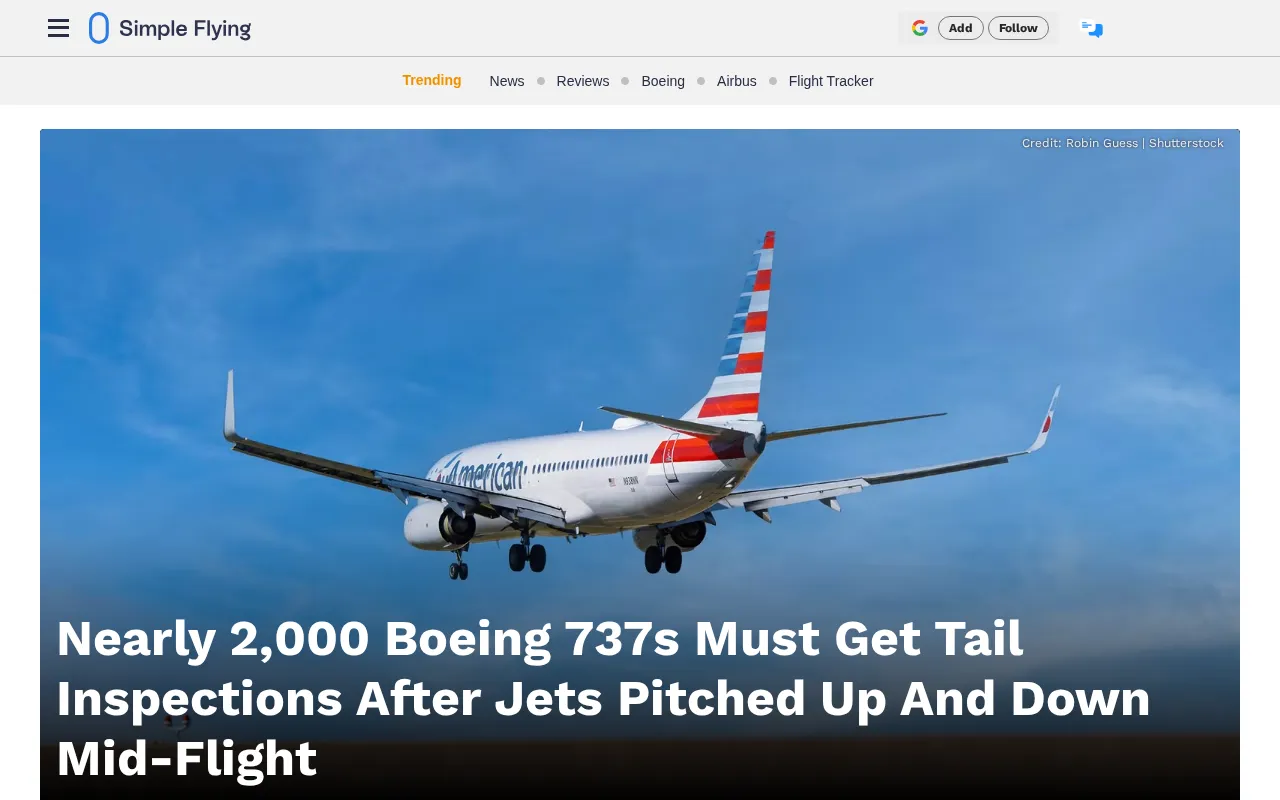
Event Overview: A Global Inspection Triggered by Flight Anomalies
According to discussions in the Hacker News community, approximately 2,000 Boeing 737 aircraft have been ordered to undergo tail inspections after multiple planes experienced abnormal pitch oscillations during flight—uncontrolled up-and-down movements of the nose. The news has drawn attention in the tech community, with discussions focusing on flight safety and the response mechanisms of airworthiness regulators.
Based on public information, after receiving multiple reports of the same type, regulatory authorities decided to issue inspection orders for specific batches of the 737 model. The inspections focus on the tail structure and related flight control components, aiming to identify systemic hazards that could lead to abnormal pitch control.
Why Tail Inspections Are So Critical
The Mechanics of Pitch Control
An aircraft's pitch attitude is controlled by elevators, which are mounted on the horizontal stabilizer. When there is play, wear, or calibration deviation in the tail structure or actuation mechanisms, the pilot's precision in controlling pitch decreases, and in severe cases, the nose may spontaneously pitch up or down.
Multiple aircraft exhibiting similar symptoms suggests the problem may not be isolated individual failures but rather a common issue pointing to a design or manufacturing flaw. This is also why regulators chose large-scale inspections rather than case-by-case handling.
Elevators and Trim Systems: Elevators are movable surfaces on the trailing edge of the horizontal stabilizer that control nose pitch by changing the direction of tail lift. When the pilot moves the control column, cables or hydraulic actuators drive the elevators to deflect. In addition, aircraft are equipped with horizontal stabilizer trim systems that can automatically or manually adjust the tail's installation angle under different speed and center-of-gravity conditions to reduce control column forces. If there is play, binding, or calibration deviation in the trim system or elevator actuation mechanisms, the pilot will feel abnormal control forces, and in severe cases the aircraft may spontaneously pitch up or down—a typical manifestation of "pitch oscillation." The 737 series uses a hybrid architecture of hydraulic-mechanical backup and fly-by-wire, so wear or misalignment of tail-related components directly alters control response characteristics.
Inspection Scope and Model Distribution
The scale of approximately 2,000 aircraft indicates that a significant proportion of the 737 fleet is affected. For airlines, this means arranging a large number of aircraft for on-ground inspections within a short period, creating direct pressure on flight scheduling and operating costs.
Airworthiness Directive (AD): When regulators (such as the U.S. FAA) identify a systemic safety hazard in a particular model, they issue an airworthiness directive mandating that all registered aircraft of that type complete inspections or modifications within a specified timeframe. ADs are legally binding; airlines must comply, or the aircraft lose their airworthiness status. The inspection of approximately 2,000 737s likely stems from the issuance of an AD. ADs typically specify the inspection scope (by serial number or production batch), inspection methods, defect criteria, and corrective actions (such as component replacement or clearance adjustment). If defects exceeding tolerance are found during inspection, they must be rectified per the AD before the aircraft can be released.
Operational Impact of On-Ground Inspections: Aircraft on Ground (AOG) means the aircraft cannot operate flights, and airlines must urgently reposition aircraft, consolidate flights, or cancel trips. For carriers with dozens of 737s, if many aircraft are grounded simultaneously, short-term capacity will drop significantly and may trigger cascading delays. The inspection itself typically takes hours to days, and longer if component replacement is needed. Additionally, maintenance resources (hangars, spare parts, licensed mechanics) may be strained in the short term, further driving up operating costs.
Impact on the Aviation Industry and Follow-Up Observations
Judging from the tone of Hacker News discussions, the community's attention to such safety events typically falls on two levels: first, whether regulatory response is timely; second, whether the manufacturer's quality control system is reliable.
For passengers, tail inspections are preventive measures designed to intercept hazards before they escalate into accidents. For airlines, short-term capacity adjustments are unavoidable, but compared to safety risks, on-ground inspections are a necessary cost.
What's worth watching going forward is the specific types of defects found during inspections and whether further airworthiness directives will follow. This will determine whether the problem is confined to the maintenance level or involves deeper design corrections.
One-line Summary
About 2,000 Boeing 737s are ordered to inspect their tails due to multiple in-flight pitch anomalies, raising concerns about flight safety and airworthiness oversight.
Paragraph Summary
Approximately 2,000 Boeing 737 aircraft have been ordered to undergo tail inspections after multiple planes experienced abnormal pitch oscillations during flight—uncontrolled up-and-down movements of the nose. After receiving multiple reports of the same type, regulatory authorities decided to issue inspection orders for specific batches, focusing on the tail structure and flight control components. Pitch control relies on elevators mounted on the horizontal stabilizer; tail hazards can reduce control precision or even cause spontaneous nose pitching. Large-scale inspections will bring grounding pressure and capacity adjustment costs to airlines, but they are preventive safety measures. Follow-up attention should be paid to the types of defects found and whether further airworthiness directives are triggered.
Related articles

Cursor AI in Practice: Weighing Efficiency Gains Against Costs in an AI IDE
An in-depth look at Cursor AI IDE's interface layout, four modes (Agent/Plan/Debug/Ask), model selection, and Git context integration, with hands-on demos weighing subscription costs against going direct to Claude.
Free Landing Page Design Rules Library: A Practical Guide for Claude Code and Cursor
A free landing page design skill for Claude Code and Cursor: MIT licensed, nearly 9,000 stars, asks about offer/audience/action before planning 12 sections with hard font and spacing constraints.

Cursor Keeps Writing Wrong Code? The Problem May Be Context, Not Prompts
Cursor keeps writing wrong code? The problem may be context, not prompts. Learn how to supply relevant files, full error messages, and expected results, plus a plan-first, small-step, test-driven workflow to reduce AI coding errors—while remembering code review remains the developer's job.