Bolcho AI: A Voice Agent Platform Built for India's Multilingual Market

Bolcho AI builds voice agents optimized for India's 22+ languages with low latency and telephony integration.
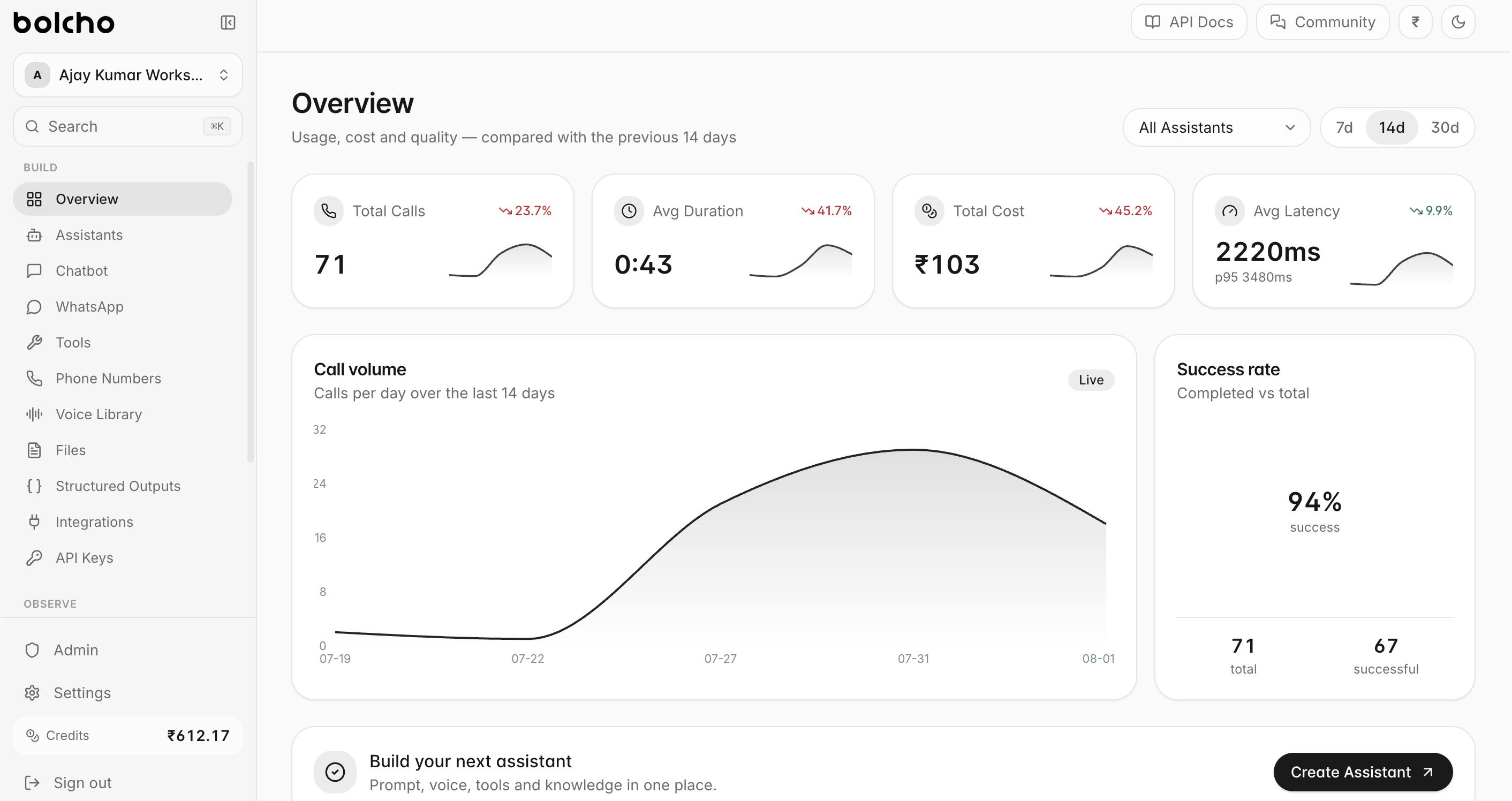
Bolcho AI is a vertical voice AI platform designed specifically for India's multilingual market. It offers native support for Indian languages like Hindi and Tamil, ultra-low latency voice response, telephony system integration, and a flexible BYO architecture for LLM, STT, and TTS providers. Targeting enterprise use cases from sales outreach to customer support, it addresses the gap left by general-purpose platforms in a market where 90% of the population doesn't use English daily.
A Voice AI Platform Built Specifically for the Indian Market
In an era of countless general-purpose voice AI platforms, Bolcho AI, a new product from Product Hunt, has chosen a differentiated path: rather than building a "one-size-fits-all" global solution, it focuses deeply on India's unique market. Its tagline — "Build Voice AI agents that actually speak India" — makes its positioning crystal clear.
The product received 84 upvotes and 8 comments on Product Hunt, ranking 8th on that day's leaderboard, categorized under Productivity, Artificial Intelligence, and Tech. Based on these numbers, it represents a solid launch for a vertical product.
Why India Needs Localized Voice AI
India is an extraordinarily linguistically diverse country, with 22 official languages and hundreds of dialects. Most general-purpose voice AI platforms are trained primarily on English and mainstream European languages, resulting in poor performance when handling local languages like Hindi, Tamil, and Bengali — low recognition accuracy, poor accent adaptation, and significant semantic understanding errors.
India's linguistic diversity is reflected not just in the number of languages but in the complexity of their linguistic characteristics. Indian languages span multiple language families including Indo-European (Hindi, Bengali), Dravidian (Tamil, Telugu), Sino-Tibetan, and Austroasiatic, with vastly different grammatical structures, phonological systems, and writing systems. Additionally, India has widespread "code-mixing" phenomena, where speakers blend local languages with English within a single sentence (such as Hinglish — a mix of Hindi and English), posing enormous challenges for traditional ASR (Automatic Speech Recognition) models. Data imbalance is another core issue: English speech datasets can reach hundreds of thousands of hours, while many Indian languages have only hundreds to thousands of hours of high-quality annotated data.
Bolcho AI targets precisely this pain point. Its key selling point is native multilingual support, enabling businesses to build phone and web AI agents that truly understand and speak Indian languages correctly. This "local-first" strategy holds significant commercial value in voice interaction scenarios, which are extremely sensitive to language nuances.
The Business Logic Behind Differentiated Positioning
For Indian domestic businesses, customers often don't communicate in English. An AI agent that only speaks standard English is virtually unusable in real-world sales, after-sales support, and appointment scheduling scenarios. By deeply optimizing for Indian languages and accents, Bolcho AI fills the gap left by general-purpose platforms — a classic opportunity window for vertical market products.
Notably, approximately 90% of India's population doesn't use English in daily life. Even among urban white-collar workers, communication with family and local service providers is typically conducted in their mother tongue. This means consumer-facing AI voice services that only support English can actually reach an extremely limited user base.
Core Capabilities: Low Latency, Telephony Integration, and Flexible Architecture
According to official information, Bolcho AI offers several key capabilities:
- Ultra-low latency voice response: Voice interaction is extremely sensitive to response speed — high latency makes conversations feel stilted. Bolcho positions low latency as a core selling point, striving to make AI conversations approach human-like experiences.
End-to-end latency in voice AI typically involves three stages: speech-to-text (STT) recognition time, large language model inference time, and text-to-speech (TTS) synthesis time. In phone scenarios, if total latency exceeds 800 milliseconds, users noticeably perceive a "pause," and beyond 1.5 seconds, conversational naturalness is severely impacted. Key technical approaches to achieving low latency include: streaming ASR, speculative decoding and first-token optimization for LLMs, incremental TTS synthesis, and deploying inference nodes at edge data centers close to users. For the Indian market, server geographic deployment and network latency optimization are particularly important, as India's mobile network quality varies significantly across regions — the 4G/5G experience in tier-1 cities can differ by several multiples from that in tier-3/4 cities or rural areas.
- Telephony Integration: Beyond web-based voice agents, it can directly interface with phone systems, allowing businesses to deploy AI for handling inbound calls and outbound campaigns.
Telephony integration involves interfacing with SIP (Session Initiation Protocol), interconnection with PSTN (Public Switched Telephone Network), and compatibility with existing enterprise PBX systems or cloud communications platforms. In the Indian market, phone calls remain the primary customer service channel — according to industry data, over 60% of customer service interactions in India occur via phone rather than online chat or email. This means AI voice agents must be able to handle real phone calls directly, not just serve as web-based voice assistants. Indian domestic cloud communications providers like Exotel, Knowlarity, and Ozonetel have already established relatively mature telephony infrastructure, providing the underlying support for voice AI phone integration.
- Bring Your Own (BYO) model flexibility: Bolcho allows enterprises to plug in their preferred LLM, STT, and TTS service providers. This open architecture avoids platform lock-in, letting businesses freely combine their tech stack based on cost and performance.
BYO (Bring Your Own) architecture is an important trend in current AI infrastructure products. In voice AI, a complete tech stack typically involves three layers: STT (e.g., Google Speech-to-Text, Deepgram, AssemblyAI), LLM (e.g., GPT-4, Claude, Llama), and TTS (e.g., ElevenLabs, PlayHT, Azure TTS). If a platform forces binding to a single vendor, enterprises face risks of uncontrollable costs and technical path dependency. BYO architecture lets businesses flexibly choose optimal combinations based on recognition performance for different languages, inference requirements for different scenarios, and budget constraints. For example, one TTS provider might excel in Tamil while another performs better in Hindi — BYO architecture allows enterprises to select different providers for different languages, achieving optimal balance between performance and cost.
This "platform + pluggable components" design philosophy both lowers the technical barrier for enterprises and preserves ample customization space, representing the mainstream architectural direction for current voice AI infrastructure products.
Typical Use Cases: From Sales Outreach to Customer Service
Bolcho AI positions itself as a "production-ready" voice agent, with officials emphasizing deployment in minutes. Its core business scenarios include:
- Sales outreach: Automated phone sales and lead follow-up
- Customer support: Handling common inquiries and after-sales issues
- Appointment management: Helping clinics, service agencies, etc. complete phone scheduling
- Customer engagement: Routine customer outreach and relationship maintenance
For India's vast number of SMEs and service-oriented industries, AI agents capable of natural conversation in local languages could significantly reduce labor costs and improve service response efficiency. India's BPO (Business Process Outsourcing) and call center industry is among the world's largest, employing millions of people with average monthly salaries of approximately 15,000-25,000 rupees (roughly $180-$300 USD). Even in this relatively low-cost labor market, facing ever-growing customer service volumes and 24/7 response demands, AI voice agents still offer significant cost advantages — especially when handling highly standardized, repetitive calls.
Industry Trend: Vertical Localization as the New Voice AI Battleground
Bolcho AI's emergence reflects the voice AI sector's evolution from a "general capability race" toward a new phase of "regional and linguistic deep specialization." As underlying LLM, STT, and TTS technologies mature and become commoditized, true competitive moats often come from deep understanding of specific markets — including language, accents, cultural habits, and even local telecommunications infrastructure integration.
As one of the world's fastest-growing digital economies, India has massive voice interaction demand and an underserved localization market. India currently has over 800 million internet users, but a significant proportion are "voice-first" users — they prefer interacting with digital services through voice rather than text. The fundamental reason is that India's literacy rate (approximately 77%) and English proficiency (only about 10% of the population can fluently use English) limit the reach of text-only interfaces. The Indian government's "Digital India" strategy has aggressively promoted mobile internet adoption, with carriers like Jio offering extremely low data rates (under $0.20 per GB) that have brought hundreds of millions of users online — but most of these new users rely more heavily on voice interaction. India's conversational AI market is estimated to reach $4 billion by 2028, with voice AI occupying a significant share. This provides vast growth potential for vertical products like Bolcho.
Regarding the competitive landscape, global giants like Google, Amazon (Alexa), and Microsoft have invested in Indian languages, but their products primarily target the consumer end or serve as general APIs, lacking end-to-end solutions for enterprise phone scenarios. Indian domestic competitors like Sarvam AI and Bhashini (a government project) are also building Indian language AI infrastructure, but with different focal points. Bolcho AI's choice to focus on the specific category of enterprise voice agents positions it to establish first-mover advantage in this niche market.
Of course, whether the product can truly deliver on its promises of "native multilingual" and "ultra-low latency" still needs to be validated through real-world scaled deployments.
Summary
Bolcho AI is a clearly positioned vertical voice AI platform whose core competitive advantage lies in targeted optimization for India's multilingual market, complemented by ultra-low latency response, telephony integration, and flexible model connectivity. In localized scenarios that general-purpose voice AI platforms struggle to cover, it provides a pragmatic and rapidly deployable solution. For practitioners focused on voice AI commercialization and regional market opportunities, this type of "local-first" product deserves continued attention.
Related articles

Build an AI Daily News Digest with n8n: Beat Information Overload in 20 Seconds
A YouTube creator built an AI morning news digest with n8n: RSS fetches Reuters headlines, AI strips clickbait and summarizes, Supabase archives each article, and Telegram delivers the brief — all in 20 seconds.

Building an AI Content Engine with n8n: Fully Automated Facebook Page Management in Practice
One creator used open-source n8n to build an AI content engine that fully automates a Facebook page — topic selection, writing, images, review, and publishing — resulting in 238 posts published.

Zapier vs. Make vs. n8n: Building the Same AI Workflow Three Times — All Three Failed
A head-to-head test of Zapier, Make, and n8n using the same AI lead classification workflow — all three failed. Deep dive into build time, speed, pricing, and silent failure traps to help you choose the right AI automation platform.