Bonsai 2 27B: Exploring Near-Lossless Model Compression at 9x Smaller Footprint
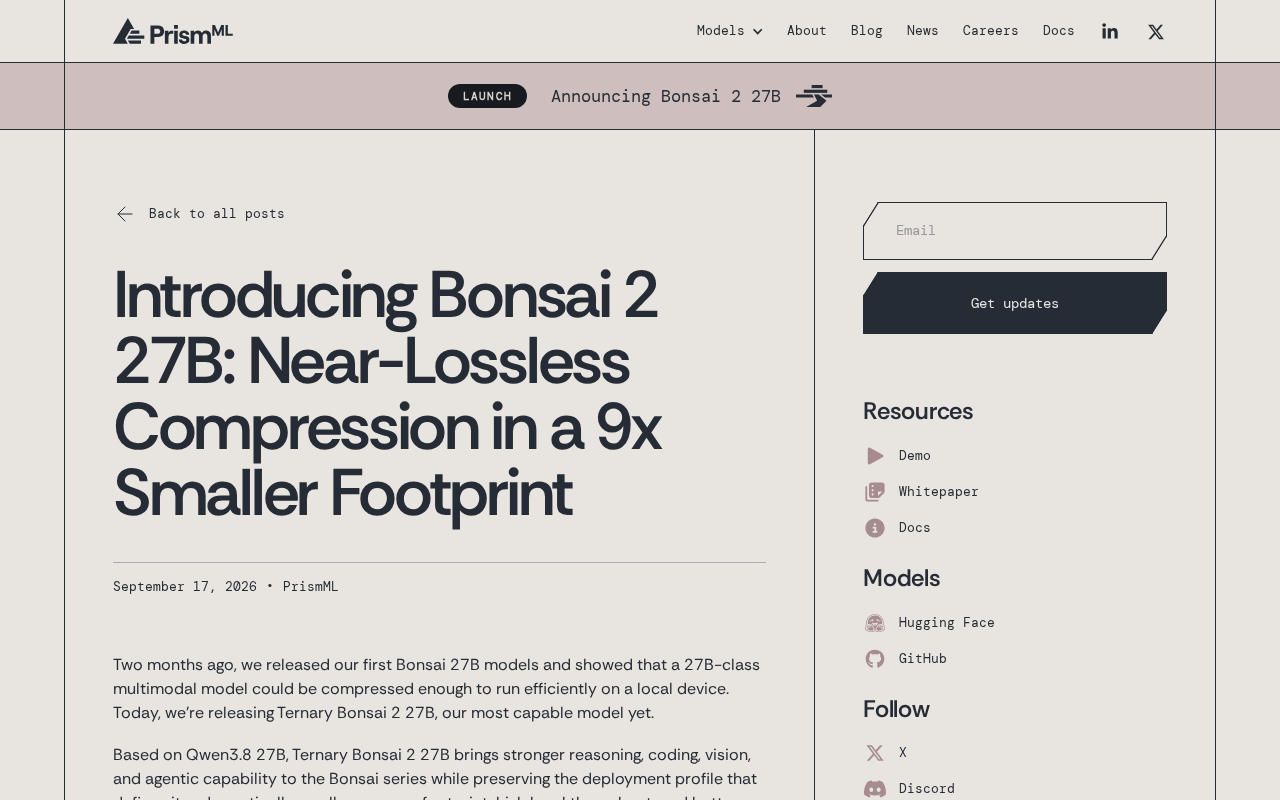
Bonsai 2 27B claims near-lossless 9x compression of a 27B model, but independent verification is still pending.
Bonsai 2 27B is a model compression project claiming to reduce a 27B-parameter model to roughly 11% of its original footprint — a 9x reduction — with near-lossless capability retention. Achieving this compression ratio typically requires combining ultra-low-bit quantization (below 4-bit), weight pruning, and distillation, each of which poses accuracy challenges. The article notes that "near-lossless" is a multidimensional claim: perplexity, downstream task accuracy, and long-context performance often degrade differently. Smaller size also doesn't guarantee faster inference if dequantization overhead is high. The project drew moderate attention on Hacker News, but the community remains cautiously skeptical. With public information still limited to high-level claims and lacking full evaluation data or a reproducible pipeline, its actual value awaits independent verification.
What Problem Bonsai 2 27B Is Trying to Solve
Deployment cost has long been a core bottleneck for production AI systems. A model at the 27-billion-parameter scale typically demands tens of gigabytes of VRAM and storage at native precision — a barrier that effectively locks out many small-to-mid-sized teams and edge deployment scenarios. The central claim of the Bonsai 2 27B project is to compress a model of this scale to roughly one-ninth of its original footprint while keeping capability loss nearly negligible.
The project name itself signals its intent: "Bonsai" evokes the art of miniaturizing a full-grown tree into a compact form — a fitting metaphor for model compression. Its headline keywords, "Near-Lossless Compression" and "9x Smaller Footprint," form the most direct value proposition.
What 9x Compression Actually Means
A 9x compression ratio means the model's storage and memory footprint is reduced to approximately 11% of its original size. For a 27B-scale model, if this can genuinely be achieved with near-zero capability loss, the engineering implications are substantial.
From a technical standpoint, achieving this level of compression typically requires combining several techniques: ultra-low-bit quantization (4-bit or lower), weight pruning, and potentially knowledge distillation or structured compression. Standard 8-bit quantization only delivers roughly a 2x reduction. To reach 9x, engineers typically need to invest heavily in mixed-precision strategies, outlier handling, and group-wise quantization to keep accuracy degradation within acceptable bounds.
"Near-lossless" is a phrase that warrants careful scrutiny. In practice, whether a compressed model is truly lossless depends heavily on how you measure it — perplexity, downstream task accuracy, and long-context performance often degrade to varying degrees. A model that looks nearly intact on standard benchmarks may exhibit significant drift on edge cases or specific task types.
Background: Why 9x Compression Is Technically Challenging
Quantization is currently one of the most widely adopted model compression techniques. Frameworks like GPTQ, AWQ, and GGUF work by compressing model weights from 32-bit or 16-bit floating point down to 4-bit or even 2-bit integer representations. In theory, going from 16-bit to 4-bit only yields a 4x reduction. Achieving 9x implies an average bit-width of roughly 1.7 bits, or that quantization is paired with structural pruning — outright removing attention heads, neurons, or entire Transformer layers. Aggressive compression of this kind poses far greater accuracy challenges than mild 8-bit quantization, because low-bit representations significantly amplify the impact of outlier weights. Established solutions to this problem include SmoothQuant (redistributing quantization difficulty) and SpQR (preserving high precision selectively for outliers) — both require non-trivial engineering, and they're worth examining closely when evaluating the technical depth of Bonsai 2 27B.
Community Interest and Healthy Skepticism
The project received 32 upvotes and 9 comments on Hacker News — enough to generate moderate attention, but not yet a breakout discussion. This level of engagement reflects the developer community's sustained interest in model compression as a field, while also suggesting that individual projects in this space face a high bar to stand out.
The technical community typically approaches claims like "near-lossless" with rational skepticism. The real value of any compression scheme usually comes down to: whether full evaluation methodology and comparison baselines are publicly disclosed, whether a diverse enough set of tasks is covered, and whether inference speed improves alongside the reduced size. A smaller model doesn't automatically mean faster inference — if decompression or dequantization overhead is significant, real-world throughput may not improve meaningfully.
Background: Why Perplexity Alone Isn't Enough
Perplexity (PPL) is the most commonly used metric for measuring compression-induced degradation. It reflects a model's prediction uncertainty on test text — lower is better. However, the field has accumulated substantial evidence that models with strong perplexity scores post-compression can still show meaningful degradation on code generation, mathematical reasoning, and instruction-following tasks. This is because perplexity primarily captures next-token prediction distribution, which has limited correlation with tasks requiring multi-step reasoning or structured output. A credible compression evaluation should therefore include benchmarks spanning multiple capability dimensions — MMLU (multidisciplinary knowledge), HumanEval (code), GSM8K (math) — with strict comparisons against the original model under identical inference configurations, not just a single perplexity number.
Implications for Developers and Industry
If Bonsai 2 27B's compression results hold up under independent verification, the real-world value would manifest on several levels. For individual developers, bringing a 27B model into the range of consumer-grade GPUs meaningfully lowers the barrier to experimentation. For enterprises, reductions in storage and VRAM costs directly affect deployment density and operational expenses.
More broadly, this project reflects an important trend in today's AI landscape: alongside the race for ever-larger models, there's a parallel effort to make existing capabilities land more efficiently. Compression, quantization, and distillation are transitioning from academic research into engineering standards. Whoever finds the best balance between capability retention and resource savings will hold a genuine advantage in real-world deployment.
What to Watch When Evaluating This Project
For readers tracking this project, here are the key angles worth examining: How large is the performance gap between the compressed model and the original on public benchmarks like MMLU and GSM8K? How does compression affect inference latency and throughput? And does the project provide a reproducible compression pipeline and toolchain?
At present, publicly available information remains largely limited to top-level claims. Determining whether Bonsai 2 27B has genuinely achieved near-lossless compression will require more detailed technical documentation, evaluation data, and independent community reproduction. Until that evidence emerges, it's best treated as a promising technical exploration worth tracking — not a concluded result.
Related articles
Bend Programming Language: Using Forma…
Bend Programming Language: Using Formal Proofs to Catch AI Bugs and Running Natively on GPUs
Bend is a programming language generating buzz on Hacker News. It uses formal proofs to catch AI-generated code errors and runs natively on GPUs for automatic parallelism.

How Uber Defends Against Retry Storms: Fault-Tolerant Design in Distributed Systems
How does Uber defend against retry storms? This article breaks down retry traffic amplification in distributed systems and explores retry budgets, circuit breakers, exponential backoff, and jitter.
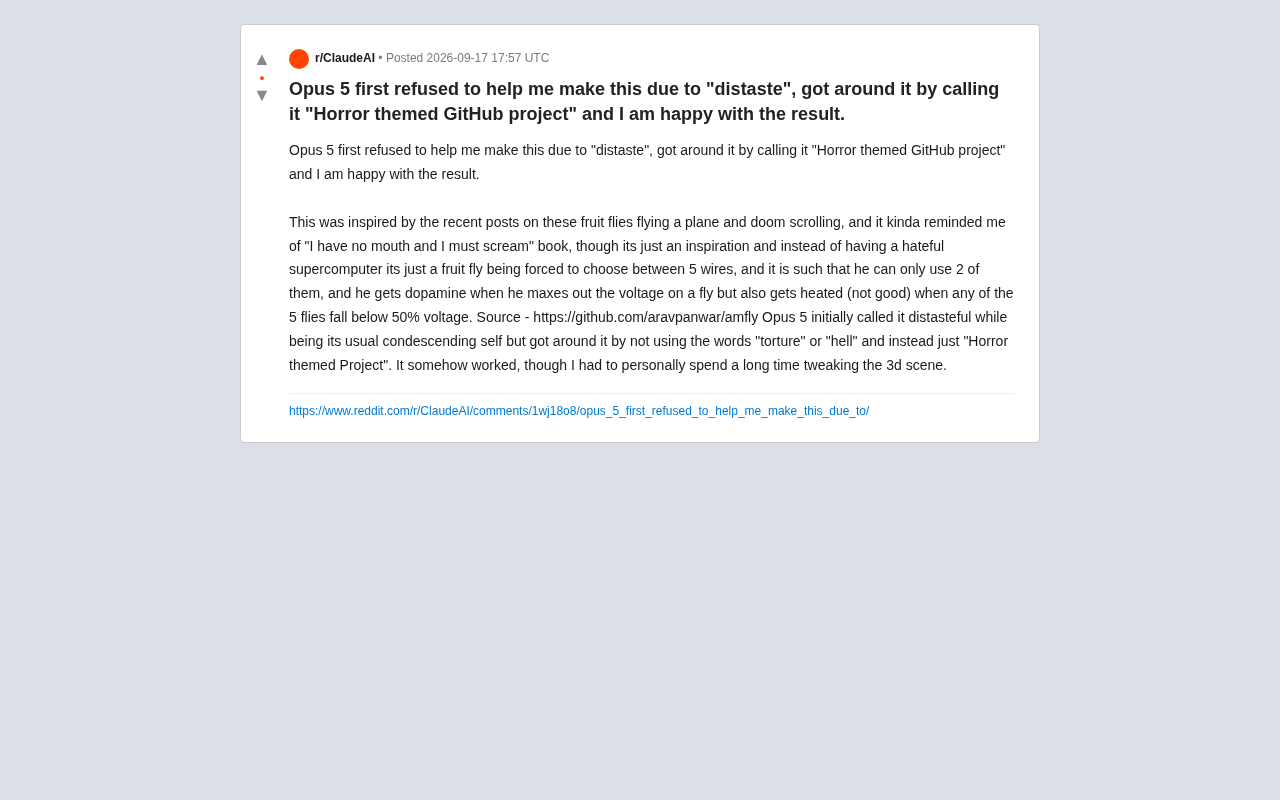
Opus 5's Ethical Boundaries: From Refusal to "Horror-Themed Project" — An Accidental Jailbreak Experiment
A developer bypassed Claude Opus 5's refusal by renaming a fruit fly simulation a "horror-themed project." Explore what this reveals about LLM content moderation and AI alignment.