BRCKS Chat: A Dedicated Chat Tool for Construction Sites That Keeps Project Information From Getting Lost

BRCKS Chat integrates construction communication, tasks, and a client portal with a "one chat room per project" approach, focusing on lightweight collaboration.
BRCKS Chat is a construction industry collaboration tool ranked #19 on Product Hunt. Its core design is "one chat room per project," centralizing communication among the construction team, subcontractors, and clients to prevent information from being scattered across WhatsApp, email, and phone calls. Differentiated features include automatic conversion of photos into trackable snag tasks, messages as project archives, and a pricing model where subcontractors and clients use it free while the general contractor pays. It also includes a client portal, video meetings, and bookings, positioning as a lightweight construction collaboration entry point—currently early-stage and UK-focused.
The construction industry has long struggled with fragmented information: foremen send instructions via WhatsApp, contractors email drawings, owners call in changes, and ultimately all communication records end up scattered everywhere—leaving nothing to point to when disputes arise. BRCKS Chat, a new product ranked #19 on Product Hunt, attempts to solve this pain point with a "one chat room per project" approach, integrating instant messaging, task management, video meetings, and a client portal into a single interface.
Core Design: Chat as the Project Hub
The basic unit of BRCKS Chat isn't a contact list but rather "one chat per job." Each project automatically generates its own conversation, with participants from three sides: the construction team, subcontractors, and the client. All messages, photos, files, and meeting records are archived under that project, forming a traceable record chain.
This design shifts communication from "person to person" to "project to project," preventing information from being lost in private chats. The official tagline "Nothing gets lost" speaks directly to the industry pain point—in traditional tools, a critical instruction can get buried among dozens of irrelevant group chats.
Photos Become Tasks, Messages Become Evidence
The product's most differentiated feature is "Photos become snags." When workers photograph a defect or to-do item on site, the photo is automatically converted into a trackable task entry rather than merely existing as an image in the chat stream. Messages themselves are also given record attributes, becoming part of the project archive.
For the rework disputes and schedule conflicts common in construction, this structured record has real value: who requested what and when is all documented.
Snag is a professional term in the construction industry referring to defects or unfinished items discovered during construction that need to be rectified. Traditionally, the snagging process relies on paper checklists or spreadsheets, where inspectors manually record items and then assign them to responsible parties one by one—a low-efficiency process prone to omissions. By converting photos directly into snag entries, BRCKS Chat essentially compresses the "discover—record—assign—track" loop into a single photo-taking action, letting frontline workers complete defect management without leaving the chat interface. This is precisely what distinguishes it from general-purpose communication tools.
Who Uses It: Free for Subcontractors and Clients
BRCKS Chat's pricing strategy is noteworthy: subcontractors (subs) and clients use it for free. This means the general contractor or main construction party pays to set up the project, while peripheral participants join at zero cost.
This model lowers the collaboration barrier—construction projects typically involve many temporary subcontractors, and requiring everyone to pay for a subscription isn't realistic. Offering free access to peripheral roles helps rapidly build network effects. The company describes the product as "Built by builders, for UK sites," with a clear positioning toward the UK construction market.
Built-in Client Portal and Video Meetings
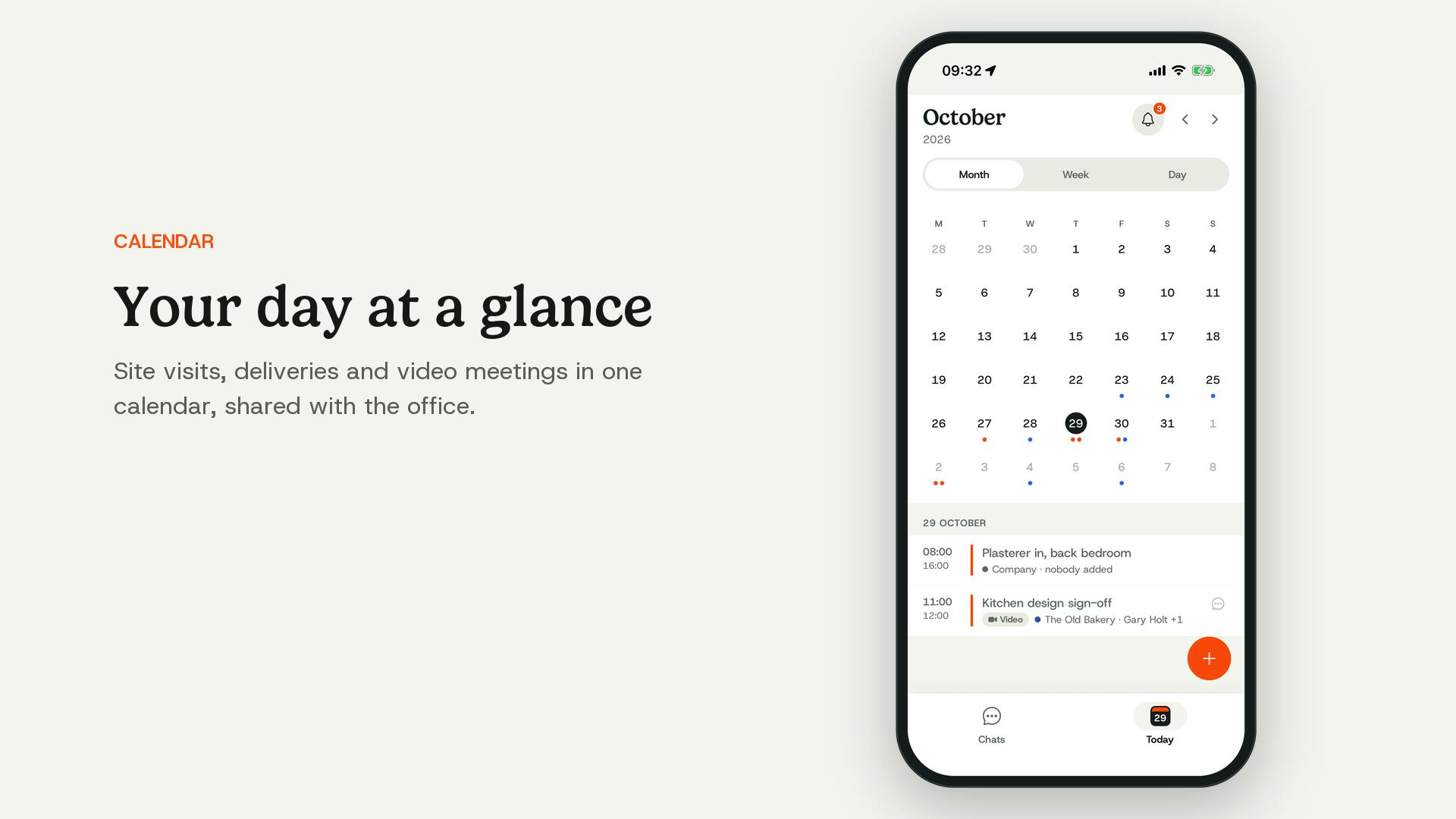
Beyond chat, BRCKS Chat also includes bookings, video meetings, and a client portal. Clients can view project progress through the portal without installing additional software. Video meeting functionality reduces the need for site visits, which is particularly useful for projects spanning multiple locations.
Network effects refer to the phenomenon where a product's value increases as the number of users grows. In construction collaboration scenarios, a single project involves the general contractor, multiple subcontractors, material suppliers, and the owner. If all parties were required to pay for subscriptions, the collaboration barrier would be extremely high, easily leading to some roles being absent and information chains breaking. By letting subcontractors and clients join for free while the general contractor pays to establish the project, BRCKS Chat essentially uses a "single-side payment, multi-side free" approach to rapidly expand the participation network—the more participants, the more complete the project records, and the stronger the general contractor's willingness to pay, creating a positive cycle. This model is common among platform-type products in SaaS, but remains a differentiated strategy in the construction industry.
A client portal is a permission-controlled online entry point that allows owners or clients to view project progress, documents, and communication records without installing professional software. In construction, owners are typically unfamiliar with project management tools and unwilling to purchase subscriptions for temporary projects, making the portal's "zero-install, low-barrier" characteristics particularly critical. It also addresses information transparency: owners can check progress on their own, reducing phone inquiries to the general contractor, while all viewing and interaction records are captured in the project archive, further reinforcing the "Nothing gets lost" product proposition.
Market Positioning and Challenges
BRCKS Chat falls into three categories—Messaging, SaaS, and Construction—and faces dual competition from general-purpose tools (like WhatsApp and Slack) and specialized construction management software (like Procore and Buildertrend).
Its advantage lies in being lightweight: no complex configuration required, chat as the entry point, and low learning curve. But this also means its feature depth may not match professional project management platforms, and whether it's suitable for large, complex projects remains to be verified.
With 68 votes and 2 comments on Product Hunt, the data indicates the product is still at an early stage. Maker James Shorter's construction industry background is an important credibility endorsement, but whether it can expand from the UK market globally depends on the product's ability to adapt to local building codes and workflows.
Key Takeaways
The construction industry's digitalization doesn't lack tools—it lacks tools that frontline workers are willing to use. BRCKS Chat chose chat as its entry point, aligning with actual site communication habits, and designs like "photos become tasks" and "free for subcontractors" demonstrate an understanding of industry workflows. For small and medium-sized construction projects, this type of lightweight solution may be more feasible than heavyweight management software.
One-line Summary
BRCKS Chat integrates construction communication, tasks, and a client portal with a "one chat room per project" approach, focusing on lightweight collaboration.
Paragraph Summary
BRCKS Chat is a construction industry collaboration tool ranked #19 on Product Hunt. Its core design is "one chat room per project," centralizing communication among the construction team, subcontractors, and clients to prevent information from being scattered across WhatsApp, email, and phone calls. Its differentiated features include automatic conversion of photos into trackable defect tasks (snags), with message records becoming project archives that provide evidence in disputes. On pricing, subcontractors and clients use it for free while the general contractor pays, lowering the collaboration barrier and creating network effects. The product also includes a built-in client portal, video meetings, and booking functionality, positioning itself as a lightweight construction collaboration entry point. Currently at an early stage and primarily targeting the UK market, it faces dual competition from general-purpose tools and professional project management platforms, with feature depth yet to be validated.
Related articles

Codex App Complete Guide: From Installation to Hands-On Practice — AI Automatically Organizes Files and Builds Reports
Codex App complete guide: install from the app store, configure everyday work mode, and use real coffee shop data to practice file organization, Excel reports, and visual dashboards. Learn Plan Mode and the little pet feature — master Codex's AI automation workflow in one episode.

Getting Started with Langfuse: Building a Financial Analysis Agent and Evaluation Platform
A Langfuse tutorial: explore the core capabilities and boundaries of this open-source AI Engineer platform, and learn how to build an enterprise-grade log tracing, evaluation, and observability platform for a Harness-architecture financial analysis multi-agent system, covering prompt management, token cost analysis, and integration with frameworks like LangChain.

AI Agents Under Attack: Cursor Backdoor and the Binance Heist
This week in AI security: a Claude code backdoor in Cursor Marketplace, Binance's $6.3B laptop breach, VaporPanda's AI agent attacks on 200+ orgs, Gitbook and Chainalysis breaches, Polymarket's $2.7M loss, and Claude writing a root exploit in 53 minutes. Learn the latest AI agent attack trends and security recommendations.