Breaking Down the Technical Logic Behind Nissan's Third-Generation e-POWER Powertrain

Nissan's third-gen e-POWER refines its series hybrid approach with better thermal efficiency, highway performance, and integration.
Nissan's e-POWER is a series hybrid system in which the combustion engine serves solely as a generator while all propulsion comes from an electric motor, delivering an EV-like experience without requiring external charging. The third generation focuses on three areas: raising engine thermal efficiency to cut fuel consumption, reducing the efficiency losses from multi-stage energy conversion at highway speeds, and tightening system integration to manage costs. Its market appeal lies in offering electric drive feel and convenience for users in regions where charging infrastructure is still limited. Whether engineering solutions can fully overcome the inherent losses of serial energy conversion remains to be confirmed by real-world production data.
What Is e-POWER
Nissan's e-POWER is a distinctive hybrid solution that differs fundamentally in architecture from mainstream hybrid systems like those from Toyota and Honda. In the e-POWER system, the combustion engine does not drive the wheels directly — it functions solely as a generator. The engine generates electricity, that electricity powers an electric motor, and the motor drives the wheels. In other words, this is a series hybrid architecture, and the driving experience feels much closer to a battery electric vehicle, with no need for external charging.
The core philosophy behind this design is straightforward: keep the engine running at its most efficient RPM range at all times, converting chemical energy into electrical energy as efficiently as possible. This enables better fuel economy in urban driving conditions compared to conventional combustion vehicles, along with smoother power delivery.
The series hybrid architecture differs significantly from the parallel/series-parallel architecture represented by Toyota's THS (Toyota Hybrid System). Toyota's THS uses a planetary gear set to couple the engine and motor, allowing the engine to simultaneously generate electricity and drive the wheels, with the system dynamically distributing power flow based on driving conditions. Honda's i-MMD similarly allows the engine to engage directly via a clutch at higher speeds. By contrast, e-POWER has no mechanical connection whatsoever between the engine and the wheels — a characteristic that makes its control logic closer to an extended-range electric vehicle (EREV) than to a conventional "gasoline-electric hybrid." The direct consequence of this architecture is that throttle response is entirely determined by the electric motor. The driver is virtually unaware of any changes in engine RPM, and NVH performance (noise, vibration, and harshness) is theoretically easier to tune. That said, the engine can sometimes start abruptly while the vehicle is stationary in order to generate power, and if sound insulation is inadequate, this can create a jarring noise experience.
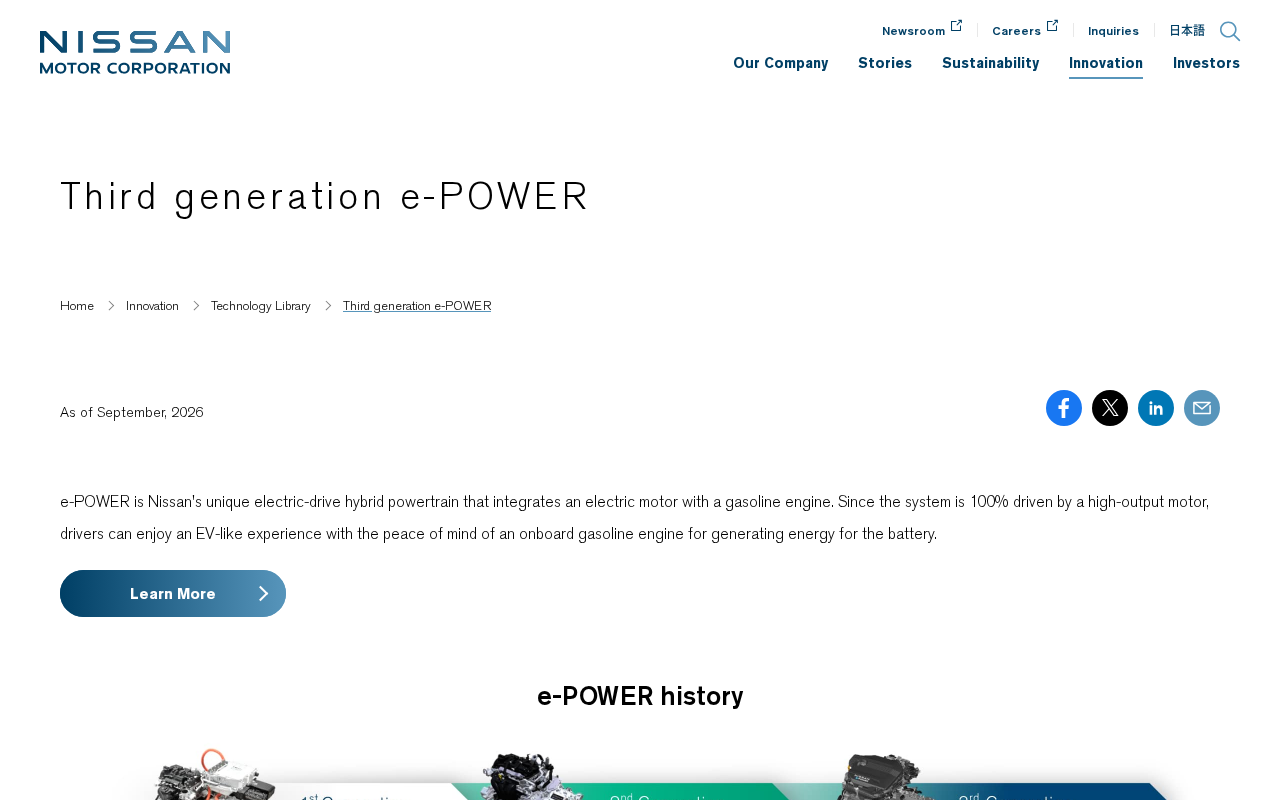
Evolution of the Third-Generation e-POWER
From the first generation through the third, Nissan's optimization efforts for e-POWER have centered on several dimensions: power generation efficiency, system integration, cost control, and fuel economy at highway speeds.
Improving Thermal Efficiency
One of the major challenges with a series hybrid is that energy undergoes multiple conversions — mechanical to electrical to mechanical — each introducing losses. In the latest generation, Nissan's primary focus has been on pushing the thermal efficiency of the dedicated generator engine further, keeping it in a highly efficient power-generation state across a broader range of operating conditions. Improvements in thermal efficiency directly determine real-world fuel consumption for the entire system.
Thermal efficiency measures what proportion of a fuel's chemical energy is converted into usable mechanical work. Conventional naturally aspirated engines typically achieve thermal efficiency in the range of 35–38%, while the engine Nissan has specifically optimized for e-POWER reportedly targets a thermal efficiency exceeding 50%. Key technologies enabling this include the Atkinson Cycle or Miller Cycle — which delay intake valve closure to increase the expansion ratio and extract more work from each combustion event — along with exhaust gas recirculation (EGR) and variable compression ratio (VCR) systems. Because the e-POWER engine never needs to respond to transient demands like hard acceleration, it can be "locked" into its most efficient RPM and load range for continuous operation. This is the natural advantage that a series architecture holds over parallel architectures when it comes to optimizing engine thermal efficiency — it allows engineers to optimize combustion around a single operating point rather than across the full range of conditions.
Improving High-Speed Performance
One of the longstanding criticisms of e-POWER has been its relatively poor efficiency at highway cruising speeds compared to parallel hybrids. At high speeds, all-electric drive combined with the accumulated losses from multiple energy conversions doesn't necessarily beat direct engine drive in terms of fuel economy. The third-generation system addresses this through a redesigned motor, inverter, and energy management strategy, aiming to narrow or even close this gap.
The efficiency disadvantage of series hybrids at high speeds comes from two compounding factors. First, electric motor efficiency decreases somewhat during high-speed, high-power output. Second, energy passes through a multi-stage conversion chain — fuel → engine mechanical energy → generator electrical energy → inverter → motor → wheels — with each stage introducing conversion losses of roughly 5–10%. Cumulatively, under sustained high-speed conditions, this can result in lower overall efficiency than direct engine drive. Some competitors, such as Honda's i-MMD, introduced a high-speed direct-drive clutch specifically to work around this problem. Nissan's decision to stick with a pure series layout rather than adding a direct-drive path means its solution must rely on more efficient inverters (silicon carbide, or SiC, power devices are the industry direction), lower-loss motor winding designs, and more sophisticated energy management algorithms to compress conversion losses without changing the underlying architecture.
System Integration and Cost
More tightly integrating the engine, generator, inverter, and drive motor not only reduces weight and saves space — it also helps lower manufacturing costs. For Nissan, which aims to scale this technology globally, cost competitiveness is a decisive factor in whether e-POWER can achieve mass-market adoption.
Market Positioning of e-POWER
The value proposition of e-POWER is clear: for drivers who aren't yet ready for, or don't have convenient access to, battery electric vehicles, it offers a driving experience close to that of an EV while relying entirely on gasoline. No charging infrastructure is required, range anxiety is absent, and the driver still gets the quiet, instantaneous torque response characteristic of electric drive.
In markets where charging infrastructure remains underdeveloped, this kind of "plug-free electric drive" technology holds genuine practical appeal. It can be understood as a technological bridge between the era of combustion engines and the era of pure electric vehicles.
Technical Trade-offs Worth Noting
Series hybrids are not without their critics. Detractors argue that multiple energy conversions inherently introduce additional losses, and that under certain conditions this approach may not outperform simpler alternatives. Supporters counter that by freeing the engine from the constraint of direct propulsion, it can be purpose-built as a dedicated power generator — allowing the overall system to achieve higher efficiency at the system level.
Whether third-generation e-POWER can deliver on its efficiency promises under real-world driving conditions ultimately depends on measured data from production vehicles. The merits of any powertrain architecture often come down to the specifics of engineering execution and the use cases of the target market — not just an abstract debate over system topology.
Summary
Nissan's third-generation e-POWER continues down the distinctive series hybrid path, with meaningful improvements in thermal efficiency, high-speed fuel economy, and system integration. As a "fill up and go" electric drive solution, it retains a clear rationale at a time when the transition to full electrification remains incomplete. For readers tracking the evolution of hybrid technology, this generation is an important data point in assessing whether series hybrids can reach genuine maturity.
Note: This article is based on publicly available information. For specific efficiency figures, production timelines, and vehicle model availability, please refer to official Nissan announcements.
Related articles

RAG Getting Started in Practice: From Principles to Building an Enterprise Knowledge Base
Bilibili RAG course highlights: from retrieval-augmented generation principles, document chunking and vectorization, to five accuracy factors and enterprise knowledge base boundaries, with fine-tuning vs RAG selection advice.

AI Model Selection Guide: DeepSeek vs. Qwen3 in Practice
How should AI developers choose models? Based on a Bilibili tutorial, this article breaks down the Function Calling differences between DeepSeek V3 and R1, Qwen3's programmatic thinking mode switching and agent capabilities, and outlines a multi-model learning path and practical selection logic.

Anchoring, Loss Aversion, and Nudges: 5 Psychological Tactics Retailers Use to Make You Spend
Behavioral economics reveals how retailers use anchoring, framing, loss aversion, and nudge theory to manipulate your spending decisions. This article breaks down 5 common psychological tactics and offers counterstrategies like slowing down decisions and setting your own anchors to see through the pricing design behind discounts.