Brockman Dodges Key Questions on the Stand as Personal Diary Becomes Musk's Strongest Evidence Against OpenAI
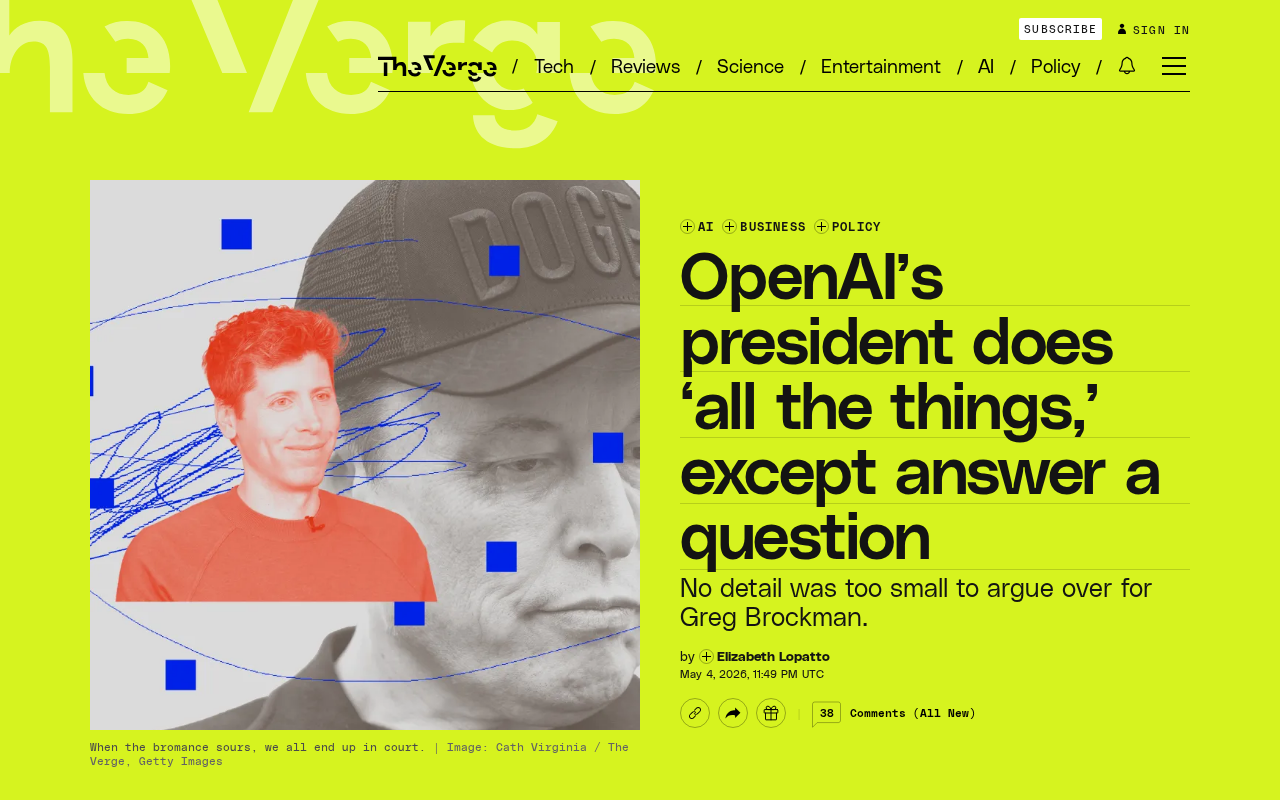
Brockman's personal diary becomes Musk's strongest evidence in lawsuit against OpenAI's nonprofit-to-profit conversion.
In Musk v. OpenAI, co-founder Greg Brockman's personal diary has emerged as the most powerful evidence to date, documenting internal deliberations during OpenAI's transition from nonprofit to for-profit status. Called as a hostile witness, Brockman employed evasive tactics on the stand. The case centers on whether OpenAI betrayed its founding mission to benefit humanity, and the verdict will set important legal precedents for AI industry governance.
Musk v. OpenAI: Why Brockman's Diary Has Become the Strongest Evidence
In Elon Musk's lawsuit against OpenAI, an unexpected figure has emerged as the most powerful witness so far — not an outside expert, but OpenAI co-founder and president Greg Brockman, along with his personal diary.
Brockman was called to the witness stand in a rather unusual manner: he underwent cross-examination first, followed by direct examination. In U.S. civil litigation, witness testimony typically follows a fixed procedure: the party that called the witness conducts "direct examination" first, using open-ended questions to elicit facts favorable to their case; then opposing counsel conducts "cross-examination," using closed and leading questions to challenge the witness's credibility. Brockman's situation was unusual because, as a core figure at OpenAI, he was called as a "hostile witness" by Musk's side, meaning Musk's attorneys conducted cross-examination-style questioning first. This procedural arrangement indicates that the calling party believed that while the witness's loyalties lie with the opposition, the information he possesses — in this case, the diary entries — provides critical support for their arguments. This unusual procedural arrangement itself hints at the complexity and drama of the case.
Brockman's Personal Diary: A First-Hand Account of OpenAI's Transformation
In legal proceedings, a party's private records often carry extremely high evidentiary value because they document genuine thoughts at the time, rather than after-the-fact justifications. Under evidence law, personal diaries fall within the category of "contemporaneous records," whose evidentiary weight typically exceeds that of retrospective statements. This is because diaries capture the author's genuine perceptions and emotional state at the time events occurred, unaffected by subsequent developments or memory distortion. Under the U.S. Federal Rules of Evidence, diaries can be admitted as exceptions to the hearsay rule under "present sense impression" (Rule 803(1)) or "then-existing mental, emotional, or physical condition" (Rule 803(3)).
Brockman's diary has been described as Musk's side's "strongest witness to date," suggesting the diary likely contains critical information related to OpenAI's transition from a nonprofit organization to a for-profit entity. The diary is considered the "strongest evidence" precisely because it may document internal discussions during OpenAI's transformation decision-making process, personal doubts, and even strategic considerations that contradict Musk's founding commitments — content that would be difficult to reinterpret or deny after the fact.
To understand why these diaries are so critical, we need to trace back to OpenAI's founding. OpenAI was co-founded in 2015 by Musk, Brockman, Sam Altman, and others, initially registered as a 501(c)(3) nonprofit organization with an explicit mission to "ensure that artificial general intelligence (AGI) benefits all of humanity." At founding, Musk and other donors collectively pledged approximately $1 billion in funding. OpenAI's early core commitments included open-sourcing research, operating without profit motives, and prioritizing safety in AGI development. However, in 2019, OpenAI created a "capped-profit" subsidiary, OpenAI LP, where investor returns were limited to 100x their investment. Between 2023 and 2024, OpenAI further pushed toward full conversion to a for-profit company (Public Benefit Corporation). This series of structural changes is at the heart of Musk's lawsuit.
Musk's core argument against OpenAI is that the organization has abandoned its original mission as a nonprofit dedicated to open-source development and benefiting all of humanity, instead pursuing commercial profits. Brockman's diary, as a contemporaneous first-hand record, may provide direct corroboration of this argument from an insider's perspective.
"High School Debate Club" Tactics on the Stand: Evasion Instead of Answers
Brockman's performance on the witness stand has been characterized as having a "high school debate club" style. The metaphor is quite ironic — it suggests that when faced with key questions, Brockman employed tactical evasion rather than giving direct answers.
To put it simply: OpenAI's president did "everything" on the stand except answer the questions. For a senior executive at an AI company that claims transparency and public benefit as its mission, this evasive posture itself sends a telling signal. In the courtroom, a witness's evasive behavior is often interpreted by juries and judges as unfavorable to their side.
The Deeper Issues Behind the Case
The Full Story of Musk vs. OpenAI
Musk's relationship with OpenAI underwent a dramatic shift from co-founder to open adversary. In 2018, Musk resigned from OpenAI's board, officially citing the need to avoid conflicts of interest with Tesla's AI operations. However, subsequently disclosed information revealed that Musk had proposed taking over as OpenAI's CEO or merging it into Tesla — proposals that were rejected, after which the relationship began to deteriorate. In 2023, Musk founded his own AI company, xAI, and developed the Grok large language model, competing directly with OpenAI's ChatGPT. In early 2024, Musk first filed suit against OpenAI, alleging breach of founding agreements, later withdrew the suit, and refiled later that year. Musk's legal claims include demanding OpenAI restore its open-source commitments, blocking its conversion to a fully for-profit company, and seeking billions of dollars in damages. OpenAI has argued that no legally binding "founding agreement" ever existed and has suggested that Musk's lawsuit is partly motivated by commercial competition.
OpenAI's Governance Structure Faces Fundamental Scrutiny
This lawsuit is more than a personal feud between Musk and OpenAI. It touches on the most fundamental governance question in the AI industry: when an organization possessing cutting-edge AI technology transitions from nonprofit to for-profit status, do its founding commitments retain any binding force? As a core figure involved from the very beginning, Brockman's testimony and diary are crucial for reconstructing the true process of this transformation.
OpenAI's transformation is not an isolated case — it reflects a deep structural contradiction in the AI industry: the computational resources required for frontier AI research are growing exponentially in cost, and nonprofit fundraising models struggle to sustain this scale of investment. Training large language models like GPT-4 is estimated to cost over $100 million, while next-generation models may cost billions. This capital-intensive technological development path forces AI labs to seek venture capital and commercial revenue. Anthropic (founded by former OpenAI members) similarly adopted a Public Benefit Corporation structure, while DeepMind was fully absorbed into a commercial system after being acquired by Google in 2014. However, OpenAI's situation is more sensitive because it secured its initial funding and public trust on the basis of explicit nonprofit commitments and public open-source declarations, subjecting its transformation to stricter legal and ethical scrutiny.
A Trust Crisis in the AI Industry's Commercialization
Brockman's performance on the witness stand also reflects the trust crisis facing the entire AI industry during its rapid commercialization. When industry leaders choose evasion at the moments demanding the most transparency, the public and regulators have every reason to question these companies' capacity for self-restraint.
What to Watch Next in Musk v. OpenAI: Three Key Focus Areas
The case is still being tried. The following aspects deserve continued attention:
- Full disclosure of Brockman's diary: What other key details in the diary might be cited as evidence, and whether they will reveal more about OpenAI's internal decision-making process
- Testimony from other core members: Whether other OpenAI co-founders or executives will be called to testify, and whether their accounts align with Brockman's
- Precedent-setting impact on the AI industry: Regardless of the outcome, this case will establish important legal precedents for AI companies' governance structures and mission commitments
Regarding precedent effects, the verdict could produce far-reaching consequences on multiple levels. First, in nonprofit law, it will clarify whether founders' donation intent constitutes enforceable legal obligations, and what legal conditions must be met for a nonprofit to convert to a for-profit entity. Second, at the corporate governance level, the ruling may affect the legal enforceability of "mission lock" mechanisms — whether provisions about social mission in corporate charters can prevent subsequent commercialization pivots. The California Attorney General's office has also intervened to review OpenAI's conversion plans, since under California law, the transfer of nonprofit assets requires the Attorney General's approval. Additionally, this case may push legislators to develop new regulations specifically targeting AI organization governance, particularly in the domain of AGI development, which involves significant public interest.
This courtroom battle is far more than a dispute between two tech titans — it is writing new rules for corporate responsibility and public trust in the age of AI.
Related articles
 Tech Frontiers
A Rare Quiet Day in AI: Recursive Self-Improvement Stirs Beneath the Surface
A rare quiet day in AI sees multiple sources go silent simultaneously. Behind the calm, Recursive Self-Improvement (RSI) research continues. What this means for the industry.
 Tech Frontiers
Reve 2 vs. Ideogram 4: A Deep Dive into Layout Control in AI Image Generation
A deep comparison of Reve 2 and Ideogram 4's layout control capabilities, covering technical approaches, real-world use cases, and industry trends for designers and creators.
 Tech Frontiers
In the Weights: Check Your Influence Score in the AI World
In the Weights is an AI influence search engine that quantifies your presence in the AI world with a score. Explore how it evaluates practitioners and what it means for digital identity.