Build an AI Mini-Program with Cursor, Zero Code: Create a Cyber Distillation Chat Simulator in 2 Minutes

A hands-on tutorial for building an AI chat simulator mini-program with Cursor in 2 minutes, zero code required.
This article breaks down how to build a "Cyber Distillation" chat simulator mini-program using Cursor's AI coding capabilities without writing any code. The core workflow has three steps: write a high-quality prompt (covering product format, core functionality, reference project, and UX requirements), use Cursor Build to generate the complete project code in one click, and configure the environment while letting AI automatically fix any errors. This approach is ideal for personal projects and prototype validation — the key skill has shifted from "knowing how to code" to "knowing how to define requirements."
Recently, AI role-simulation apps like "Ex-Partner Skill" and "Colleague Skill" have gone viral online, but most people don't know how to build one themselves. Based on a hands-on tutorial shared by a Bilibili creator, this article breaks down step by step how to build a "Cyber Distillation" chat simulator mini-program in 2 minutes using Cursor's AI coding capabilities — without writing a single line of code.
What Is a "Cyber Distillation" Mini-Program?
The core idea behind "Cyber Distillation" is importing your real chat history with someone and letting AI learn their tone, vocabulary habits, and personality traits to generate an AI assistant that can automatically carry on conversations. You can use it to simulate conversations with an ex, a former colleague, or even a deceased loved one.
The concept isn't new, but implementing it used to require some programming skills. Now, with AI coding tools like Cursor, even complete beginners can build a working mini-program in just a few minutes.

Three Practical Steps: From Prompt to Complete Mini-Program
Step 1: Write the Core Prompt to Help AI Understand Your Requirements
The starting point of the entire project is a carefully crafted prompt. Here's the prompt template the creator used:
I want to develop a mini-program that imports specific chat logs or documents to simulate the other person's tone and personality, generating an AI assistant that can automatically carry on conversations. The overall approach can reference (attach an open-source Skill project link). Help me plan the pages and logic — it should have convenient interactions and a beautiful interface.
There are several key elements worth noting in this prompt:
- Clear product format: A mini-program, not a webpage or native app
- Defined core functionality: Import chat logs → simulate tone and personality → automated conversation
- Reference project provided: Giving AI an open-source Skill project as reference dramatically reduces communication overhead
- UX requirements stated: Convenient interactions, beautiful interface
Here's a very practical tip — provide AI with a reference project. Rather than writing lengthy descriptions of what you want, just share a link to a similar open-source project and let AI understand the architecture and logic on its own. This is several times more efficient.
Step 2: AI Auto-Planning + Cursor Build for One-Click Code Generation
After inputting the prompt, the AI in Cursor doesn't jump straight into writing code. Instead, it enters a "planning phase," guiding you step by step to confirm project details: What tech stack to use? What pages are needed? How should data be stored?
You don't need to understand these technical terms — just make choices based on your needs and click "Continue." The AI will then generate a complete project planning document.
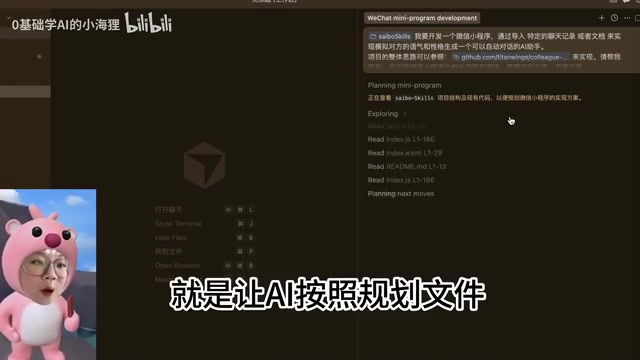
Once planning is complete, use Cursor's Build feature, and the AI will generate all project code in one click based on the planning document. This process is fully automated — just wait anywhere from a few seconds to a few minutes.
This is Cursor's core advantage over regular ChatGPT conversations: it doesn't just generate code snippets — it creates a complete file structure directly in your project directory. Front-end pages, back-end logic, configuration files — everything is ready to use out of the box.
Step 3: Configure the Environment Following the Instructions, and Let AI Fix Any Errors
After code generation is complete, the AI also outputs detailed deployment instructions. You simply follow the steps to configure the WeChat Mini-Program cloud development environment.
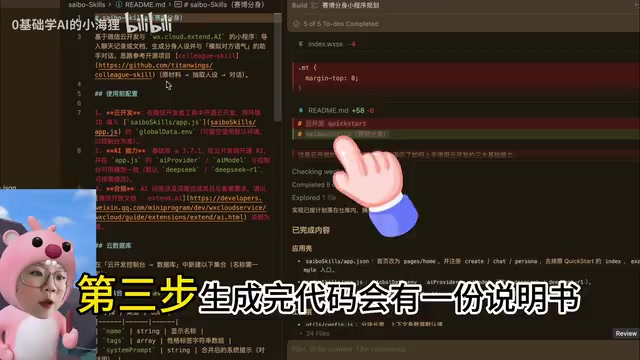
Once configured, click "Normal Compile" to run the mini-program. If everything goes smoothly, the mini-program will run right away.
But reality is rarely that smooth — errors are almost inevitable. The creator shared an extremely practical approach for handling them:
- Copy the complete error message
- Send it to the AI in Cursor with a note: "The mini-program compilation returned the following error — help me analyze and fix it"
- The AI will automatically locate the issue and modify the code
- Refresh, the error disappears, and the mini-program runs normally
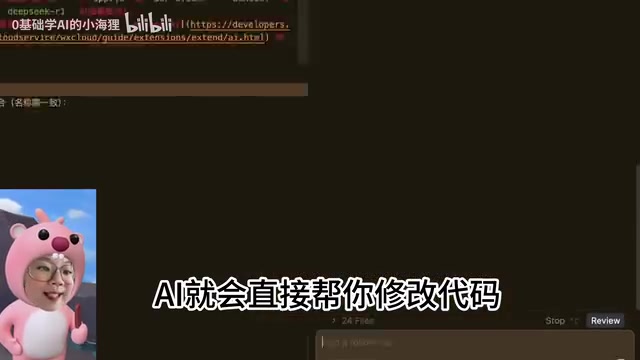
This "error → copy → let AI fix → refresh" loop is the core workflow of zero-code AI programming today. You don't need to understand the error messages — you just need to be an "information courier," accurately passing error information to the AI.
Some Thoughts on Zero-Code AI Programming
Prompt Engineering Matters More Than Programming Itself
Throughout the entire process, there's really only one step that requires human thinking — writing a good initial prompt. The quality of your prompt directly determines the quality of AI's output. A good prompt should contain four elements: product format, core functionality, reference case, and UX requirements — all are indispensable.
The Boundaries of This Approach
It's important to recognize clearly that this zero-code approach is suitable for developing relatively simple applications with straightforward logic. If you want to build a commercial-grade product with high concurrency and complex business logic, relying purely on AI-generated code isn't sufficient yet. But for personal projects, prototype validation, and small tool development, this workflow is already powerful enough.
From "Knowing How to Code" to "Knowing How to Define Requirements"
This case once again confirms a trend: the future programming threshold won't be about whether you've mastered a particular programming language, but whether you can clearly describe requirements and break down problems. Tools like Cursor are redefining "programming" from "writing code" to "defining requirements."
Summary
The entire workflow can be summarized as: Write a prompt → AI plans → One-click generation → Configure environment → Fix errors → Launch. No code needs to be written throughout the process. The core skills are "being able to describe requirements" and "being able to copy and paste error messages." For non-technical people who want to quickly validate ideas, this is one of the most efficient paths available today.
Related articles
 Tech Frontiers
A Rare Quiet Day in AI: Recursive Self-Improvement Stirs Beneath the Surface
A rare quiet day in AI sees multiple sources go silent simultaneously. Behind the calm, Recursive Self-Improvement (RSI) research continues. What this means for the industry.
 Tech Frontiers
Reve 2 vs. Ideogram 4: A Deep Dive into Layout Control in AI Image Generation
A deep comparison of Reve 2 and Ideogram 4's layout control capabilities, covering technical approaches, real-world use cases, and industry trends for designers and creators.
 Tech Frontiers
In the Weights: Check Your Influence Score in the AI World
In the Weights is an AI influence search engine that quantifies your presence in the AI world with a score. Explore how it evaluates practitioners and what it means for digital identity.