Build an AI Revenue Leakage Detector with n8n: Automatically Recover Lost Payments

Build an AI automation system with n8n to detect and recover revenue lost to broken business processes.
The article introduces a low-code AI automation system built on n8n for solving corporate revenue leakage. It aggregates invoices, delivery records, payment records, and follow-up records, uses a Code Node to find inconsistencies, and hands them to AI for a "second opinion" to distinguish actionable discrepancies from ignorable anomalies, then automatically sends collection emails or Slack notifications. The AI step compensates for the rules engine's false positives and inability to generate communication scripts. The solution has a low technical barrier and suits SMBs with many projects and diverse clients, but depends on data connectivity. Currently an event-based demo, it requires business-specific adjustments for real deployment.
Revenue Leakage: The Invisible Profit Killer
Many businesses only discover during their monthly reconciliation that some payments that should have been collected never arrived, and some projects that should have been followed up on were left unattended. This kind of "Revenue Leakage" is often not malicious delinquency, but rather an oversight caused by broken processes. A YouTube creator built an AI automation system with n8n specifically to detect and recover this lost revenue.
The core logic of this system isn't complicated: pull together four data sources — invoices, actual delivery records, payment records, and follow-up records — use a Code Node to find discrepancies, and then let AI determine whether a collection email should be sent to the client.
Workflow Breakdown: From Data Retrieval to AI Decision-Making
The entire automation flow can be divided into three key stages:
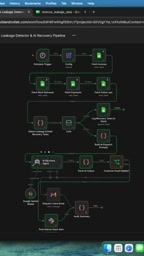
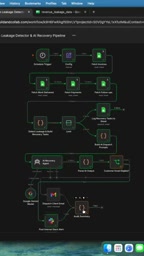
Data Aggregation Layer: The system automatically retrieves invoice information, delivered work content, received payments, and all follow-up records the team has made with clients. This data is typically scattered across different tools — financial systems, project management tools, CRMs — and n8n serves as the connector here.
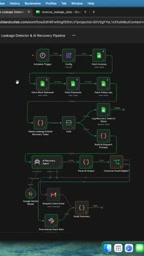
Leakage Detection Layer: A dedicated Code Node compares these data sets to identify inconsistencies. For example, a project has been delivered but no invoice was issued, or an invoice was issued but payment hasn't arrived, or follow-up records show the client responded but no further progress was made. All of these are flagged as "leakage points."
AI Decision Layer: Once leakage is detected, the system logs the recovery task in a spreadsheet and sends a dispatch prompt to the AI, asking for a "second opinion."
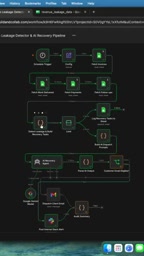
The AI's output is parsed, and different actions are executed based on its recommendation: if the AI determines the client should be contacted directly, the system automatically sends an email; otherwise, it sends an internal notification on Slack with an audit summary attached.
About n8n: n8n is an open-source workflow automation platform that uses a node-based visual orchestration approach, where users build automation flows by dragging and connecting nodes. It supports hundreds of built-in integrations (such as Slack, Google Sheets, various CRMs and financial systems), while also allowing custom JavaScript logic through a Code Node, making it suitable for API calls, data transformation, and conditional branching. Unlike closed tools like Zapier, n8n can be self-hosted, so data doesn't have to leave the company's internal network — a particularly critical point for compliance and privacy in revenue leakage detection scenarios involving financial and client information. Its low-code nature also lowers the barrier to entry for non-engineers.
Why Add the AI "Second Opinion" Step
A pure rules engine has a natural flaw when it comes to leakage detection: it can only find cases where "the data doesn't match," but it can't judge whether that discrepancy is worth pursuing or how to pursue it.
For example, an invoice amount differing from the contract amount by a few dollars could be a rounding issue; a client paying three days late could be a normal delay in their financial process. A rules engine would flag all of these as anomalies, generating a large number of false positives.
With AI providing a second judgment, the system can distinguish between discrepancies that "truly require action" and those that "can be ignored" based on context. More importantly, AI can also generate specific communication scripts — whether it's a gentle reminder or a formal collection notice, the tone and wording can be adjusted based on the client relationship and the amount involved.
The creator mentions in the video that this workflow is currently an event-based demo, meaning it demonstrates full technical feasibility, but actual deployment would require adjustments based on specific business scenarios.
Rules Engine vs. AI Judgment: A rules engine relies on pre-set conditions (e.g., "flag as anomaly if amount discrepancy exceeds X dollars"), making execution deterministic and auditable, but lacking contextual awareness. AI judgment is based on semantic understanding and can make decisions closer to human judgment by synthesizing factors like client relationships, historical behavior, and amount size — at the cost of some uncertainty in results and the need to design prompts and output parsing logic carefully. In practice, the two are often used in combination: the rules engine efficiently filters candidate anomalies, and AI performs secondary screening and generates communication content for those candidates. This "rules-based pre-filtering + AI precise judgment" architecture controls AI invocation costs while preserving process explainability.
Who This Solution Is For
In terms of technical barriers, n8n's low-code nature allows non-engineers to build similar workflows. But what really determines whether this system works isn't technology — it's data quality.
If your invoicing system, project management system, and CRM aren't connected to begin with, and data formats are inconsistent, then the upfront data cleaning and field mapping will consume most of your time. Conversely, if these systems already have API interfaces or existing n8n node support, the build time can be kept to within a few days.
For small and medium-sized service businesses — consulting firms, agencies, freelance teams — the need for this kind of revenue leakage detection is particularly strong. With many projects and diverse clients, manual reconciliation easily leads to oversights. The value of this system lies precisely in this: it doesn't require you to change your existing work habits — it simply quietly compares data in the background and only notifies you when anomalies are found.
Readers who want to get the complete workflow can comment "revenue leakage" under the original video to receive the share link.
Event-Based vs. Scheduled Polling: Event-based means the system only triggers the flow when a specific event occurs (such as a new payment being received or an invoice status change), offering high real-time responsiveness and low resource consumption, but it depends on data sources being able to actively push events. Scheduled polling pulls data for comparison at fixed intervals (such as every night). The demo version uses event-based triggering, indicating its focus is on demonstrating the complete chain from a single detection to decision to action; in actual deployment, since leakage often requires periodic inventory to be discovered, many teams would switch to or supplement with scheduled polling to ensure no events are missed. Which mode to choose depends on the business's requirements for timeliness and the data source's event-pushing capabilities.
Background Notes
Dispatch Prompt: This refers to the structured instruction the system sends to the large language model, which typically embeds key context extracted from data comparison, such as discrepancy amounts, client historical payment behavior, and follow-up record summaries. The purpose of the dispatch prompt is to hand off the decision task of "should we pursue this, and how" to the AI along with the necessary background, allowing the model to provide recommendations with sufficient information. Unlike a simple one-off question, a dispatch prompt is often designed to require the AI to output structured results (such as whether to act, communication tone, email draft) so that subsequent nodes can directly parse and execute them. This combination of "prompt engineering + workflow orchestration" is a common pattern in current AI automation systems.
One-line Summary
Build an AI automation system with n8n to detect and recover revenue lost to broken business processes.
Paragraph Summary
The article introduces a low-code AI automation system based on n8n that addresses corporate revenue leakage. The system aggregates four types of data — invoices, delivery records, payment records, and follow-up records — uses a Code Node to identify inconsistencies as leakage points, and then hands them to AI for a "second opinion" to distinguish differences that truly require action from anomalies that can be ignored, automatically sending collection emails or Slack internal notifications accordingly. The addition of AI compensates for the flaws of a pure rules engine — excessive false positives and inability to generate communication scripts. The solution has a low technical barrier and is especially suitable for small and medium-sized service businesses with many projects and diverse clients, but whether it works depends critically on whether the data is connected upfront. Currently, this workflow is an event-based demo, and actual deployment requires adjustments based on business scenarios.
Related articles

A Single Prompt Triggers a Global PHP Security Storm: Is AI a Savior or a Hidden Risk?
A single AI prompt triggered a global PHP security crisis affecting Wikipedia and the Internet Archive. This article reviews the incident, analyzes the OpenAI-Amazon controversy, and explores the security paradox of lowered vulnerability discovery barriers in the AI era and developer response strategies.

When AI Is Taken Away: How Reliance on Shortcuts Undermines Your Problem-Solving Resilience
A study of 1,222 people found that after using AI to answer questions, once AI was removed, people gave up on more problems than a control group that never used AI. The article analyzes the impact of AI reliance on learning resilience and metacognition, and explores design implications for AI learning tools.

Carta and NewView Partner to Let Startup Employees Cash Out Equity Early
Carta and NewView Capital partner to simplify startup tender offers, helping employees sell equity early. Analysis of the mechanism, liquidity pain points, and impact.