Build an AI Super Employee System at Zero Cost: A Full Breakdown of Automated Agent Workflows

Breaking down the AI super employee system demoed on Bilibili: capability boundaries, differentiated modules, and zero-cost lead-generation logic.
Based on a Bilibili demo video, this article breaks down an "AI super employee" system that claims zero-cost account setup. It uses agent conversations as the entry point, enabling low-code agent building through template copying and persona rewriting. The content production chain covers text-to-image, voiceover videos, digital human cloning, and viral video rewriting, forming an automated closed loop from generation to publishing. Map-based acquisition and enterprise lead collection are the most differentiated modules, allowing bulk export of store and company contact information by region. The system also offers scenario-based capabilities like intelligent customer service for personal WeChat and WeCom, AI recruiting, and AI legal. The article notes that these capabilities essentially package general-purpose LLMs into business scenarios, with results depending on the underlying model and prompt quality; the so-called zero-cost signup is mostly a lead-generation tactic, and model accuracy, lead update frequency, and multi-account risk control are the real keys to ROI.
AI agents are moving from concept to reality, but products that genuinely cover the full chain of customer acquisition, content production, customer service, and legal support—true "end-to-end digital employees"—are still rare. A demo video on Bilibili showcased an AI super employee system that claims to offer zero-cost account setup, bundling agent conversations, multi-platform customer acquisition, short-video matrices, digital human livestreaming, and intelligent customer service into a single backend. Based on that demo, this article breaks down the system's actual capability boundaries and its real value for internet entrepreneurs.
1. The Agent Hub: From Conversations to Reusable Agents
The system's entry point is a ChatGPT-like chat interface where users issue tasks and the agent executes them automatically. What's really worth noting is the "AI Brain" module below—it provides a large number of preset agent templates, such as academic literature summarization and news key-point extraction. Users can directly copy a template, modify the persona and response logic, and click publish to generate their own custom agent.

This "template copy + persona rewrite" design lowers the barrier to building agents, but it also means results depend heavily on the underlying model's capabilities and prompt quality. In the video, the demonstrator emphasizes that persona, response logic, avatar, description, model, and search category are all customizable—essentially a low-code agent orchestration layer rather than a model trained from scratch.
Agent (AI Agent) refers to a software entity capable of perceiving its environment, making autonomous decisions, and invoking tools to accomplish goals. What distinguishes it from an ordinary chatbot is its task planning, memory, and tool-calling capabilities. Current mainstream implementations use a large language model (LLM) as the reasoning core, define roles and behavioral boundaries through prompts (Prompt), and then attach external tools such as search, code execution, and API calls. The "low-code agent orchestration layer" mentioned in the article is the engineering embodiment of this idea: the platform does not train models but instead combines model capabilities, prompt templates, and business interfaces into reusable agents. Its upper performance limit is determined by the underlying model's understanding and reasoning ability, while its lower limit is determined by prompt design and the quality of tool integration—so the same orchestration layer can perform very differently across different models.
2. The Content Production Chain: From Posters to Digital Human Voiceovers
The "AI Design" module supports uploading product images and entering descriptions to generate posters, covers, or product images with one click—a typical text-to-image application. More comprehensive is the short-video matrix capability in "AI Creation": after users add video footage, background music, and voiceover scripts and set video parameters, the system can generate voiceover videos with one click, suited to short-video e-commerce scenarios.

Users who don't want to appear on camera can enter the "Digital IP" module to clone their voice and appearance and generate digital human voiceover videos. The video also demonstrated "one-click viral chasing": copying a viral video link, extracting the script and rewriting it, then matching voice, appearance, and cover, and finally publishing with one click. From generation to publishing, this forms an automated closed loop—the most productive part of the entire system, though it also involves copyright compliance issues around script rewriting, so commercial use requires careful evaluation.
Digital human cloning typically consists of two independent steps: voice cloning and appearance cloning. Voice cloning trains a timbre model (such as TTS timbre transfer) based on a small number of speech samples, while appearance cloning builds lip-sync driving and expression transfer models through video capture; the two are combined and driven by text to generate voiceover videos. Current consumer-grade solutions mostly adopt the "2D digital human" approach—training lightweight models based on real-person videos, which is low-cost and fast to generate but less flexible and realistic than 3D modeling solutions. Note that cloning another person's voice and appearance involves portrait rights and voice rights, so authorization should be obtained before commercial use; "one-click viral chasing," which extracts viral scripts and rewrites them, may also implicate copyright and platform originality rules, so actual deployment requires a compliance assessment.
3. The Acquisition Engine: Map-Based Acquisition and Enterprise Lead Collection
Customer acquisition is the most differentiated module of this system. "Map-based acquisition" can search for stores in a specific category by region—for example, searching for milk tea shops in Wanzhou District, Chongqing—and the system lists store names, contact information, and business addresses, with support for filtering and exporting to WeChat or WeCom for outreach. "Enterprise acquisition" works the same way, searching for relevant companies in a region and exporting enterprise data.
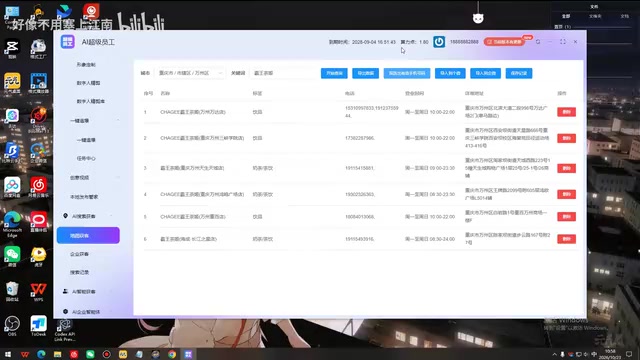
"Intelligent acquisition" covers platforms such as Douyin, Xiaohongshu, and Kuaishou, offering channels including benchmark-account prospecting, video prospecting, keyword prospecting, livestream prospecting, and follower prospecting; after configuring keywords and execution accounts, users can batch-collect targeted customers. For teams in local life services, franchising, or B2B sales, this kind of bulk lead collection can significantly reduce upfront research costs, but users must vet the compliance of the data sources themselves.
Lead generation compliance boundaries are mainly governed by China's Personal Information Protection Law and Data Security Law: publicly available store names and addresses are generally public commercial information, but contact phone numbers and WeChat IDs that can identify natural persons may constitute personal information, and bulk collection and export require a legal basis (such as user consent or other statutory circumstances). In addition, platform terms of service on Douyin, Xiaohongshu, and similar platforms generally prohibit unauthorized automated scraping, and batch operations across multiple accounts may trigger platform risk controls, leading to throttling or account bans. Therefore, the practical usability of such tools depends not only on collection capability but also on whether data sources are lawful and whether the account matrix can be operated sustainably.
4. Customer Service and Legal: A 24/7 Digital Employee
The system configures intelligent customer service separately for personal WeChat and WeCom, supporting keyword-triggered scripted replies to enable 24/7 online responses. For private-domain traffic operators, this can ease the pressure of responding during peak inquiry periods.

There is also an "AI Recruiting" module that manages accounts, intelligently takes over, automatically greets, and assists with job posting and candidate screening; and an "AI Legal" module that supports Q&A on laws and regulations, judicial case and statute search, as well as professional risk assessment and revision suggestions after photographing contracts. These capabilities are essentially general-purpose LLM capabilities packaged into specific business scenarios, and their effectiveness depends on the professionalism of the underlying model.
5. The Business Logic Behind Zero Cost
In the video, the demonstrator says the software's market price is 1,980 to 3,680 yuan, while they can offer "zero-cost account setup," obtained by following, liking, and commenting to receive a software package. This model is fairly common on Bilibili—typically using a free software package as a lead-generation tactic, with follow-ups potentially involving paid courses, agency distribution, or value-added services. Readers need to distinguish between "free software use" and "long-term free service"—the latter is difficult to sustain commercially.
From a product perspective, this system integrates agent orchestration, AIGC content generation, lead collection, and intelligent customer service into one backend, which is somewhat attractive to individual entrepreneurs and small teams and can replace some repetitive manual work. But the demo video does not show the model's accuracy, the update frequency of lead data, or the risk-control performance of multi-account operations—these are the keys to determining the actual return on investment. A free trial is a low-cost way to validate it; whether it can truly become an "AI super employee" still needs to be proven through a closed loop in real business.
Related articles

A Single Prompt Triggers a Global PHP Security Storm: Is AI a Savior or a Hidden Risk?
A single AI prompt triggered a global PHP security crisis affecting Wikipedia and the Internet Archive. This article reviews the incident, analyzes the OpenAI-Amazon controversy, and explores the security paradox of lowered vulnerability discovery barriers in the AI era and developer response strategies.

When AI Is Taken Away: How Reliance on Shortcuts Undermines Your Problem-Solving Resilience
A study of 1,222 people found that after using AI to answer questions, once AI was removed, people gave up on more problems than a control group that never used AI. The article analyzes the impact of AI reliance on learning resilience and metacognition, and explores design implications for AI learning tools.

Carta and NewView Partner to Let Startup Employees Cash Out Equity Early
Carta and NewView Capital partner to simplify startup tender offers, helping employees sell equity early. Analysis of the mechanism, liquidity pain points, and impact.