Build an SBTI Personality Test Mini Program with AI in 10 Minutes: From Development to Monetization

Use AI to build a personality test mini program for social virality and monetization.
Starting from the viral success of the SBTI personality test, this article analyzes its social currency dynamics and presents a three-step strategy for anyone to quickly develop similar personality test mini programs using AI tools like Cursor: differentiated repositioning, AI-generated test content, and rapid MVP launch. It covers the entire workflow from development environment setup and scoring logic implementation to WeChat Mini Program submission, plus monetization through rewarded video ads.
Why Did SBTI Go Viral? The Underlying Logic of Social Sharing
The SBTI personality test recently took over social media feeds, but it didn't go viral because it was particularly professional — quite the opposite. It's simply a 3D-styled personality test that takes just a few minutes to complete. The key insight is this: after finishing the test, users' first instinct isn't to close the page — it's to share their results.
This reveals a core insight: SBTI is not a tool — it's social currency. Wharton professor Jonah Berger argues in Contagious that people's real motivation for sharing content often isn't the information's inherent value, but rather that the act of sharing makes them appear more interesting and unique within their social circles. Personality tests naturally fit this mechanism — test results serve as both a tool for self-expression and a conversation starter that invites interaction. When results feel like "that's so me," sharing happens organically.
It's worth noting that SBTI is a visually reimagined version built on the MBTI (Myers-Briggs Type Indicator) framework. MBTI was created in the 1940s based on Jung's theory of psychological types. Despite ongoing academic debate about its validity and reliability, its mass appeal has endured. SBTI replaces text labels with 3D cartoon characters, lowering the comprehension barrier while dramatically increasing the visual shareability of results pages — this "simplified sharing" strategy is a common pattern behind viral test products in recent years. This type of product is naturally suited for AI replication — questions can be written, results can be generated, and pages can be built, all using AI.
How Ordinary People Can Get Started: A Three-Step Strategy
Step 1: Reskin and Reposition — Find Your Differentiation
You don't need to build another SBTI. Instead, create thematic variants:
- Fashion personality edition
- City personality edition
- Workplace personality edition
- Romance personality edition
The underlying logic is identical — just swap the theme and context. The core consists of 20–30 questions, a dozen or so dimensions, and a dozen or so result types. Each label needs a name, a brief description, and shareable copy — whether users are willing to share their results determines whether the mini program can achieve viral spread.
Step 2: Use AI to Generate All Test Content
Let AI plan the questions, dimensions, and result descriptions. Key elements:
- Each result label should be memorable and distinctive
- Share copy should carry emotional value
- Result descriptions should create a sense of identification
The AI coding tool used here is Cursor — an AI-native code editor built on the VSCode architecture, deeply integrated with large language models like Claude and GPT-4. Unlike traditional code completion tools, Cursor supports multi-file context understanding and natural language-driven code generation. Developers can describe requirements in plain language and have AI generate complete page code. In the mini program development scenario, Cursor can generate corresponding WXML (WeChat Mini Program template language) and JavaScript code based on screenshot descriptions, significantly lowering the entry barrier for non-professional developers.
Step 3: Build an MVP and Launch Quickly
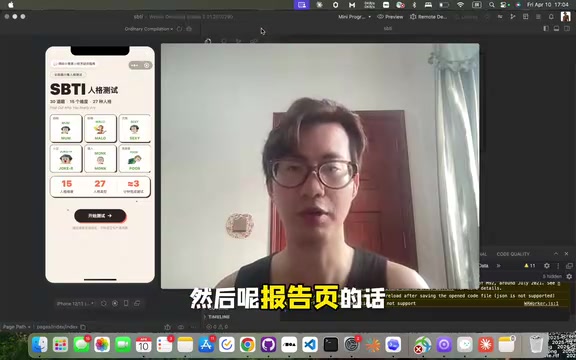
You only need four pages to get it running: homepage, quiz page, loading page (matching animation), and results report page. This is a textbook application of the Lean Startup methodology's MVP (Minimum Viable Product) approach — validate core assumptions at the lowest possible cost and avoid wasting resources on features that haven't been market-tested. Each page in the four-page structure serves an irreplaceable conversion role: the homepage handles conversion, the quiz page delivers the core experience, the loading page builds anticipation, and the results page drives sharing. Get it running, get it live, get it approved — then iterate and optimize.
Hands-On Development: From Zero to WeChat Mini Program Launch
Setting Up the Development Environment
- Download WeChat Developer Tools (the official IDE)
- Take 30+ screenshots of a reference mini program's interface
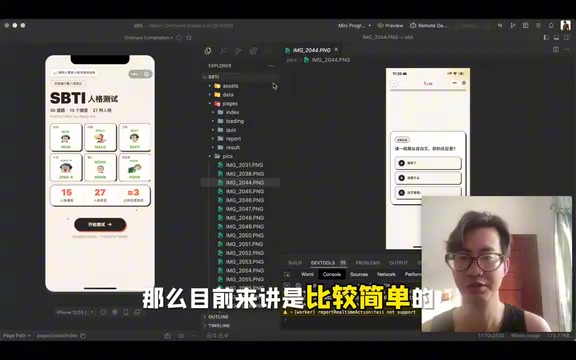
- Have AI (Cursor in this case) plan the code skeleton based on screenshots
The core page structure includes: homepage, loading page, quiz page, report page, and results page. This skeleton can be reused across different themed versions later.
Implementing the Personality Test Scoring Logic
The scoring logic is actually quite simple:
- Each question corresponds to a dimension
- User selections accumulate scores
- Each dimension maps to a high/medium/low level
- The final result matches the closest type in the personality database
No complex algorithms are needed, but the user perception is strong — they feel the result was "calculated" rather than randomly assigned. This "pseudo-precision" experience design is crucial. From a psychological perspective, this also aligns with the "Barnum Effect": people tend to believe that vague, generalized personality descriptions are highly accurate for them specifically, creating a strong sense of identification and an urge to share.
WeChat Mini Program Registration and Launch Process
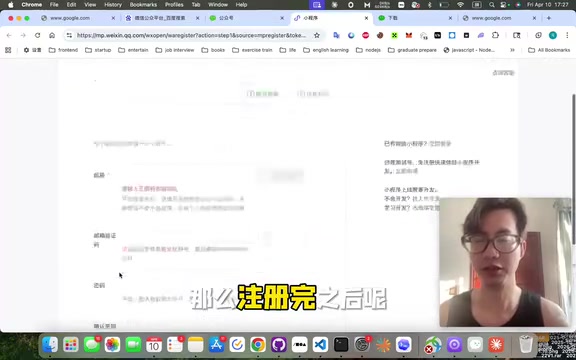
Register a mini program account on the WeChat Official Accounts Platform, fill in basic information, add developer permissions, and then upload the code through the developer tools.
Solving the 2MB Code Package Size Limit
A common problem encountered during upload: the code package exceeds the 2MB limit. The reason is that images are stored statically within the project. The solution is to upload images to Alibaba Cloud OSS (Object Storage Service) and keep only image URL references locally.
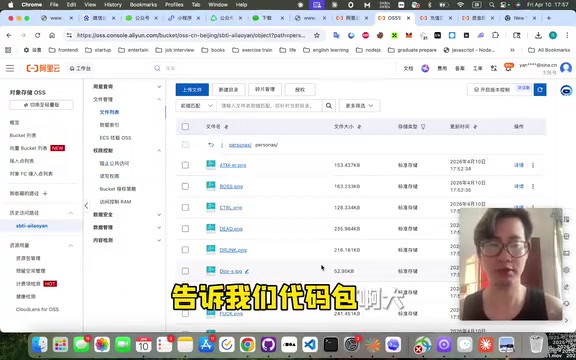
OSS (Object Storage Service) is a critical component of cloud computing infrastructure, designed specifically for storing and distributing unstructured data like images and videos. By combining OSS with a CDN (Content Delivery Network), static resources are cached at edge nodes closest to users. This not only solves the package size problem but also significantly improves image loading speed on the user's end. WeChat Mini Program's 2MB code package limit is essentially a constraint on logic code — externalizing static resources like images to OSS + CDN is the industry-standard solution. After deleting local images and replacing them with CDN links, the upload succeeds.
Mini Program Monetization: From Traffic to Revenue
There are two primary monetization approaches for mini programs:
Approach 1: Enable Traffic Monetization and Integrate Ads
Once your mini program accumulates over 1,000 users, you can qualify for traffic monetization. The best ad placement is when users click "Unlock Detailed Report" — a rewarded video ad pops up, and users unlock the full report after watching.
Rewarded Video Ads are one of the most user-accepted ad formats in the mobile internet advertising ecosystem. Their core design principle is "value exchange" — users watch a complete video in exchange for in-app content unlocking privileges. Compared to forced interstitial ads, the user-initiated trigger mechanism of rewarded videos typically achieves completion rates above 85%, and advertisers are willing to pay higher CPM (cost per thousand impressions) for this. In the personality test scenario, "unlock your detailed report" serves as a natural value exchange point.
Related articles
 Tutorials
ChatGPT Plus Subscription Guide: Are GPT-5.5, image-2, and Codex Worth the Upgrade?
A detailed look at ChatGPT Plus features — GPT-5.5, image-2, and Codex — with a Plus vs Pro comparison and a complete step-by-step subscription guide for users outside the US.
 Tutorials
Harness AI Engineering in Practice: Using Claude Code to Master Enterprise-Level E-Commerce Development
Deep dive into Harness AI Engineering: master enterprise e-commerce development with Claude Code using the Rules, Skills, Wiki, and Changes framework.
 Tutorials
Cursor + Codex Dual-IDE Collaboration: A Practical Methodology for Open-Source Project Customization
A complete methodology for open-source project customization based on real-world experience, detailing the Cursor+Codex dual-IDE workflow, seven-stage process, MVP validation, and AI source code reading techniques.