Build Your Own ChatGPT for $100: An Analysis of Karpathy's Open-Source nanochat Project

Karpathy open-sources nanochat, enabling a full conversational model training pipeline for $100.
nanochat is an open-source project by Andrej Karpathy that aims to train a complete conversational model for $100, with nearly 60k GitHub stars. It offers an end-to-end pipeline from data prep to training to inference, emphasizing minimalist design and reproducibility to lower the barrier for individual developers. Over 8,000 forks show strong interest in secondary development. While it can't match commercial models, its value lies in education, experimentation, and understanding how conversational models work.
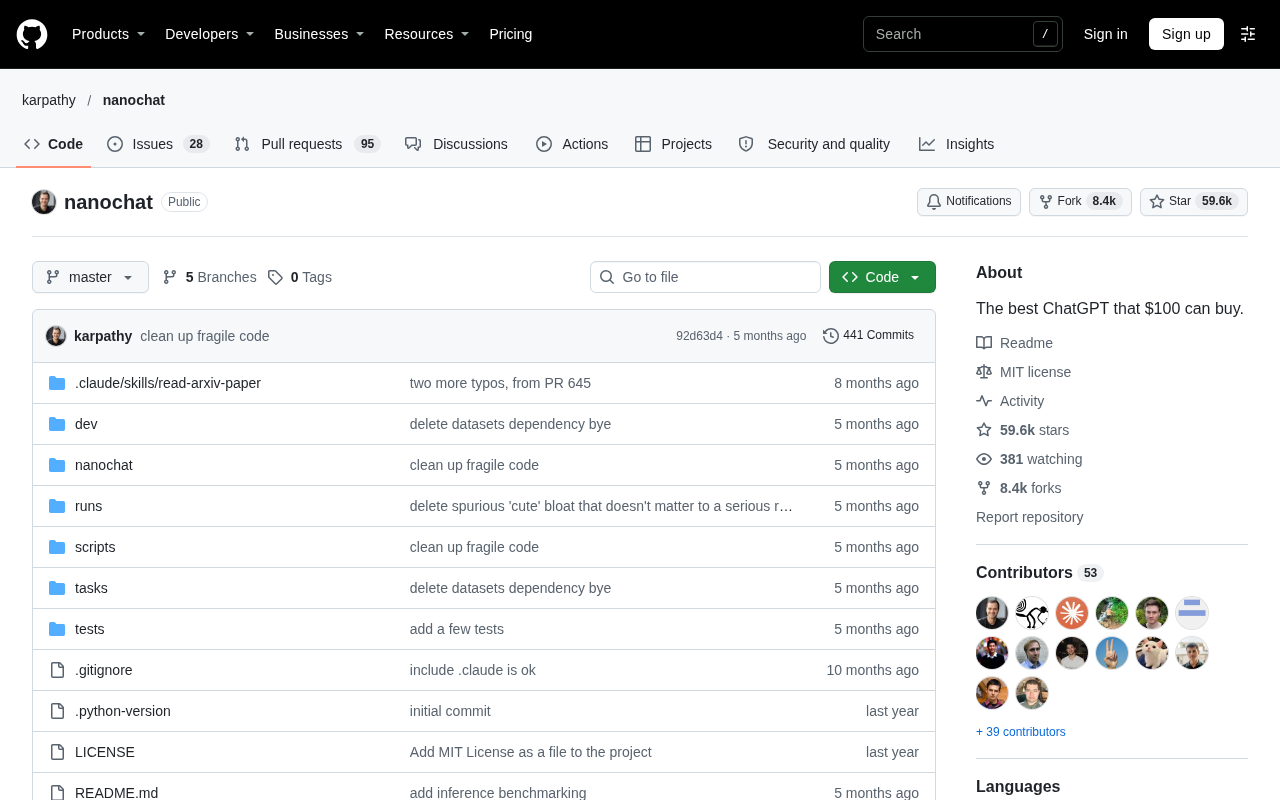
In an era where training AI models routinely costs millions of dollars, an open-source project called nanochat proposes a remarkably bold idea: train your own ChatGPT for $100. The project comes from well-known AI researcher Andrej Karpathy, and after its release it quickly amassed nearly 60,000 GitHub stars, becoming a hot topic in the developer community.
Project Overview: Validating the Feasibility of Low-Cost Conversational Models
The core claim of nanochat is stated right in its title—"The best ChatGPT that $100 can buy." This isn't marketing hype but a rigorous technical exercise: build a complete, trainable, and inferable conversational model pipeline while keeping the total cost within an extremely low threshold.
According to the repository information, the project is written in Python, currently has 59,599 stars and 8,385 forks, with 325 new stars in a single day—clear evidence of its community attention. Unlike many open-source projects that only provide inference code, nanochat emphasizes end-to-end reproducibility—everything from data preparation and model training to conversational inference is included in the project.
Why $100 Is a Key Number
Large model training costs are typically measured in millions of dollars, making them nearly inaccessible to ordinary developers. nanochat's angle is this: by streamlining model size, optimizing the training process, and choosing appropriate hardware, it compresses training costs into a range individuals can afford.
The $100 figure isn't a precise budget promise—it's more of a yardstick, meaning you can complete a full model training experiment using a single consumer-grade graphics card or a small amount of rented cloud compute time. This low-cost characteristic gives many developers who previously could only "read papers" their first opportunity to personally train a conversational model.
Consumer-grade graphics cards typically refer to GPUs aimed at the personal computer market, such as NVIDIA's RTX series. These cards' VRAM capacity (commonly 8GB to 24GB) and compute power are far below data-center-grade GPUs (such as A100/H100), but they cost anywhere from several hundred to several thousand dollars. That nanochat can complete training within a $100 budget means the model parameter count it uses is very small and the training pipeline is highly optimized—likely requiring only a few hours to a few days of single-GPU training time, or a small number of rented cloud GPU hours. This lowering of the hardware barrier is the key prerequisite for enabling individual developers to participate in model training.
Technical Architecture and Design Philosophy
Although the specific implementation details require consulting the repository code, several clear design principles can be inferred from the project's positioning:
Minimalism first. The project pursues completing core functionality with the fewest lines of code and dependencies, avoiding over-engineering. This makes the code easier to read and modify, and more suitable as learning material.
Full-pipeline coverage. From data processing to model training to inference deployment, nanochat provides a complete chain rather than isolated modules. Developers can understand every step of a conversational model from zero to one.
Strong educational value. Rather than chasing performance limits, nanochat prioritizes understandability. It's more like an executable tutorial that helps developers build a systematic understanding of large model training.
End-to-end reproducibility in machine learning engineering means that every step from raw data to final model output is contained in the codebase, and that anyone can reproduce the results in the same or a substitutable environment by following the documentation. This typically requires fixing random seeds, declaring dependency versions, providing data preprocessing scripts, and specifying training configurations. nanochat's emphasis on this characteristic means developers can not only see the inference code but also trace how the model weights were trained step by step from data—which is crucial for teaching and debugging.
Community Response and Open-Source Impact
With nearly 60,000 stars and over 8,000 forks, nanochat has clearly outgrown the category of an ordinary tutorial project. The high fork count is especially noteworthy—forking usually means developers aren't just reading but intend to modify and build upon it.
This popularity reflects a real demand: developers aren't satisfied with calling APIs—they want to understand and control models. nanochat happens to offer such a low-barrier path. At the same time, Karpathy's personal influence brought initial attention to the project, but continued star growth shows the project itself stands up to scrutiny.
Fork is a core collaboration mechanism on GitHub: it creates a complete copy of the original repository under the developer's own account, allowing independent modification without affecting the original project. A high fork count usually indicates that many developers not only follow the project but also plan to experiment, customize, or contribute code based on it. Compared with stars (which merely indicate interest), forks better reflect the depth of actual use and secondary development. nanochat's more than 8,000 forks show that many developers are trying to adjust model size, swap datasets, or adapt it to their own hardware environments.
Who It's For
nanochat's target audience is quite clear. For students and developers wanting to get started with large model training, it offers a rare hands-on opportunity; for researchers needing to quickly validate ideas, the low-cost full-pipeline framework can significantly shorten experiment cycles; for AI educators, the project itself is excellent teaching material.
It should be noted that low cost means limited model size—the models trained by nanochat can't compare in capability with commercial large models. Its value lies in understanding and practice, not in replacing production-grade services.
Conclusion
nanochat answers the question "Can ordinary people train ChatGPT themselves?" with a $100 threshold. Its significance isn't in producing a powerful model but in turning large model training from a black box into tangible practice. For developers hoping to deeply understand how conversational models work, this is an open-source project worth studying seriously.
One-line Summary
Karpathy open-sources nanochat, enabling a complete conversational model training pipeline with a $100 threshold.
Paragraph Summary
nanochat is an open-source project released by Andrej Karpathy that aims to train a complete conversational model for $100, and it has already garnered nearly 60,000 GitHub stars. The project provides an end-to-end pipeline from data preparation to model training to inference deployment, emphasizing minimalist design and reproducibility, lowering the barrier for individual developers to participate in large model training. More than 8,000 forks indicate strong developer interest in secondary development. Although the model's capabilities can't match commercial large models, its core value lies in education, experimentation, and helping developers understand the complete workings of a conversational model—not in replacing production-grade services.
Related articles

How Accurate Are Sci-Fi's Predictions About AI?
How accurate are sci-fi's predictions about AI? Drawing on a Hacker News discussion, this article analyzes sci-fi's foresight and blind spots in AI development, arguing its true value lies in inspiring thought rather than precise prediction.

SwarmEvolve: Latent-Space Agent Swarms Accelerate Evolutionary Search
SwarmEvolve lets hundreds of low-cost agents swarm-reason in latent space, sharing info via KV caches to achieve fast evolutionary search for math and science problems—reaching in a median of 3–8 minutes the best scores other frameworks need 60 minutes for.

trainlint: Static Checks Catch ML Training Bugs That Don't Crash
trainlint is a static analysis tool that finds ML training bugs that don't throw errors, including data leakage, leftover eval mode, and softmax/CrossEntropyLoss conflicts across 14 categories. This article covers its principles, validation results, and limitations.