Building a $5,000 Home Solar System: Budget Breakdown, DIY Process & Payback Analysis

A comprehensive guide to building a sub-$5,000 DIY home solar system with full payback analysis.
This article details how to build a complete home solar power generation and storage system for under $5,000, covering component selection for PV panels, hybrid inverters, and LiFePO4 batteries, with a practical budget breakdown. It analyzes the technical barriers, DC safety risks, grid-connection compliance issues, and provides economic payback calculations showing 5-6 year ROI depending on local electricity rates and solar conditions.
Why DIY Home Solar Is Gaining Popularity
As photovoltaic components and energy storage batteries continue to drop in cost, more and more tech enthusiasts are attempting to build their own home solar systems. A post titled "DIY Home Solar System for under $5000" on Hacker News sparked an intense community discussion—building a complete home-scale solar power generation and storage system for under $5,000. This isn't just a cost-saving engineering project; it represents the intersection of energy independence and hands-on practice.
This trend is backed by clear data: according to the International Renewable Energy Agency (IRENA), the global weighted average price of PV modules has dropped over 90% in the past decade, from approximately $4.7 per watt in 2010 to under $0.3 per watt in recent years. Meanwhile, lithium battery storage system costs have been declining at roughly 15% per year. The convergence of these two cost curves has brought photovoltaic technology—once affordable only for commercial power plants—within the budget range of ordinary household DIY enthusiasts.
This article systematically analyzes the components of a DIY home solar system, budget control strategies, and the key factors to weigh during implementation.
Core Components of a Home Solar System
A complete home solar system typically consists of several core modules. Understanding each module's role is a prerequisite for controlling costs and ensuring safety.
PV Modules: The Power Generation Core
Solar panels are the "power engine" of the entire system. The dramatic drop in per-watt pricing for monocrystalline silicon modules in recent years has made DIY projects economically viable. Within a $5,000 budget framework, solar panels typically account for about one-third of the total cost. The sensible approach is to work backward from your household's average daily electricity consumption (kWh) to determine the required installed capacity, avoiding blindly stacking panels.
To understand the logic behind PV module selection, you need to know the current mainstream cell technology paths. The most common on the market is monocrystalline PERC (Passivated Emitter and Rear Contact) cells, with mass-production conversion efficiencies reaching 22%-23% and excellent cost-effectiveness, making them the top choice for DIY projects. The newer generation TOPCon (Tunnel Oxide Passivated Contact) cells further improve efficiency to 24%-25% over PERC and are rapidly replacing PERC as the market mainstream. There are also HJT (Heterojunction) cells, which have less efficiency degradation in high-temperature environments (temperature coefficient of approximately -0.26%/°C, better than PERC's -0.35%/°C), making them suitable for hot regions, though prices remain slightly higher. For DIY users, choosing PERC or TOPCon modules typically yields the best cost per watt, while polycrystalline silicon modules—though cheaper—are less efficient and require more installation area for the same power output, making them actually uneconomical when rooftop space is limited.
Inverter: The Critical DC-to-AC Conversion Device
The inverter converts the direct current (DC) produced by solar panels into alternating current (AC) usable by household appliances. It's the most technically demanding component that directly affects safety and conversion efficiency. Options include string inverters, microinverters, and hybrid inverters, among which hybrid inverters can simultaneously manage the grid, batteries, and loads, making them a common solution for off-grid or grid-tied hybrid scenarios.
The differences between these three inverter types are worth explaining in detail. String inverters are the most traditional approach, connecting multiple PV panels in series and feeding them into a single inverter for conversion. Their advantages are low cost and high reliability; the drawback is that the entire series circuit's power output is limited by the worst-performing panel (the "weakest link" effect), making shading issues significantly impact the system. Microinverters are installed on the back of each panel, enabling panel-level independent conversion and optimization, effectively solving shading and inconsistent orientation issues while allowing per-panel monitoring and maintenance—but at a higher per-watt cost. Hybrid inverters (also called storage inverters) integrate PV MPPT input, battery charge/discharge management, and grid interaction functions into one unit, making them the most common choice for DIY setups with energy storage.
The MPPT (Maximum Power Point Tracking) mentioned here is a core technology in inverters. A PV panel's output power isn't a fixed value but follows a complex power-voltage curve that changes with light intensity, temperature, and load—with one point on the curve where power is maximized. MPPT algorithms dynamically adjust the operating voltage in real time, keeping the PV panel running near its maximum power point. Compared to simple PWM (Pulse Width Modulation) control, this can capture 15%-30% more energy. For budget-limited DIY systems, choosing an inverter or charge controller with MPPT functionality is a cost-effective way to improve overall system generation efficiency.
Energy Storage Batteries: Insurance for Sunless Hours
Energy storage is the component with the most cost variability in DIY solar projects. LiFePO4 (Lithium Iron Phosphate) batteries have become the mainstream choice for home storage due to their high safety and long cycle life (typically 4,000+ cycles). Many skilled enthusiasts choose to purchase cells and assemble battery packs themselves (paired with a BMS), further reducing costs—but this demands greater knowledge of safety practices and proper procedures.
The reason LiFePO4 has become the top choice for home storage is closely tied to its chemical properties. Compared to ternary lithium batteries (NCM/NCA) widely used in consumer electronics and electric vehicles, LiFePO4 has lower energy density (approximately 160Wh/kg vs 250Wh/kg), meaning larger volume and weight for the same capacity. However, its thermal stability is far superior—the thermal runaway temperature exceeds 270°C, while ternary lithium batteries can experience thermal runaway and release large amounts of flammable gas at around 200°C. In a home environment, safety takes far higher priority than compactness, making LiFePO4 the overwhelming choice. Additionally, LiFePO4's cycle life is typically 2-3 times that of ternary lithium, with a much flatter discharge curve (voltage changes very little across most of the discharge range)—characteristics well-suited to the long-term, deep-cycling use case of home energy storage.
The BMS (Battery Management System) is indispensable in self-assembled battery packs and handles several critical functions: overcharge protection (preventing individual cell voltage from exceeding the 3.65V safety limit), over-discharge protection (preventing voltage from dropping below 2.5V causing irreversible damage), overcurrent protection, temperature monitoring and protection (cutting off charging/discharging at extreme temperatures), and the crucial balancing function—ensuring that the capacity and voltage of each series-connected cell remain consistent, preventing individual lagging cells from dragging down the performance and lifespan of the entire pack. When assembling battery packs yourself, BMS selection and parameter configuration serve as the last line of defense for safety. Incorrect BMS settings can lead to overcharge fires or over-discharge cell damage, which is why many experienced community members recommend that beginners first purchase pre-built battery packs and only attempt self-assembly after gaining sufficient experience.
Specific Budget Allocation for $5,000
Keeping total costs under $5,000 comes down to trade-offs and the extent of your DIY effort. Here's a typical budget allocation reference:
| Item | Budget Range | Notes |
|---|---|---|
| Solar Panels | ~$1,500 | Several high-efficiency monocrystalline modules |
| Storage Batteries | ~$1,500-2,000 | Self-assembled packs can significantly reduce this |
| Inverter | ~$800-1,200 | Hybrid inverters offer broader applicability |
| Accessories | ~$500 | Mounting hardware, cables, breakers, junction boxes, etc. |
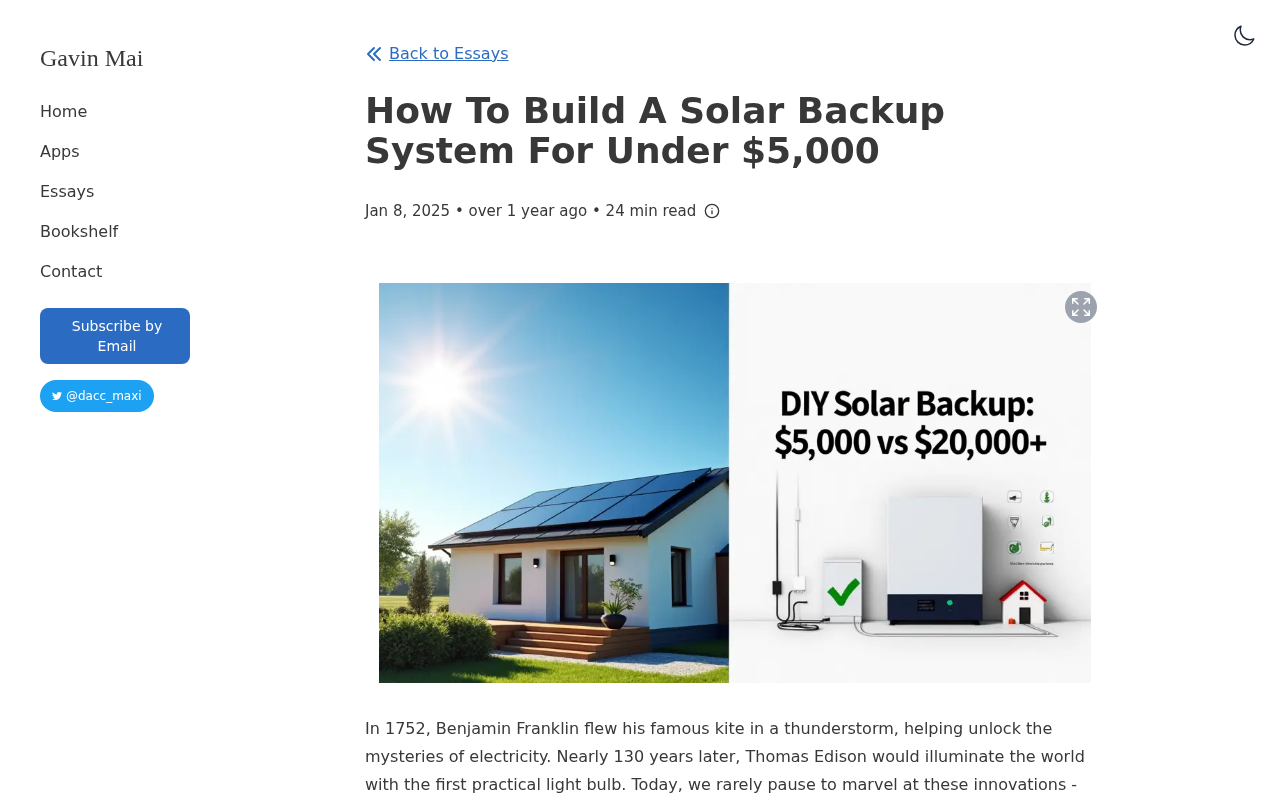
The core logic of DIY cost savings is eliminating installer labor fees and brand premiums. Professional companies typically charge $10,000-$20,000 or more to install a system of equivalent scale, while self-procurement and installation can compress costs to less than one-third.
It's worth noting that this budget framework's feasibility largely benefits from global PV manufacturing overcapacity and mature supply chains. China, as the world's largest producer of PV modules and lithium batteries, drives continuously declining end-product prices through its supply chain's economies of scale. DIY enthusiasts can obtain near-factory pricing by purchasing directly from manufacturers or wholesale platforms rather than through installer markups. Additionally, cable specification selection in accessories shouldn't be overlooked—DC cables commonly used in PV systems need to meet UL 4703 or equivalent solar-specific cable standards; using ordinary household wiring can lead to insulation degradation and fire hazards.
Risks and Considerations for DIY Solar Systems
Technical Barriers and Safety Risks
While DIY sounds appealing, it's far from a simple "plug-and-play" project. High-voltage DC systems present electrocution and fire risks, and incorrect battery pack configurations can lead to thermal runaway. Therefore, having foundational electrical knowledge and understanding local electrical codes are prerequisites for safe implementation.
The dangers of DC electricity deserve special emphasis here. Many people have an instinctive wariness of household 220V/110V AC, but lack awareness of the high DC voltages in PV systems. A string of series-connected PV panels under full sunlight can easily produce 300-600V of open-circuit voltage, and DC arcs—unlike AC—don't naturally extinguish at zero-crossing points. Once a DC arc forms, it can burn continuously and ignite surrounding materials. The US National Electrical Code (NEC) and International Electrotechnical Commission (IEC) standards have detailed requirements for PV system wiring, grounding, overcurrent protection, and Rapid Shutdown. In the US, NEC 2017 and later versions require rooftop PV systems to be equipped with module-level rapid shutdown devices so that roof voltage can be quickly reduced to safe levels during emergencies such as fire rescue.
In the Hacker News community discussion, many experienced commenters particularly reminded newcomers to pay attention to:
- Correct wiring methods and wire gauge selection
- Fuse protection for each series/parallel string
- Battery pack temperature monitoring and overcharge/over-discharge protection
- Grounding and lightning protection measures
Grid-Tied Compliance vs. Off-Grid Strategy
In many countries and regions, connecting a self-built system to the grid requires approval and professional inspection. Off-grid systems are relatively more flexible but must account for storage redundancy during consecutive overcast days.
An important concept for grid-tied systems is Net Metering policy. In regions with net metering, excess electricity produced by household PV systems during the day can be fed back into the grid, with the meter "running backward." When users draw power from the grid at night, they only pay for the net difference. This policy greatly enhances the economics of residential PV because users don't need large-capacity storage batteries to cover nighttime consumption—the grid itself acts as a "virtual battery." However, net metering policies vary enormously worldwide: US states have differing policies (California introduced the controversial NEM 3.0 in 2023, significantly reducing compensation rates for selling electricity to the grid), many European countries use Feed-in Tariffs rather than net metering, and China has a "self-consumption first, surplus to grid" model. For DIY users, whether local regulations allow systems installed by non-licensed individuals to qualify for subsidies or net metering is a question that must be researched early in project planning. Some jurisdictions explicitly require that only systems installed by licensed electrical contractors can receive grid-connection approval.
For this reason, many DIY projects start with small-scale off-grid power supply—such as powering select household loads or serving as backup power—verifying system stability before gradually expanding capacity.
Economic Analysis: How Long Until Payback?
When evaluating whether such a project is worthwhile, the payback period is an unavoidable core question. Based on a $5,000 total investment:
- If the system saves $800-1,000 in electricity costs annually, the theoretical payback period is 5 to 6 years
- High-quality PV modules generally have a lifespan of 20-25+ years
- LiFePO4 batteries can serve 10+ years with proper use
This means that during the latter half of the system's lifecycle, the electricity produced is essentially "net profit."
Of course, actual payback speed is influenced by multiple factors:
- Local electricity rates: Higher rates mean greater savings
- Solar irradiance conditions: Annual peak sun hours directly determine generation output
- Battery degradation curve: Affects long-term storage efficiency
- Government subsidies and tax rebate policies: Some regions offer additional incentives for distributed PV
Among these, Peak Sun Hours (PSH) is the core parameter for estimating generation output. PSH doesn't refer to the total hours of sunshine in a day, but rather converts the varying solar irradiance throughout the day into equivalent full-power generation hours. For example, a region with PSH of 5 means a 1kW PV panel can theoretically produce about 5kWh of electricity per day under ideal conditions. The National Renewable Energy Laboratory's (NREL) PVWatts Calculator and NASA's POWER database both allow users to query historical solar data by specific geographic coordinates—extremely practical free tools for the DIY planning stage. However, there's typically a 15%-25% gap between theoretical generation and actual output, stemming from system loss factors—including efficiency drops from module temperature rise (approximately 0.3%-0.4% loss per 1°C increase), inverter conversion losses (typically 3%-5%), cable transmission losses, dust shading, and module degradation over time (quality modules degrade at approximately 0.5% per year). When performing economic calculations, using a system efficiency factor of 0.75-0.85 will yield results much closer to reality than theoretical values.
In areas with high electricity rates and abundant sunshine, the economic advantages of DIY solar systems are particularly pronounced. In the US, for example, residential electricity rates in Hawaii, California, and northeastern states generally range from $0.25-0.45/kWh—far above the national average of approximately $0.16/kWh—and DIY solar system payback periods in these areas can shrink to 3-4 years. At the US federal level, the Investment Tax Credit (ITC) allows taxpayers to directly deduct 30% of solar system installation costs from their federal income tax (this policy has been extended through 2032), meaning a $5,000 system could theoretically receive $1,500 in tax relief, further shortening the payback period.
From Cost-Saving Project to Energy Independence
Building a $5,000 home solar system is fundamentally a tech enthusiast's exploration of energy autonomy. It's both a genuinely money-saving engineering project and a deep engagement with renewable energy technology. For those with electrical fundamentals who are willing to invest time in research, it's a project that combines practical value with a sense of accomplishment.
From a broader perspective, the rise of DIY home solar systems is also a microcosm of the larger trend toward Distributed Energy Resources (DER). The traditional power system follows a one-way flow from "large power plants → high-voltage transmission → distribution → end users," but the proliferation of distributed PV, home storage, and electric vehicle V2G (Vehicle-to-Grid) technology is pushing power systems toward a flatter, bidirectional network structure. When thousands of homes are both electricity consumers and producers (a role called "Prosumer"), the operational logic, pricing mechanisms, and dispatch methods of the grid will undergo profound transformation. Every builder of a DIY solar system is participating in this energy transition in their own way.
However, as community discussions reflect, safety and compliance should always come first. Before getting hands-on, thoroughly research local regulations, complete proper electrical design planning, and consult licensed electricians or professionals when necessary—ensuring your system runs reliably and cost-effectively for years to come.
Key Takeaways
Related articles

PPT Master: AI One-Click Generation of Native Editable PowerPoint Presentations
PPT Master is an open-source project with over 45K GitHub Stars that generates native editable .pptx files via AI, featuring data charts, animations, voice narration, and custom templates.

Delphi 13 Community Edition Free Download: The Classic RAD Tool for Cross-Platform Native Development Returns
Delphi 13 Community Edition is now available for free download. Explore its cross-platform native compilation, features, licensing, and Object Pascal's unique value in modern development.

GPT-5.6 Free Unlimited Conversations, Kimi K3 Officially Joins GitHub Copilot
OpenAI announces GPT-5.6 Luna unlimited free conversations, Kimi K3 becomes the first Chinese model in GitHub Copilot. Google releases WeatherNext, NVIDIA advances Physical AI infrastructure.