Building a Personal Cognitive System with AI: A Practical Guide to Claude Code + DeepSeek + Obsidian

A hands-on case study of using AI to automatically build a personal cognitive framework system.
One creator combined Claude Code, DeepSeek V4, and Obsidian to automatically decompose cognitive frameworks and build a structured mental model system. The setup spans layers from daily idea capture to integrated Eastern and Western cognitive models — requiring only a seed file for AI to expand into a full knowledge structure. It marks a paradigm shift in PKM from manual connection to AI-assisted generation.
Introduction: A New AI-Driven Paradigm for Knowledge Management
When most people think about AI applications, they picture code generation, image creation, or conversational Q&A. But a deeper use case is quietly being explored by a small group of practitioners — using AI to build a personal cognitive system. One creator shared his hands-on experience combining Claude Code, DeepSeek V4, and Obsidian to automatically decompose cognitive frameworks and construct a structured library of mental models.
The core breakthrough here: by providing just a single seed file containing a cognitive framework, the AI can automatically break it down and expand it into a complete mental model system. This was previously considered nearly impossible in the domain of text-based knowledge bases.
To appreciate the value of this system, it helps to understand the evolution of Personal Knowledge Management (PKM). Early PKM tools like Evernote were built around collect and retrieve — storing external information in a database and searching for it when needed. Around 2020, "Second Brain" tools like Roam Research and Obsidian shifted the paradigm toward connect and emerge — emphasizing that the relationships between notes are more valuable than the notes themselves, and that new insights arise from those connections. Tiago Forte's PARA method (Projects/Areas/Resources/Archives) and Progressive Summarization became the defining methodologies of this era. Now, the rise of large language models is pushing PKM into a third phase: from manual connection to AI-assisted generation and expansion. The case in this article sits right at that inflection point — AI is no longer just a retrieval tool, but an active participant in constructing knowledge structures. This represents a genuine paradigm shift in PKM.
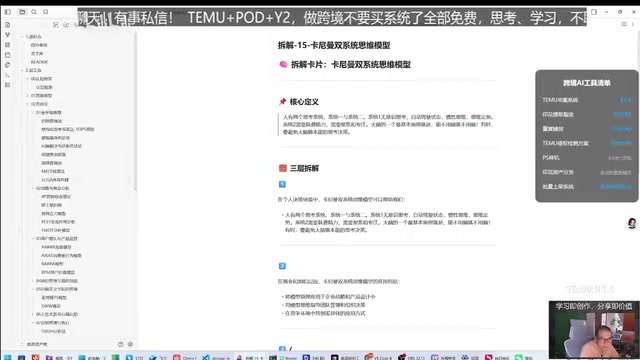
Overall Architecture of the Knowledge Base
Layer One: Daily Tasks and Idea Capture
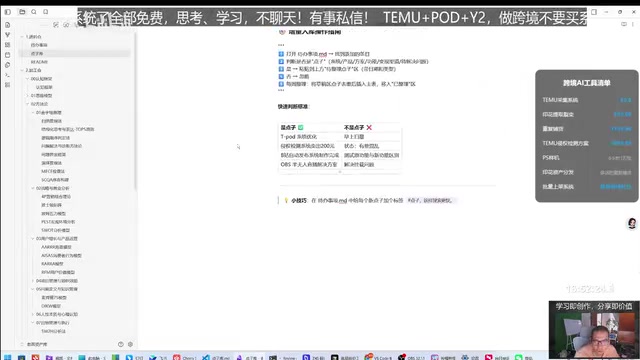
The foundation of this system is a daily to-do system. From everyday tasks, the system automatically generates and accumulates an "idea library." This design follows an important principle: cognition doesn't emerge from thin air — it's distilled from daily practice.
To-do lists may seem mundane, but they serve as the input layer for the entire cognitive system. Every task and every action can become raw material for a new mental model.
Layer Two: Integrating Eastern and Western Cognitive Frameworks
At the core of the system is a cognitive framework layer. The creator systematically integrated Eastern and Western thinking models:
Eastern Model: Dao, Fa, Shu, Qi, Shi — from the highest level of "Dao" (fundamental principles) down to the concrete "Qi" (tools and methods), forming a top-down cognitive hierarchy.
The "Dao-Fa-Shu-Qi-Shi" framework originates from classical Chinese philosophy — particularly Taoist and military strategist thought — and has been widely reinterpreted in modern business and management contexts. "Dao" refers to the essential laws governing how things work, representing the highest level of cognition. "Fa" encompasses the principles, strategies, and methodologies derived from Dao. "Shu" covers specific techniques, skills, and operational methods. "Qi" refers to the tools, platforms, and vehicles that carry Shu into practice. "Shi" represents the environment, trends, and timing — the idea of moving with the current rather than against it. Together, these five levels form a complete cognitive framework spanning from abstract to concrete, from strategy to tactics. The profound insight is that most people focus only on "Shu" and "Qi" (which tools to use, how to operate them) while neglecting the "Dao" level — the fundamental judgment about what's actually true.
Western Model: First principles, foundational logic, circle of competence, long-termism, inversion thinking, various architectural patterns, and ARR models.
The key insight is that these two systems have corresponding relationships. For example, the Eastern concept of "Dao" maps to the Western concept of "first principles," while "Fa" corresponds to "foundational logic" — and so on across the framework.
Related articles
 Tutorials
ChatGPT Plus Subscription Guide: Are GPT-5.5, image-2, and Codex Worth the Upgrade?
A detailed look at ChatGPT Plus features — GPT-5.5, image-2, and Codex — with a Plus vs Pro comparison and a complete step-by-step subscription guide for users outside the US.
 Tutorials
Harness AI Engineering in Practice: Using Claude Code to Master Enterprise-Level E-Commerce Development
Deep dive into Harness AI Engineering: master enterprise e-commerce development with Claude Code using the Rules, Skills, Wiki, and Changes framework.
 Tutorials
Cursor + Codex Dual-IDE Collaboration: A Practical Methodology for Open-Source Project Customization
A complete methodology for open-source project customization based on real-world experience, detailing the Cursor+Codex dual-IDE workflow, seven-stage process, MVP validation, and AI source code reading techniques.