Building AI Algorithms from Scratch: A Complete Breakdown of the 523-Lesson Open Source Course

MIT-licensed open source course with 523 lessons for building AI algorithms from scratch, now with 6-volume e-books and 8-language support.
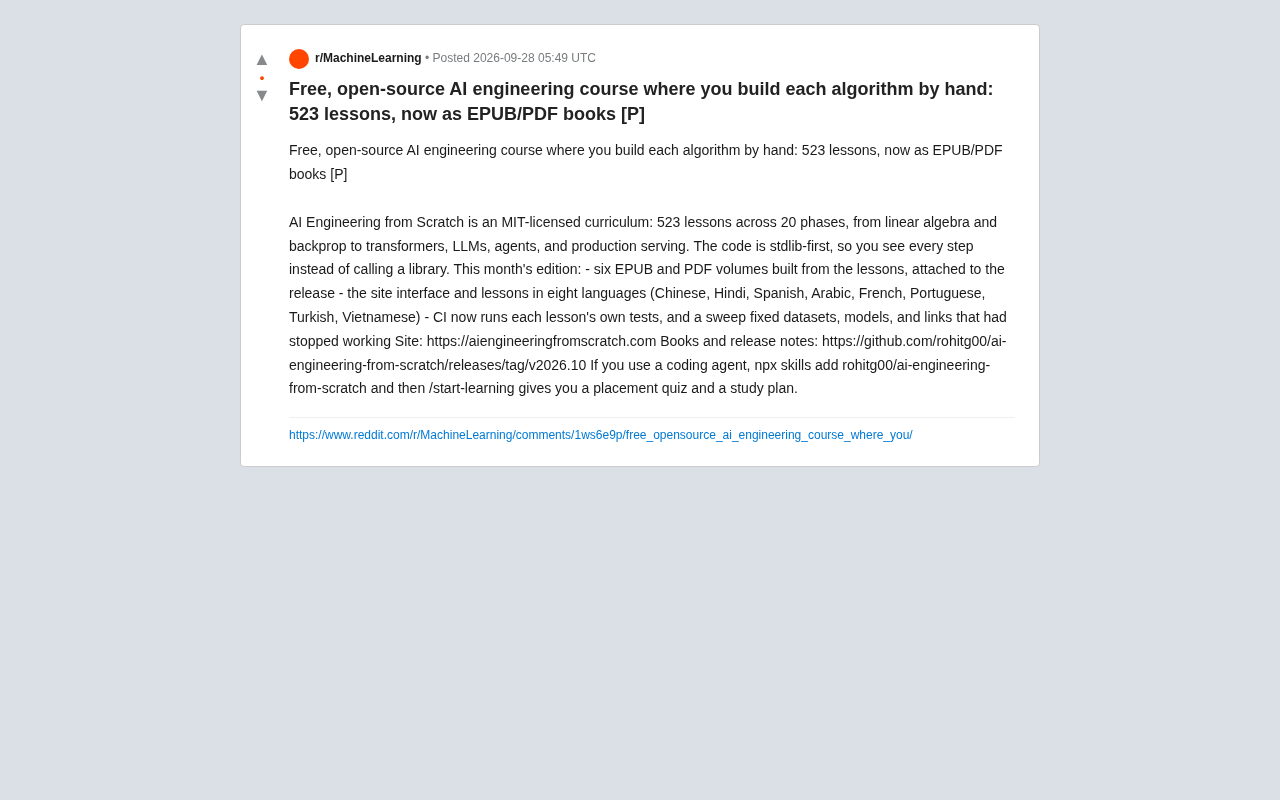
AI Engineering from Scratch is a comprehensive, MIT-licensed AI engineering curriculum spanning 523 lessons across 20 phases — from linear algebra and backpropagation to Transformers, LLMs, agents, and production deployment. Its core philosophy is stdlib-first: learners implement every algorithm by hand to build genuine intuition for the underlying mechanics. The latest v2026.10 release adds six-volume EPUB/PDF e-books, localization in eight languages including Chinese, and CI-verified lesson tests. The course also integrates with coding agents, using placement quizzes to generate personalized starting points and study plans.
The open source community has gained another heavyweight learning resource. A project called AI Engineering from Scratch has been making waves on Reddit — released under the MIT license, it contains 523 lessons covering a complete journey from linear algebra and backpropagation all the way to Transformers, large language models, agents, and production deployment.
Unlike many courses that rely heavily on high-level frameworks, this curriculum is built around a stdlib-first philosophy — you implement every algorithmic step by hand rather than calling pre-built library functions. This "build it from scratch" approach is precisely what it takes to deeply understand the underlying principles of AI engineering.
Course Structure: A Systematic 20-Phase Pathway
The entire curriculum is broken into 20 phases, forming a progressive arc from mathematical foundations to real-world engineering. It starts with the mathematical bedrock of linear algebra, moves into core neural network mechanics like backpropagation, then climbs toward today's most in-demand Transformer architecture and LLM implementations, ultimately landing on agents and production model serving.
What makes this structure valuable is its continuity. Many self-learners fall into the trap of "knowing how to call APIs but not understanding the underlying principles" when studying AI on their own. The granularity of 523 lessons means each concept is broken down to a fine enough level. When you write out the attention mechanism's computation logic line by line instead of doing import transformer, your intuition for model behavior becomes fundamentally different.
Backpropagation is the core algorithm for training neural networks. Its essence is using the chain rule to propagate error signals from the output layer backward through the network, computing the partial derivative (gradient) of the loss function with respect to each parameter, then updating weights via gradient descent. Most introductory courses complete this entire process with a single line —
loss.backward()— leaving learners unclear about what's happening inside the framework. Writing backpropagation by hand means building your own computational graph and implementing the forward and backward logic for every operator. This is crucial for later debugging vanishing/exploding gradients and understanding why certain network architectures are difficult to train. The attention mechanism is the core component of the Transformer, allowing the model to dynamically "attend" to information at other positions in a sequence when processing each position, rather than relying on a fixed local receptive field. Implementing the Q/K/V matrix multiplications and softmax normalization by hand makes the computational complexity and parallelization advantages of multi-head attention feel concrete and intuitive.
This Month's Updates: E-books, Multilingual Support, and Engineering Quality
According to the release notes, the v2026.10 release brings several substantial upgrades:
Six-Volume E-book Collection
The project has compiled all course content into six volumes available as EPUB and PDF e-books, bundled with the release. This is a welcome addition for learners who prefer offline reading or want to work through the material systematically — no browser required, just read through each volume like a textbook.
Localization in Eight Languages
The site interface and course content now support eight languages: Chinese, Hindi, Spanish, Arabic, French, Portuguese, Turkish, and Vietnamese. This multilingual support significantly lowers the barrier for non-native English speakers and reflects the project's orientation toward a global community. Chinese-speaking users can now learn this material entirely in their native language.
Continuous Integration for Course Reliability
The engineering improvements are equally worth noting. The project now runs each lesson's built-in tests via CI (continuous integration) and has gone through a round of fixes to resolve previously broken datasets, models, and links. For a long-term educational project, this kind of "invisible" engineering investment directly determines the learning experience — nobody wants to follow a tutorial full of errors and dead links across 523 lessons.
Learning with Coding Agents
The project also provides integration for AI coding assistants. If you use a coding agent, you can run:
npx skills add rohitg00/ai-engineering-from-scratch
Then use the /start-learning command, and the system will generate a placement quiz and a study plan tailored to you. This means learners don't have to start blindly from lesson one — instead, they're placed at the right starting point based on their existing knowledge, then given a personalized progression path.
This design — connecting an open source curriculum to a coding agent — reflects a broader trend in learning tools today: content is no longer static text, but a dynamic resource that can work in sync with your development environment and AI assistant.
The
npx skills addcommand comes from a tool ecosystem that injects skill packs into a coding agent's context. The way it works: the course's metadata, chapter structure, and quiz logic are injected in a structured format into the agent's system prompt or tool-calling chain, enabling the AI assistant to be aware of course progress, understand the current learning objective, and provide feedback aligned to specific course content as you write code. The placement quiz is essentially a diagnostic set of questions covering knowledge points across various phases. Based on your answers, it infers your knowledge boundaries and maps you to a specific phase in the course as a starting point — preventing learners with existing experience from wasting time on material they've already mastered. This "curriculum as tool context" design is fundamentally different from traditional MOOC platform progress bars: the latter only records where you stopped watching; the former lets an AI assistant actively participate in driving your learning forward.
Who This Course Is For
Based on what's available, this course is best suited for three types of learners: developers who want to shed the "framework-caller" label and truly understand the foundations of AI; self-learners who need a structured path and don't want to jump between scattered tutorials; and tech enthusiasts who prefer open source and value code that is transparent and readable.
The MIT license means you're free to use, modify, and even apply this content commercially — a notably generous stance for educational resources. Relevant links:
- Website: aiengineeringfromscratch.com
- E-books and release notes: GitHub repository
rohitg00/ai-engineering-from-scratch, v2026.10 release page
For learners who want to genuinely master the full AI engineering stack without being trapped inside a framework's black box, 523 hand-coded lessons paired with multilingual support and e-books make this a seriously worthwhile open source resource to bookmark.
Related articles

Why Does the Tesla Roadster Need to Fly? A Deep Dive into Musk's Wild Demo
Tesla's Roadster launch showed wall-climbing, upside-down driving, and flying stunts—but The Vergecast notes the demo car may lack a battery, the Rocket version is invite-only and not street-legal, and the website terms don't guarantee delivery. After nine years of delays, why does this car still need to exist?

AI Is Not a Replacement: Human-AI Collaboration Through the Lens of Factory Root Cause Analysis
Starting from factory root cause analysis, this article explains how AI accelerates evidence chain construction rather than replacing human experts, exploring the pragmatic implementation logic and business value of 'AI supporting people rather than replacing them.'

AI Agent Decision Auditing: Building an Evidence Chain in Regulated Workflows
Starting from a Reddit discussion, this article analyzes three core issues in AI agent decision auditing within regulated workflows: what fields audit records should contain, how to handle feedback latency for erroneous decisions, and how to continuously calibrate LLM judge consistency with human judgment.