Building an AI Factory Digital Twin with Agent-Assisted Workflows

NVIDIA uses agent-assisted workflows to build an AI factory digital twin, with the core being a unified model and clear division of labor.
The article centers on NVIDIA's agent-assisted AI factory digital twin workflow, pointing out that the real difficulty is not visualization but converging site planning, equipment assets, and engineering requirements into a semantically consistent model via Omniverse. Agents handle repetitive coordination work such as asset entry and parameter validation rather than fully automated generation, freeing engineers for judgment-based tasks. Digital twins shift AI factories from "build then see" to "simulate first," reducing trial-and-error costs, though standardized data and platform acceptance are required.
AI factory construction is moving from blueprints to simulation. A recent NVIDIA developer blog post explained how to build a digital twin of an AI factory using agent-assisted workflows, with the core challenge being to integrate site planning, equipment assets, and engineering requirements into a single consistent model. What's worth noting about this content isn't any specific tool, but the engineering paradigm shift it reveals: a digital twin is no longer just a visualization model, but collaborative infrastructure driven by intelligent agents.
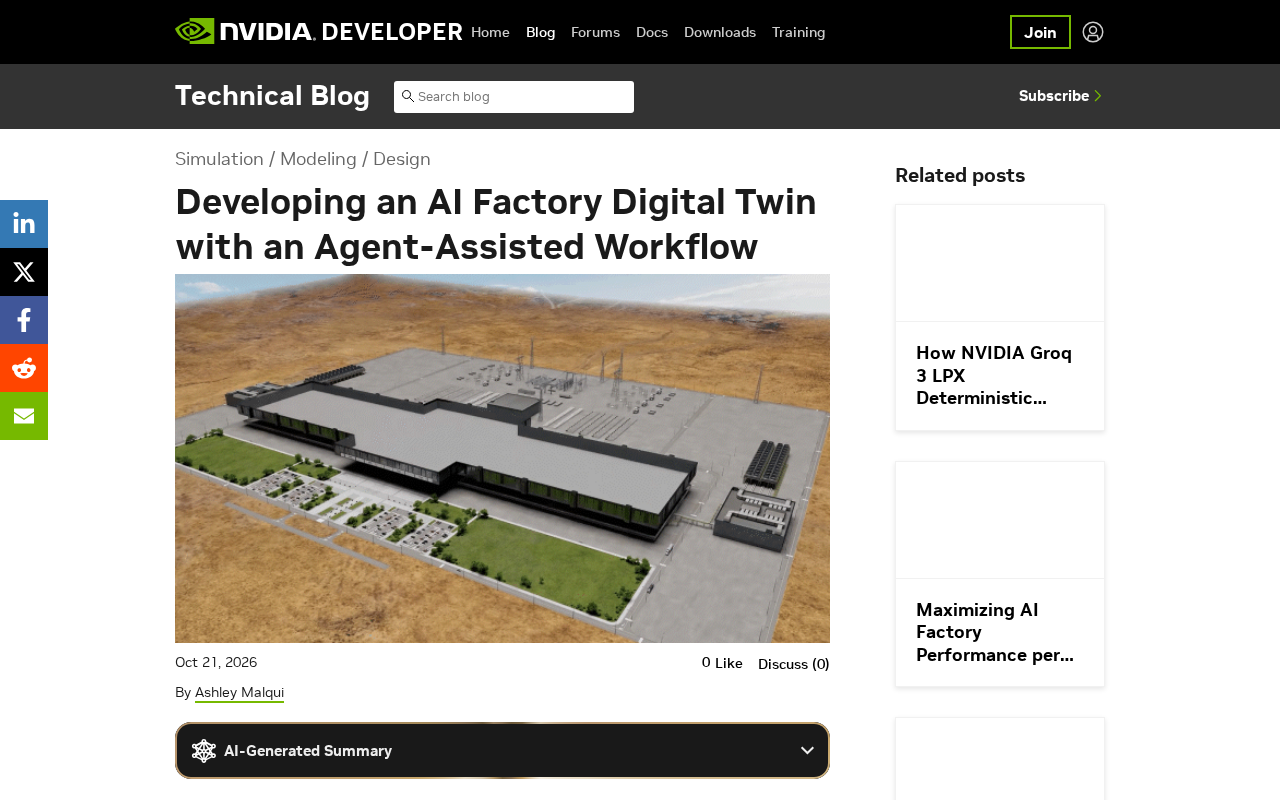
The Real Difficulty of Digital Twins: Model Consistency
The original article opens by pointing out the key contradiction—developers need to unify site floor plans, equipment assets, and engineering requirements into the same model. It sounds like a data integration problem, but it's actually far more complex.
AI factories are fundamentally different from traditional data centers: the power density, cooling paths, and power redundancy of GPU clusters all directly affect availability and operating costs. The value of a digital twin lies in its ability to simulate behavior under these constraints before physical construction. But the prerequisite is that all specialized teams—architectural design, MEP engineering, IT operations—use the same semantically consistent model. In reality, these teams often maintain independent data sources with inconsistent definitions, so the resulting twin cannot reflect the real system.
NVIDIA's approach is to use the Omniverse ecosystem to establish a unified simulation foundation, allowing asset data from different sources to converge within the same scene description. This isn't simple format conversion; it requires clearly defined asset schemas and ways of expressing engineering constraints.
The Role of Omniverse and USD: NVIDIA Omniverse is not a single piece of software, but an open collaboration platform built on Universal Scene Description (USD). USD was originally developed by Pixar to unify the geometry, materials, lighting, and hierarchy of complex scenes in animation production, and its core advantage is that it supports layered overlay and real-time synchronization of multi-source data within the same scene description. In the AI factory context, USD serves as the carrier of a "single source of truth": architectural BIM models, CAD assets of MEP equipment, and specification parameters of IT racks can each be attached to the same USD scene as reference layers, without forcing conversion into a unified format. This is precisely the technical basis for what the original article calls "allowing asset data from different sources to converge within the same scene description." Understanding USD's composition mechanism helps grasp why model consistency is both an organizational problem and a data architecture problem.
What Role Do Agents Play in the Workflow
The "agent-assisted" in the title easily brings to mind fully automated generation, but a more accurate understanding is: agents take on the repetitive coordination work in the model-building process.
In digital twin projects, a large amount of time is consumed by mechanical tasks such as asset entry, parameter validation, and scene alignment. Agents can read engineering documents, extract equipment specifications, generate corresponding simulation asset descriptions, and feed back to engineers when conflicts are found. This frees people from moving data around and lets them focus on judgment-based work—such as whether the cooling solution is reasonable and whether the redundancy configuration meets standards.
The significance of this division of labor lies in lowering the barrier to building digital twins. A scene model that previously required a dedicated team and months to build can now have a first version completed in a shorter time by a few engineers working with agents, and then be iteratively refined.
The Difference Between Agent Workflows and Traditional Script Automation: The "agent assistance" mentioned in the original article does not refer to simple batch-processing scripts. Traditional scripts rely on predefined rules and fixed input formats, and fail as soon as the layout or field naming of engineering documents changes. In contrast, agents based on large language models have a certain degree of semantic understanding and tool-calling capability: they can parse unstructured equipment specification sheets, call parameter validation interfaces as needed, and generate natural-language questions and pause for human confirmation when encountering ambiguity. This "interruptible, question-capable" characteristic makes them suitable for handling the large number of semi-structured coordination tasks in digital twin construction. But precisely because of this, agent outputs need traceable audit records; otherwise, model consistency may instead suffer from hidden errors introduced by automation that are difficult to troubleshoot. This explains why the original article emphasizes that agents take on repetitive coordination work rather than replacing engineering judgment.
Practical Impact on AI Infrastructure Construction
The scale of capital expenditure for AI factories means the cost of trial and error is extremely high. Digital twins change solution validation from "build it and see" to "simulate first," which is especially critical for the deployment pace of GPU clusters.
From an engineering perspective, the transferability of this approach is worth noting. Once the digital twin model is established, it can be reused for capacity planning, failure drills, energy efficiency optimization, and other scenarios, forming a continuously updated asset. Agent-assisted workflows make the maintenance cost of this model manageable—equipment updates and layout adjustments can all be reflected in the twin through semi-automated processes.
However, this approach also has obvious prerequisites: it requires relatively standardized engineering data inputs, as well as the team's acceptance of a unified simulation platform. For organizations with weak data foundations or fragmented processes, implementation is quite difficult. The original article does not avoid this point, but instead discusses "establishing a consistent model" as the starting point of the problem; this candor actually makes it more valuable as a reference.
Simulate-First and the Power Density Constraints of AI Factories: The power density of current-generation GPU racks has risen from the traditional thousands of watts per rack to the order of tens or even hundreds of kilowatts, and choices regarding liquid cooling, power busways, and redundancy topology are locked in at the civil construction stage, with extremely high later retrofit costs. The reason "simulate first" in digital twins is critical is that it enables quantitative validation of physical constraints such as heat flow distribution, power switching sequences, and fault domain isolation at the design stage, rather than discovering local hot spots or insufficient redundancy only after equipment is powered on. Such simulations typically require coupling computational fluid dynamics (CFD) with electrical topology models in the same scene, demanding far higher semantic precision than 3D visualization. This is also why a unified asset schema cannot be omitted: simulation solvers read parameters, not appearance.
Conclusion
Agent-assisted digital twin workflows are essentially a new attempt to solve two old problems in AI factory construction: "multi-disciplinary collaboration" and "simulation asset reuse." Beyond the technology stack, what's more worth learning from is its re-division of the workflow: let agents handle consistency maintenance, and let people handle engineering judgment. Whether this boundary is drawn clearly determines whether a digital twin project can truly be implemented.
One-line Summary
NVIDIA uses agent-assisted workflows to build an AI factory digital twin, with the core being a unified model and clear division of labor.
Paragraph Summary
The article centers on the agent-assisted AI factory digital twin workflow introduced by the NVIDIA developer blog, pointing out that the real difficulty is not visualization but converging site planning, equipment assets, and engineering requirements into a semantically consistent model. NVIDIA uses the Omniverse ecosystem to establish a unified simulation foundation, solving the problem of inconsistent data definitions across multi-disciplinary teams. Agents here take on repetitive coordination work such as asset entry, parameter validation, and scene alignment rather than fully automated generation, thereby freeing engineers to focus on judgment-based tasks such as cooling solutions and redundancy configuration. Digital twins shift AI factories from "build it and see" to "simulate first," significantly reducing the trial-and-error costs of high capital expenditure, and the model can also be reused for capacity planning, failure drills, and energy efficiency optimization. However, the approach has high requirements for the standardization of engineering data and the team's acceptance of a unified platform, so there are barriers to implementation.
Related articles

Why Does the Tesla Roadster Need to Fly? A Deep Dive into Musk's Wild Demo
Tesla's Roadster launch showed wall-climbing, upside-down driving, and flying stunts—but The Vergecast notes the demo car may lack a battery, the Rocket version is invite-only and not street-legal, and the website terms don't guarantee delivery. After nine years of delays, why does this car still need to exist?

AI Is Not a Replacement: Human-AI Collaboration Through the Lens of Factory Root Cause Analysis
Starting from factory root cause analysis, this article explains how AI accelerates evidence chain construction rather than replacing human experts, exploring the pragmatic implementation logic and business value of 'AI supporting people rather than replacing them.'

AI Agent Decision Auditing: Building an Evidence Chain in Regulated Workflows
Starting from a Reddit discussion, this article analyzes three core issues in AI agent decision auditing within regulated workflows: what fields audit records should contain, how to handle feedback latency for erroneous decisions, and how to continuously calibrate LLM judge consistency with human judgment.