Building an AI IDE from Scratch: Replicating Cursor's Core Features with Next.js

Building Polaris, a full AI-powered IDE from scratch, dissecting the core architecture of AI coding tools.
Based on Code With Antonio's hands-on tutorial, this article deeply analyzes the technical architecture behind AI coding tools like Cursor and Replit. By building a complete AI IDE called Polaris, it covers Ghost Text intelligent completions, AI Agent autonomous file operations, in-browser live preview, Firecrawl web scraping to overcome training data freshness limitations, and provides a complete tech stack reference including Next.js, Convex, CodeMirror 6, and Web Containers.
What's Really Happening Behind AI Coding Tools?
Cursor, Replit, and other AI editors have fundamentally changed how developers write code. But have you ever wondered what the technical architecture behind these tools actually looks like? Code With Antonio's latest hands-on tutorial provides the answer — building a complete AI-powered IDE called Polaris from scratch, covering core features like Ghost Text intelligent completions, AI Agent file operations, in-browser live preview, and GitHub integration.
This isn't just a coding tutorial — it's a comprehensive technical handbook for building AI developer tools.
Deep Dive into Core Features
Natural Language Project Creation: Describe Your Needs, AI Generates the Code
Polaris's first highlight is its project creation workflow. Open the new project dialog, describe the application you want to build in natural language, and the AI generates a complete project structure in real-time — files, folders, and components all included. All data is stored in a Convex database, leveraging Convex's Sync Engine for instant availability — no refreshing, no polling, truly real-time responses.
How Convex's Real-Time Database Works: Convex is a "reactive database" whose Sync Engine operates similarly to reactive programming at the database level. Traditional web apps fetch data via HTTP requests, and clients have no way to detect server-side data changes except through polling. Convex maintains persistent connections via WebSocket, and when any subscribed data changes in the database, the server proactively pushes updates to all relevant clients. For collaborative tools like an AI IDE, this means that when an AI Agent modifies files in the background, the editor interface can respond within milliseconds without any manual refresh. This is similar to Firebase's real-time database concept, but Convex provides stronger type safety and transaction support.
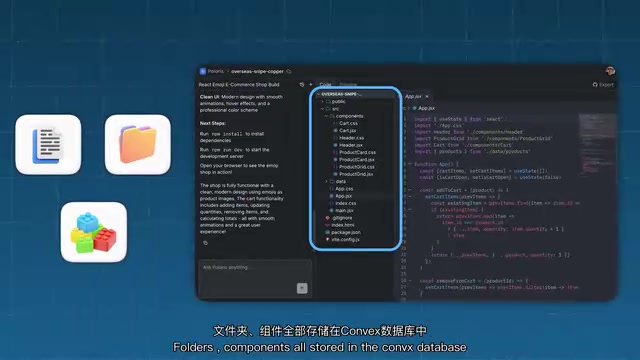
Even more impressive — once project creation is complete, the application is already running. No local environment setup, no terminal commands — Web Containers technology provides a complete Node.js runtime environment within the browser, with installation logs, dev server output, and live app preview all integrated into the same interface.
Web Containers Technical Background: Web Containers is a breakthrough technology developed by the StackBlitz team that ports a complete OS-level runtime environment into the browser's WebAssembly sandbox. Traditionally, Node.js must run on a server or local operating system, but Web Containers implements a micro OS kernel via WebAssembly that can execute real Node.js code, run npm install, and start dev servers — all within a browser tab. The significance of this technology is that it completely eliminates "environment configuration hell" — different operating systems, different Node versions, dependency conflicts all disappear. Online IDEs like Replit and StackBlitz are built on similar principles.
Ghost Text Intelligent Completions: Context-Aware with CodeMirror 6
The editor is built on CodeMirror 6, supporting full syntax highlighting, code folding, and Minimap. But the real highlight is AI-powered intelligent completions: as you type code, AI suggestions appear as semi-transparent Ghost Text, and pressing Tab accepts them.
CodeMirror 6 Architecture: CodeMirror 6 is a complete rewrite of its predecessor, adopting a functional, modular architecture. Its core innovation is the complete separation of editor State from View, with all state changes passed through immutable Transaction mechanisms, making extension development and state management extremely predictable. Compared to Monaco Editor (the editor engine used by VS Code), CodeMirror 6 is lighter, easier to embed in web applications, and has better mobile support. AI completion features like Ghost Text are implemented in CodeMirror 6 through the Decoration API, which can render virtual text layers without modifying actual document content — this is the technical foundation behind the "ghost text" visual effect.
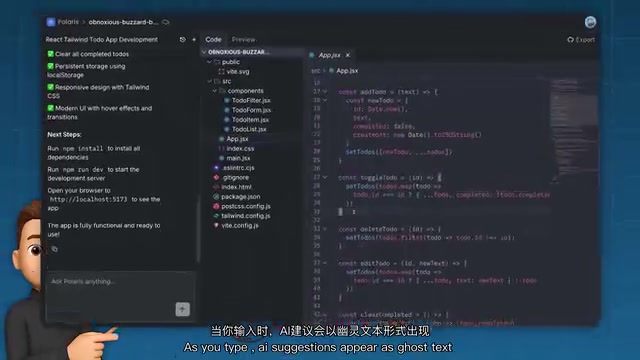
This completion system is context-aware — it analyzes the code around the cursor to provide relevant completion suggestions, rather than simple template matching. This is highly consistent with Cursor's core experience.
Quick Edit + Firecrawl: Breaking AI's Training Data Freshness Limitations
The tutorial demonstrates a highly creative feature: select any code, open Quick Edit, and paste a URL. Firecrawl scrapes the page content and provides it directly as context to the AI.
What does this mean? Documentation for a library released last week, GitHub READMEs, API references — any content on the internet can instantly become AI context. The AI is no longer limited by training data freshness — this is the true power of Firecrawl.
AI Agent Autonomous Operations: Creating Files and Modifying Code Seamlessly
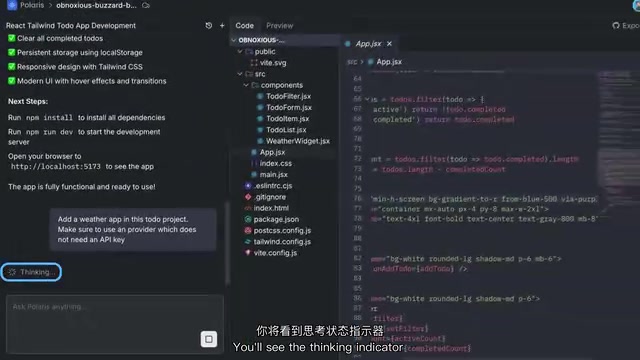
Open the chat sidebar, ask the AI to add a feature, and watch it work. You'll see a thinking indicator, followed by the AI invoking tools — creating files, modifying code, progressively building your requirements.
AI Agent Architecture Pattern: The core of AI Agent architecture is the "ReAct" pattern (Reasoning + Acting), which lets large language models alternate between reasoning and action in a loop. The specific flow is: the model receives a task, first outputs its thinking process (Chain of Thought), then decides which tool to call (Tool Calling), receives the tool's return results and continues reasoning, until the task is complete. OpenAI's Function Calling and Anthropic's Tool Use API are both standardized implementations of this pattern. The value of task managers like Ingest lies in handling the engineering challenges of Agent execution: timeout retries, concurrency control, state persistence — these are reliability problems that must be solved to move Agents from lab prototypes to production environments.
Background processing is handled by Ingest, which manages the AI Agent's execution flow. If a step fails, the system automatically retries, ensuring overall reliability. This Agent architecture — from thinking to tool calling to execution — is the core design pattern of current AI coding tools.
Complete Tech Stack Reference
This project's technology choices cover virtually every key aspect of modern AI application development, providing excellent reference for building similar products:
| Layer | Technology | Responsibility |
|---|---|---|
| Framework | Next.js + TypeScript | Application infrastructure |
| Database | Convex | Data storage & real-time sync |
| Auth & Billing | Clerk | Login flow, OAuth, subscription management |
| Background Tasks | Ingest | AI Agent execution & background jobs |
| Editor | CodeMirror 6 | Code editing core |
| Runtime | Web Containers | In-browser code execution |
| Web Scraping | Firecrawl | URL content extraction |
| Monitoring | Sentry | Error tracking & AI monitoring |
| Code Review | CodeRabbit | AI-powered PR Review |
Notably, Sentry's AI monitoring feature records every LLM call, including model name, token count, and cost per request. This is crucial for controlling AI application operational costs.
LLM Observability vs. Traditional APM: Traditional Application Performance Monitoring (APM) focuses on infrastructure metrics like CPU, memory, and response time. When LLM calls become core application logic, a new class of observability needs emerges: token consumption directly corresponds to API costs (GPT-4 costs tens of dollars per million tokens), prompt version changes affect output quality, and model hallucination rates need to be tracked. Tools like Sentry's AI monitoring, LangSmith, and Helicone are filling this gap. For commercial AI applications, LLM observability is not just a technical issue — it's a financial one.
Related articles
 Tutorials
ChatGPT Plus Subscription Guide: Are GPT-5.5, image-2, and Codex Worth the Upgrade?
A detailed look at ChatGPT Plus features — GPT-5.5, image-2, and Codex — with a Plus vs Pro comparison and a complete step-by-step subscription guide for users outside the US.
 Tutorials
Harness AI Engineering in Practice: Using Claude Code to Master Enterprise-Level E-Commerce Development
Deep dive into Harness AI Engineering: master enterprise e-commerce development with Claude Code using the Rules, Skills, Wiki, and Changes framework.
 Tutorials
Cursor + Codex Dual-IDE Collaboration: A Practical Methodology for Open-Source Project Customization
A complete methodology for open-source project customization based on real-world experience, detailing the Cursor+Codex dual-IDE workflow, seven-stage process, MVP validation, and AI source code reading techniques.