Bulbthings: An AI-Powered Unified Management Platform for Enterprise Physical Assets
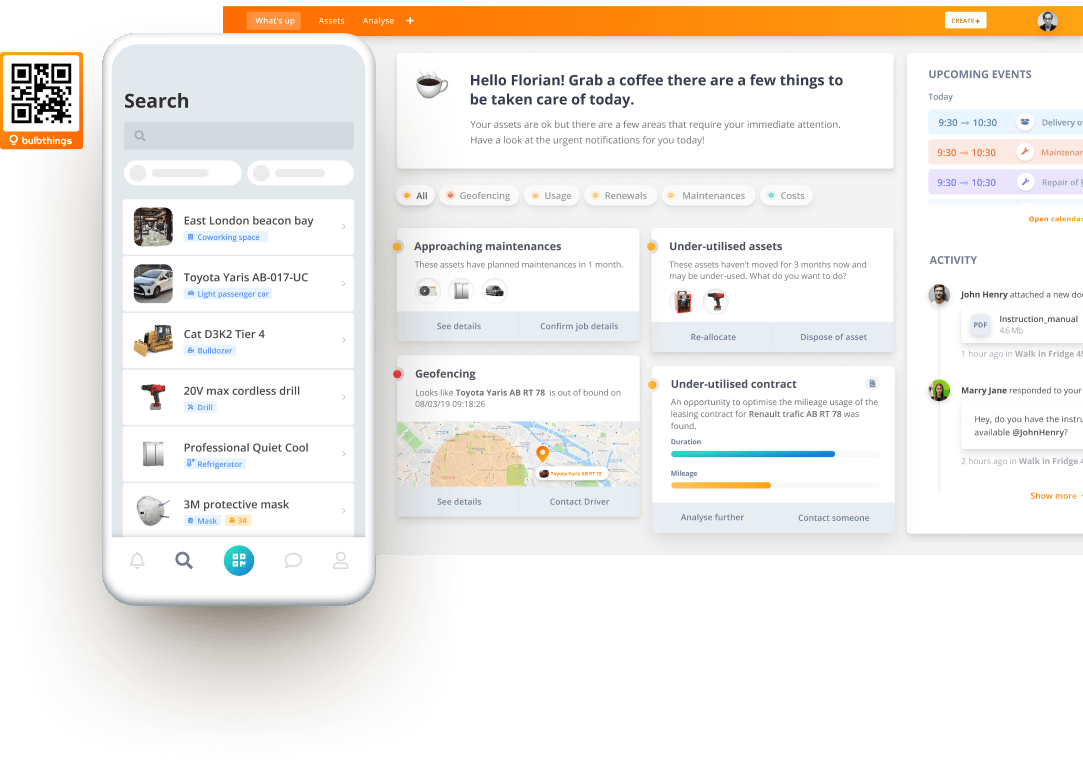
AI-powered platform unifying physical asset management for SMBs beyond spreadsheets.
Bulbthings is an AI-driven physical asset management platform that consolidates inventory tracking, booking and scheduling, maintenance planning, and team collaboration into one unified system. Targeting SMBs stuck between spreadsheets and heavyweight enterprise solutions, it leverages AI for smart asset registration, predictive maintenance, and data-driven insights, while offering open APIs for seamless integration with existing business tools.
The Overlooked Blind Spot: Enterprise Physical Assets
For many businesses, digital transformation efforts tend to focus on customer data, financial reports, and project collaboration — while the tangible "things" that physically exist in offices, warehouses, and on-site — equipment, tools, furniture, vehicles — remain stuck in a management gray zone.
Bulbthings, which recently debuted on Product Hunt, targets exactly this pain point. The product ranked 13th on the daily leaderboard with 78 upvotes, and its core proposition hits the nail on the head: "Businesses run on physical things, but most teams still manage them with spreadsheets and WhatsApp."
This statement accurately describes the reality for most small and medium-sized businesses. Asset information is scattered across Excel spreadsheets, chat logs, and employees' memories, lacking a unified "single source of truth" — leading to frequent problems like lost equipment, duplicate purchases, and delayed maintenance. "Single source of truth" is a core concept in data management, referring to the practice where all members of an organization obtain information from one authoritative data source to ensure data consistency and accuracy. When a company lacks such a single authoritative source, the same piece of information — such as which department a piece of equipment belongs to or its current status — can exist in multiple contradictory versions across different systems and people's memories, ultimately causing decision-making confusion and significantly reducing operational efficiency.
Core Features of Bulbthings
Bulbthings positions itself as an AI-powered physical asset management platform, aiming to consolidate scattered management processes into a single system. According to its official description, it covers the following key dimensions:
Unified Inventory Management
The platform creates a unified record for every physical item a company owns — from IT equipment to vehicles, from tools to office furniture — all can be registered, categorized, and tracked. This fundamentally solves the basic questions of "where is it, who's responsible for it, and how much is it worth," helping businesses escape the trap of fragmented information.
Booking and Scheduling System
For shared assets (such as conference room equipment, company vehicles, and specialized tools), Bulbthings provides online booking functionality that effectively prevents resource conflicts and usage disputes, making team collaboration more organized and transparent.
Equipment Maintenance Management
Physical assets depreciate with use and require regular maintenance. Bulbthings integrates maintenance planning into the system, helping businesses proactively manage the full lifecycle of their equipment rather than reacting only after failures occur — thereby reducing downtime risks and repair costs.
Notably, the technical philosophy behind this feature aligns closely with Predictive Maintenance from the Industry 4.0 era. Traditional maintenance strategies either intervene only after equipment fails (costly) or perform maintenance on fixed schedules (potentially leading to over-maintenance or under-maintenance). Predictive maintenance collects equipment operational data — such as usage duration, frequency, and environmental conditions — and combines it with machine learning algorithms for modeling and analysis, accurately predicting the optimal maintenance window before a failure actually occurs. According to McKinsey estimates, predictive maintenance can reduce maintenance costs by 10%-40% and cut equipment downtime by 50%. In large-scale manufacturing, this technology is already quite mature. Bulbthings' unique value lies in bringing similar concepts down to the level of everyday office equipment management for SMBs, enabling non-industrial scenarios to benefit from the efficiency gains of intelligent maintenance.
Multi-Device Collaboration Experience
Bulbthings offers both desktop and mobile versions, allowing team members to update and check asset status anytime, anywhere. The product particularly emphasizes "no training needed, no chaos," demonstrating a strong commitment to usability — which is especially important for small teams without dedicated IT support.
What Role Does AI Play in Asset Management?
In terms of product categorization, Bulbthings falls under Productivity, API, and Artificial Intelligence. In the context of asset management, AI's value is primarily reflected in the following areas:
- Intelligent Asset Registration: Rapidly cataloging assets through image recognition or automation, significantly reducing the workload and error rate of manual data entry;
- Predictive Maintenance Alerts: Intelligently predicting the optimal timing for equipment servicing and replacement based on usage data and historical records;
- Data-Driven Insights: Automatically generating visual reports on asset utilization rates, cost distribution, and more, providing data support for procurement and budgeting decisions.
Additionally, the product offers open API interfaces, meaning it's not just a standalone tool but can seamlessly integrate with a company's existing ERP, financial systems, or IT management platforms, fitting into more complete business workflows. API (Application Programming Interface) is the foundational infrastructure that enables modern SaaS products to interconnect. A product with open APIs allows third-party systems to read or write information through standardized data interfaces, preventing the formation of "data silos." In actual enterprise operations, asset management systems often need to sync procurement data with ERP systems, interface with financial systems for depreciation calculations, and share device status with IT asset management tools (such as JAMF and Intune). Without API capabilities, these data flows can only rely on manual import/export — extremely inefficient and error-prone. By listing API as one of its core product categories, Bulbthings signals that its product strategy is not about building a closed standalone tool, but rather becoming a pluggable node within a company's digital ecosystem.
Market Positioning and Competitive Landscape
Asset management is not a brand-new market — mature solutions like Asset Panda and Snipe-IT already exist. Asset Panda is an enterprise-grade full-lifecycle asset tracking platform known for its highly configurable workflows and barcode/RFID scanning capabilities, serving a substantial mid-market customer base in North America. Snipe-IT is an open-source IT asset management tool that is popular among technical teams for being free and self-hostable, though its functionality primarily focuses on IT equipment (laptops, monitors, software licenses, etc.), with relatively limited support for non-IT physical assets. Additionally, products like EZOfficeInventory, UpKeep, and Limble CMMS approach this space from inventory management or maintenance management angles. Overall, this market is characterized by "many tools but little integration" — companies often need to combine multiple tools to cover their complete asset management needs.
Bulbthings differentiates itself in two key ways: first, using AI capabilities to lower the barrier to entry, making the platform accessible even to non-specialists; and second, emphasizing aesthetically pleasing and lightweight product design, breaking the stereotype of traditional enterprise software being clunky and hard to use.
In terms of target users, Bulbthings is best suited for SMBs that have a meaningful volume of physical assets but lack a dedicated asset management team. These companies are often stuck in the awkward position where "Excel spreadsheets are no longer sufficient, but professional systems are too heavy." This dilemma is extremely common in SMB digital transformation: free or low-cost general-purpose tools (like Excel and Google Sheets) are flexible but lack specialized features and automation capabilities, quickly hitting their limits as businesses scale; while enterprise-grade professional systems (like SAP EAM and IBM Maximo) are powerful but have long deployment cycles and high customization costs, with annual fees often ranging from hundreds of thousands to millions — far exceeding SMB budgets. This "middle ground" has been a golden zone for SaaS startups in recent years — offering professional-grade functionality through cloud subscription models while maintaining lightweight deployment and user experiences. The success of products like Notion, Airtable, and Monday.com all validate this market logic, and Bulbthings is applying the same approach to the vertical domain of physical asset management, neatly filling this market gap.
Conclusion: Physical Asset Digitization Deserves More Attention
The emergence of Bulbthings reminds us that enterprise digital transformation shouldn't focus solely on "data" — it should also cover the tangible "things" you can see and touch. Integrating inventory management, booking and scheduling, maintenance planning, and team collaboration into a unified platform, augmented by AI to boost operational efficiency — this product philosophy is logically clear and pragmatic.
Of course, as a newly launched product, Bulbthings' actual effectiveness of its AI capabilities, system stability, and real-world performance in enterprise environments still need to be validated through more user feedback. But at the very least, it offers a modern solution worth watching for the long-neglected field of physical asset management.
Related articles

AgentCore in Practice: Connecting Custom Tools and MCP Servers to Agents
DebuggerCafe tutorial shows how to connect custom tools and MCP servers to Amazon Bedrock AgentCore agents, covering tool contract design, MCP reuse, and production concerns.

816B Parameters Scores Only 39? The Real Cost-Effectiveness of the Open-Source LLM Parameter Race
Meta's 816B Muse Spark Open scores just 39 on Artificial Analysis, while 180B Qwen3.8-Flash-Next scores 40. This article analyzes 11 open-weight models' parameters vs. scores, exploring the real impact of activated parameters, quantized size, and deployment cost.

Aerial Manipulators: The Next Step for Drones from 'Seeing' to 'Changing'
Starting from a Reddit discussion, this article analyzes the technical challenges, potential applications, and deployment bottlenecks of aerial manipulators, exploring the key challenges for drones moving from environmental perception to physical manipulation.