Bumble Sells for $1.3 Billion: The Online Dating Industry Hits a Reset Moment

Bumble's $1.3 billion acquisition marks the online dating industry's shift from growth to consolidation.
Bumble has agreed to be acquired for $1.3 billion, closing its independent era and warning the entire online dating industry. The article argues Bumble's core dilemma isn't operational failure but the structural breakdown of the subscription model amid matching pool saturation, user fatigue, and competitive pressure. The deal signals that the window for independent operation is closing, capital no longer waits for growth stories, and product innovation must go beyond swipe matching.
The online dating industry is undergoing a structural shock. Bumble has agreed to be acquired for $1.3 billion, drawing a chapter-closing line under what was once a star company—and casting a huge question mark over the future direction of the entire sector.
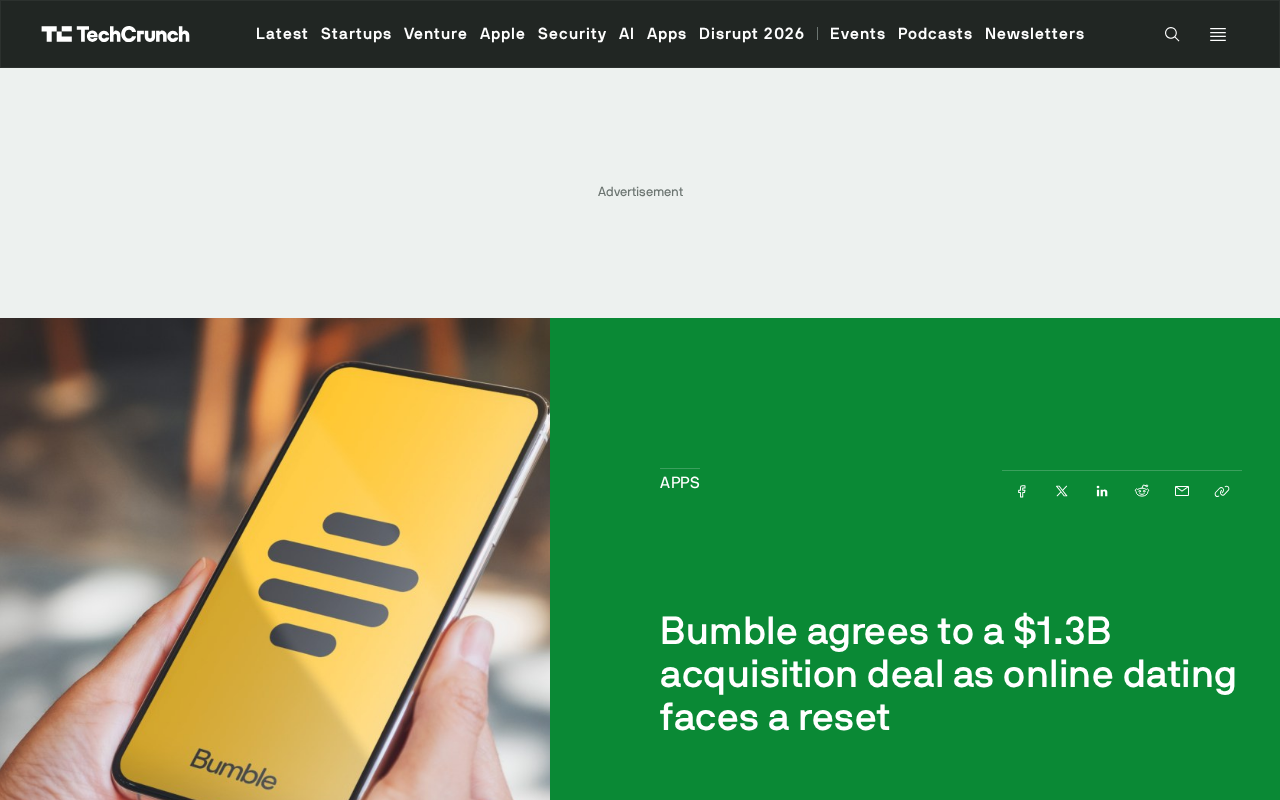
One Deal, the End of an Era
$1.3 billion might have been a rounding error in Bumble's valuation just a few years ago, but now it serves as the "alternative" to continuing to operate independently. According to the original report, Bumble's subscriber numbers have been declining for years, with revenue shrinking in tandem. This isn't a case of one company's operational missteps—it's a collective predicament facing the entire online dating market after pandemic-era tailwinds faded, user fatigue set in, and competition intensified.
The acquisition means Bumble will no longer face quarterly earnings pressure as an independent public company, but it also means a brand that once broke Tinder's monopoly and differentiated itself with a women-first matching mechanism has officially entered a phase of "being consolidated."
Why Has the Subscription Model Stalled?
The Breakdown of User Growth Logic
Bumble's core revenue comes from subscription services. When the user base grows, subscription conversion and renewal figures naturally look good. But dating apps have a clear physical ceiling: the number of potential matches in any given city is finite. Once platform penetration approaches saturation, the marginal matching value brought by new users drops sharply. Users find that "it's the same batch of people every time you swipe," and both activity levels and willingness to pay decline in lockstep.
Competitive Squeeze and Alternative Options
On the other side, Tinder's parent company Match Group still holds a size advantage, while emerging social formats—from Discord interest communities to Xiaohongshu-style casual dating—are diverting young users' attention. According to the original data, Bumble's paying user count and revenue have declined for multiple consecutive years. This isn't a single-quarter fluctuation—it's a trend-level decline.
Network Effects and Matching Pool Saturation
Dating apps are essentially classic two-sided market products, whose value depends on the bilateral density of active users within the same geographic area. Unlike social networks, dating apps have a counterintuitive "negative network effect": when there are too many potential matches, users fall into choice overload and decision fatigue (the so-called "Tinder fatigue"); and once platform penetration reaches a certain level, genuinely new matchable users tend toward exhaustion. At this point, the marginal value brought by any new user is diminishing—existing users see repeated faces, match success rates decline, and the appeal of paid unlock features and other value-added services drops accordingly. This is precisely the structural reason why subscription revenue for platforms like Bumble has peaked: it's not insufficient marketing, but rather that the available matching pool within physical radius is approaching its upper limit. Breaking this deadlock typically requires expanding to broader geographic ranges, more niche demographics, or entirely new social scenarios—but this often comes at the cost of match quality and conversion rates.
Match Group's Scale and Multi-Brand Portfolio
Match Group is a Nasdaq-listed dating industry giant that owns dozens of brands including Tinder, Hinge, Match, OkCupid, and Plenty of Fish. This "multi-brand matrix" strategy allows it to occupy positions across different age groups and dating intentions—using Tinder to capture young casual users while Hinge targets those seeking serious relationships. The core logic preventing internal brand cannibalization is that different demographics have fundamentally different expectations of "dating purpose." By contrast, Bumble has long relied on a single brand, lacking a buffer pool once its core user group erodes. Understanding this background helps clarify why industry consolidation pressure falls first on "single-brand independent companies": in a zero-sum game phase, scale and matrix operational capability are themselves moats.
What Does the Online Dating Industry's "Reset" Mean?
This acquisition is not an isolated event for the entire industry. It sends three signals:
- The window for independent operation is closing. When one of the top platforms chooses to sell rather than continue competing independently, it means the market has shifted from competing for growth to consolidating existing players.
- Capital is no longer patiently waiting for the "next growth story." After years of decline, investors prefer to see an exit rather than continue betting on a sector that requires fundamental product transformation to turn around.
- Product innovation must go beyond "swipe matching." If the core experience of dating apps hasn't changed fundamentally in the past decade, user attrition is almost inevitable.
What Happens to Bumble After the Acquisition?
Acquisitions typically lead to two paths: one is continuing to operate as an independent brand with funding and resource support from the parent company; the other is gradually being integrated into the acquirer's product ecosystem, ultimately losing independent identity. Given Bumble's brand recognition and female user base, the former is more likely—but this also depends on the acquirer's strategic intentions.
For users, the product experience is unlikely to change dramatically in the short term, but in the long run, pricing strategy, matching algorithms, and even brand tone could all be redefined. For the industry, this deal is a clear signal: online dating is no longer a sector where you can win the market just by "changing how you swipe."
The real reset isn't a change in company ownership—it's that the entire industry needs to answer a fundamental question again: when users are tired of "left swipe, right swipe," what irreplaceable value can dating apps still offer?
Common Integration Paths After Private Equity Acquisition
After tech companies are acquired—especially by private equity or strategic buyers—they typically go through several phases: the first year is a "stabilization period," retaining the original brand and management team to avoid user and employee attrition; next comes a "cost synergy period," improving profit margins by merging redundant functions and optimizing server and marketing expenses; finally comes a "strategic repositioning period," either folding the brand into the parent company's product ecosystem or restructuring it as an asset targeting a specific niche market. Bumble's women-first matching mechanism and strong brand recognition give it value worth retaining as an independent brand—but if the acquirer is itself a dating sector player, the probability of long-term integration rises significantly. For observers, simple signals to judge the nature of this deal are: whether Bumble changes its CEO after the acquisition, whether it continues independent brand advertising, and whether subscription pricing strategy undergoes obvious changes.
One-line Summary
Bumble's $1.3 billion acquisition marks the online dating industry's transition from growth expansion to consolidation.
Paragraph Summary
Bumble has agreed to be acquired for $1.3 billion, closing the book on its independent operation era and sounding a warning bell for the entire online dating industry. The article points out that Bumble's core predicament isn't operational failure, but the structural failure of the subscription model amid matching pool saturation, user fatigue, and competitive squeeze—once the user base peaks, marginal matching value drops sharply and willingness to pay declines in tandem. Meanwhile, Match Group's multi-brand matrix and emerging social formats' attention diversion further compress Bumble's living space. The deal sends three signals: the window for independent operation is closing, capital is no longer waiting for the next growth story, and product innovation must go beyond swipe matching. The real industry reset lies in re-answering what irreplaceable value dating apps can offer when users tire of left-swiping and right-swiping.
Related articles

OpenAI Partners with Shield: How the Astra Agent Revolutionizes IT Troubleshooting
OpenAI and Shield launch the Astra agent, which autonomously logs into computers and legacy systems to fix IT issues in real time, 35-40% faster than traditional models, with humans involved only when judgment is needed.

iPhone Duo Battery Life Tested: One Charge a Day Is Unavoidable, and the Large Screen Is the Culprit
iPhone Duo battery test: heavy use needs at least one charge a day, and about 30% remains after 6.5 hours of screen-on time. How often the large screen is unfolded is key; a MagSafe battery pack helps, and long-term degradation is also worth watching.

Kimi K3.1 Pro Open-Sourced: 2.8 Trillion Parameters Close In on Opus
Moonshot releases the open-source MoE model Kimi K3.1 Pro, with 2.8T total parameters and 104B activated, trailing Opus 5.5 by under 1 point on Terminal Bench 4.0.