Busabase Deep Dive: A Database Built for AI Agents
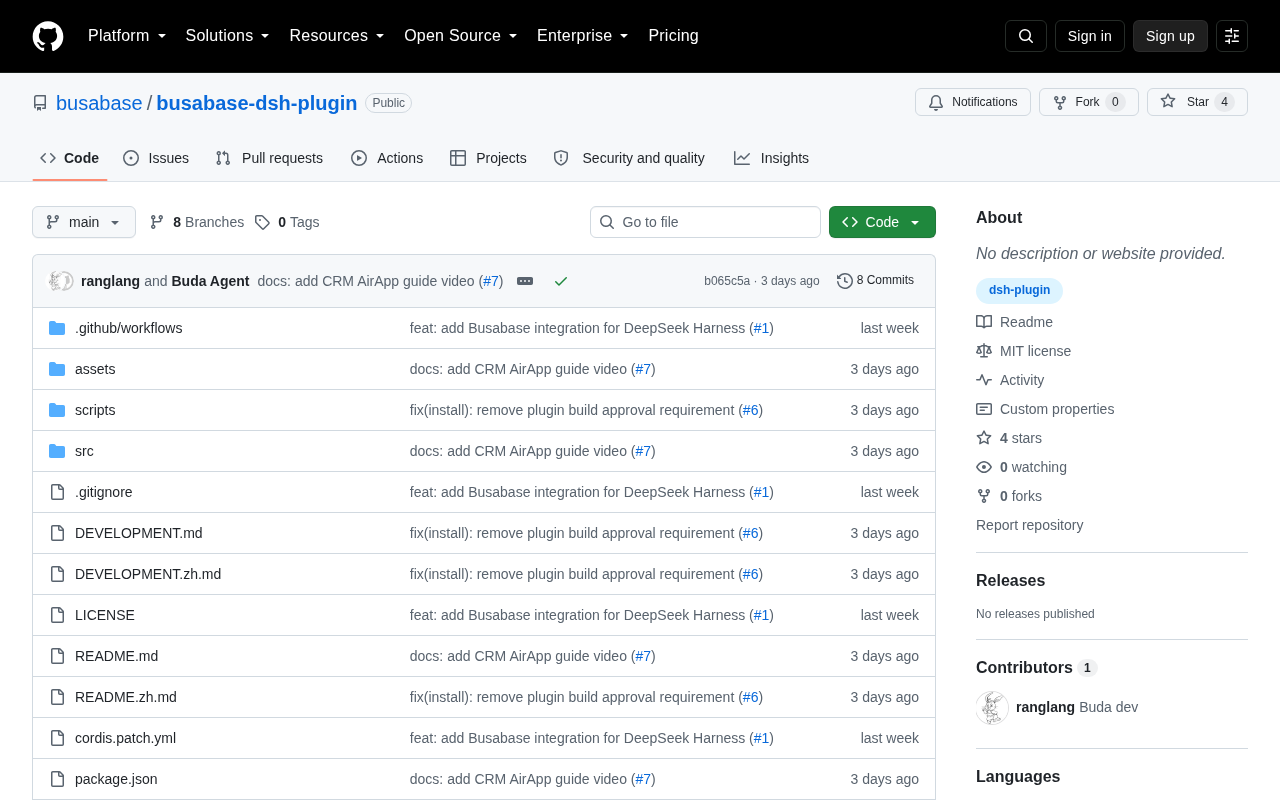
Busabase merges data storage and skill execution into a unified Agent-native database.
Busabase for DeepSeek Harness is an emerging Agent database that combines data storage with computational execution to serve AI Agent runtime needs. By consolidating vector databases, task queues, and sandbox environments into a single platform, it addresses the infrastructure fragmentation pain point in Agent development. While its market timing and concept are promising, questions around maturity, ecosystem openness, and long-term sustainability remain.
The Agent Era Demands a New Kind of Database
As large language models (LLMs) rapidly advance in capability, AI Agents are moving from concept to reality. LLMs have evolved from the text generation of the GPT-3 era, through breakthroughs like Instruction Tuning and RLHF (Reinforcement Learning from Human Feedback), to gradually acquiring Tool Use and Function Calling capabilities. This breakthrough has transformed LLMs from passive Q&A systems into proactive task executors — the defining characteristic of an Agent is the perception-reasoning-action loop: it can understand user intent, formulate execution plans, invoke external tools to complete subtasks, and dynamically adjust strategies based on feedback. This is fundamentally different from traditional software automation with pre-defined, fixed workflows.
Unlike traditional software, Agents need more than just the ability to read and write data — they need the ability to execute: running applications, invoking skills, and completing complex multi-step tasks. Busabase for DeepSeek Harness, which recently appeared on Hacker News, is a new product targeting exactly this trend. It positions itself as "an Agent database that can run applications and skills."
This is an ambitious positioning. Traditional databases are responsible for storage and retrieval, but Busabase attempts to merge "computational execution" with "data storage," specifically serving the runtime needs of AI Agents. Let's take a deeper look at this product concept in the context of the current Agent infrastructure landscape.
What Is an Agent Database?
A Paradigm Shift from Storage to Execution
Traditional databases (like PostgreSQL and MongoDB) focus on data persistence, consistency, and query efficiency. PostgreSQL, as a representative relational database, is built on relational algebra and excels at ACID transactions (Atomicity, Consistency, Isolation, Durability) for structured data. Document databases like MongoDB offer flexible schema design for semi-structured data. However, the core design philosophy of both types is the "separation of storage and retrieval" — the database handles only data persistence and querying, while business logic is handled at the application layer. Although Stored Procedures once attempted to push computation into the database layer, they never became a mainstream computational execution platform due to limitations in security models and programming paradigms.
The emerging concept of an "Agent database" attempts to layer an execution layer on top of the data layer — not only storing an Agent's memory and state, but also executing skill logic directly near the data, achieving deep synergy between data and computation.
For an AI Agent, its workflow typically involves several key components:
- Memory Management: Storing conversation history, task context, and long-term memory. An Agent's memory system is typically divided into short-term memory (the context window of the current conversation), working memory (the state of tasks currently being processed), and long-term memory (knowledge and experience persisted across sessions). Different types of memory have significant differences in storage structure and retrieval strategies.
- Skill Invocation: Executing predefined functions, tools, or APIs, including web search, code execution, database queries, third-party service calls, and more.
- Application Execution: Running complete application logic in a controlled environment, such as data analysis pipelines or document processing workflows.
- State Maintenance: Tracking intermediate states of multi-step tasks, including task dependency graphs, execution progress, error recovery points, and other information.
Busabase's core proposition is to consolidate all of these capabilities into a unified data backend, so that an Agent's "data" and "behavior" are no longer separated. Developers no longer need to cobble together vector databases, task queues, function runtimes, and other independent systems — instead, they can accomplish everything through a single platform.
Busabase's Deep Integration with DeepSeek Harness
Interestingly, the product name explicitly mentions DeepSeek Harness. DeepSeek, developed by the company DeepSeek (深度求索), features flagship models DeepSeek-V2/V3 that employ an innovative MoE (Mixture of Experts) architecture and Multi-head Latent Attention mechanism, dramatically reducing inference costs while maintaining performance levels comparable to top closed-source models. The DeepSeek-R1 series focuses on reasoning capabilities, achieving outstanding performance on math and programming tasks through long Chain-of-Thought training. DeepSeek has emerged as a leading open-source LLM known for its exceptional cost-performance ratio and strong reasoning capabilities.
"Harness" in the LLM ecosystem typically refers to a model's invocation framework and orchestration layer, responsible for managing prompt templates, tool registration, multi-turn conversation state, and evaluation pipelines — serving as a middleware that provides tool calling, evaluation, and orchestration capabilities.
Busabase's choice to deeply integrate with DeepSeek Harness reflects a clear strategic direction: building supporting infrastructure around a specific open-source model ecosystem. At its core, this is a bet on the rapid growth of the Chinese open-source LLM ecosystem, aiming to become an indispensable infrastructure component within it. Optimizing for a specific model can yield better performance and tighter integration — for example, optimizing data sharding strategies for DeepSeek's MoE architecture characteristics, or deeply adapting to its function calling protocol. However, this may also introduce a degree of ecosystem lock-in risk — developers who later wish to migrate to other models may face significant switching costs.
The Current State of Agent Infrastructure
Why Agents Need a Dedicated Backend
In recent years, Agent frameworks have proliferated — from LangChain and AutoGPT to various enterprise-grade Agent platforms. LangChain is currently the most popular LLM application development framework, offering abstraction layers for Chains, Agents, and Memory, but it does not solve underlying storage and execution problems. AutoGPT was an iconic early Agent concept project that demonstrated the possibility of LLMs autonomously decomposing tasks and executing them recursively, but it gradually cooled off due to insufficient stability and practicality. More recently, multi-Agent collaboration frameworks like Microsoft's AutoGen and CrewAI, as well as commercial Agent platforms like OpenAI's Assistants API, deserve attention. These frameworks share a common trait: they focus on the orchestration and application layers while outsourcing storage, execution, and other low-level capabilities to third-party components.
This brings us to a widespread pain point: infrastructure fragmentation. Developers often need to simultaneously manage:
- Vector databases (for RAG — Retrieval-Augmented Generation): RAG is one of the most important architectural patterns in current LLM applications. Its core idea is to retrieve relevant document fragments from an external knowledge base before the LLM generates an answer, injecting the retrieved results as context into the prompt. Vector databases (such as Pinecone, Weaviate, Milvus) are core components of the RAG pipeline, converting text into high-dimensional vectors via embedding models and providing efficient Approximate Nearest Neighbor (ANN) search capabilities. However, vector databases typically only solve the semantic retrieval problem and do not cover other Agent needs like task scheduling or code execution.
- Relational or document databases (for structured data storage), managing user information, configuration parameters, task metadata, and other traditional structured data.
- Message queues or workflow engines (for task orchestration and scheduling), such as Celery, Temporal, and Apache Airflow, handling asynchronous task distribution, retry mechanisms, and workflow orchestration.
- Sandbox environments (for securely executing code or skills), providing isolated runtime environments to execute LLM-generated code or invoke external tools.
This tech stack complexity significantly slows down the development and deployment of Agent applications. The emergence of all-in-one Agent databases like Busabase is a direct response to this pain point — converging the tech stack to lower the barrier to building Agent applications. This approach is consistent with the "hyperconverged" trend in the database world, similar to how NewSQL databases attempt to merge OLTP and OLAP. Agent databases merge storage and execution.
Core Technical Challenges of Running Skills
Enabling a database to "run applications and skills" is far from trivial. It involves several deep technical challenges:
- Security Isolation: When executing external code or skills, sandbox security must be guaranteed to prevent malicious or erroneous code from damaging the system. Current mainstream sandboxing technologies include: container-level isolation (e.g., Docker, gVisor), which uses Linux kernel namespace and cgroup mechanisms to isolate processes, networks, and file systems; WebAssembly (Wasm) sandboxes, which provide lightweight isolation with near-native performance and have been widely adopted in edge computing and plugin systems; and more fine-grained isolation solutions based on eBPF system call filtering and V8 Isolates. The unique challenge in Agent scenarios is that the executed code may be dynamically generated by an LLM, making its behavior unpredictable. Therefore, the sandbox must not only defend against malicious attacks but also gracefully handle infinite loops, memory leaks, illegal system calls, and other anomalies.
- State Consistency: During multi-step execution, data and execution state must be kept strictly consistent. This involves classic distributed systems problems like distributed transaction management, fault recovery, and idempotency guarantees, which become even more complex in Agent scenarios due to the dynamic nature of execution paths.
- Observability: Agent behavior is often unpredictable, requiring comprehensive logging, tracing, and debugging capabilities. Traditional APM (Application Performance Monitoring) tools are not easily adapted to an Agent's non-linear execution paths. Specialized Agent tracing solutions are needed to record the decision-making reasoning process, tool call parameters, and return results at each step.
- Performance and Scalability: Merging the execution layer with the storage layer may introduce performance bottlenecks, requiring careful architectural design. Compute-intensive skill execution and IO-intensive data read/write operations have fundamentally different resource requirements. How to achieve efficient resource scheduling and elastic scaling within the same system is a major engineering challenge.
These challenges determine whether Agent databases can truly make it into production environments or remain at the concept demo stage.
Busabase: Opportunities and Uncertainties
The Market Timing Is Right
From a timing perspective, Busabase is entering a market on the verge of explosive growth. As open-source models like DeepSeek democratize Agent capabilities — DeepSeek-V3's API call costs are only a fraction of GPT-4's, dramatically reducing the operational costs of Agent applications — small and medium teams and independent developers have a real and urgent need for low-cost, easy-to-use Agent backends. A database that can run skills out of the box, if the user experience is smooth enough, genuinely has the opportunity to fill a current market gap.
From an industry trend perspective, Gartner predicts that by 2028, 33% of enterprise software will incorporate Agent capabilities, yet the maturity of current Agent development toolchains lags far behind this demand growth. There is an enormous market opportunity at the infrastructure layer.
Potential Risks Worth Watching
As an early-stage product that has received only limited attention on Hacker News, Busabase currently lacks sufficient community validation and real-world deployment cases. The following points are worth careful evaluation by potential users:
- Product Maturity: Whether it has been thoroughly tested in real production environments, particularly regarding stability and reliability under high concurrency and long-running scenarios.
- Ecosystem Openness: Whether it serves only the DeepSeek ecosystem or is compatible with other mainstream models (such as Claude, the GPT series, Llama, etc.) and supports standardized tool calling protocols (such as OpenAI's Function Calling format).
- Documentation and Community Building: For an infrastructure product, documentation quality and community activity are crucial. Developers are typically very cautious when choosing foundational infrastructure — comprehensive documentation, rich examples, and active community support are key to building trust.
- Long-term Sustainability: The maintenance and evolution capabilities of early-stage open-source projects — including team size, funding support, and release cadence — directly influence enterprise adoption decisions.
The Future Direction of Agent Infrastructure
Busabase for DeepSeek Harness represents an important emerging trend — Agent-native infrastructure. As AI evolves from "answering questions" to "completing tasks," the underlying systems that support it must evolve as well. An Agent database that unifies data storage and skill execution may be a critical piece of this evolutionary path.
From a broader perspective, the evolution of Agent infrastructure may follow a trajectory similar to cloud computing: from IaaS (Infrastructure as a Service) to PaaS (Platform as a Service) to SaaS (Software as a Service). Agent infrastructure may similarly evolve from the current stage of cobbling together components, to a platformized stage, and ultimately to a standardized Agent runtime specification. As a core component in this evolution, the design philosophy and technical standards of Agent databases will profoundly shape the direction of the entire Agent ecosystem.
Although the product is still in its early stages with limited community attention, the direction it points to is worth deep consideration across the industry: In the Agent era, what kind of data and computing infrastructure do we actually need? The answer may not yet be entirely clear, but the exploration has begun. For developers focused on the engineering and production deployment of AI Agents, continuously tracking the evolution of the Agent database sub-sector will help them seize the initiative in the technological transformations ahead.
Related articles

Edu-QuRating: How Multi-Dimensional Educational Data Curation Improves LLM Training Quality
Deep dive into the Edu-QuRating multi-dimensional educational data curation framework, achieving 0.917 accuracy via distilled pairwise judgments across six dimensions to improve LLM pre-training and GRPO post-training.

The AI Filmmaking Cost Revolution: A $2 Million Production Completed for $90
A creator spent just $90 on AI tools to independently produce a short film that would traditionally cost $2 million. Explore how AI is revolutionizing filmmaking from visuals to voice to music.

Vercel AI SDK xAI Integration Adds Batch Management Features
Vercel AI SDK xAI provider releases v4.0.57 with batch cancellation and listing features, improving cost management and task observability for Grok model apps.