ByteDance Interviewer Deep Dive: How Vibe Coding Is Reshaping Frontend Engineers' Core Competitiveness

ByteDance interviewer reveals how Vibe Coding is reshaping frontend engineering interviews and skill requirements.
A ByteDance interviewer publicly breaks down how Vibe Coding (AI-assisted programming) is transforming big tech hiring. Interviews now test three layers: AI tool familiarity, engineering complex products with AI, and completing full-stack development in one hour. The message is clear — architectural thinking and the ability to direct AI tools are the new core competencies for engineers.
Is Frontend Development Really Being Replaced by AI?
"Will ordinary frontend developers lose their jobs?" As AI-assisted programming sweeps across the dev industry, this has become an anxiety no engineer can escape. Recently, a ByteDance interviewer shared an in-depth breakdown in a public Bilibili session, analyzing internal Vibe Coding (AI-assisted programming) practices and the latest interview questions designed around AI coding capabilities.
The core message isn't pessimistic — but it's a serious wake-up call: today, whether frontend or backend, the vast majority of technical development scenarios have already incorporated significant AI involvement. If a developer still lacks the mindset to "program with AI," they're already falling behind in the competition.

The interviewer emphasized that this discussion isn't meant to generate anxiety, but to help developers see the real industry trajectory — Vibe Coding is rapidly going mainstream and is redefining what it means to be a qualified engineer.
What Is Vibe Coding?
Vibe Coding is a programming paradigm centered on AI large language models: developers no longer write code line by line. Instead, they describe requirements, intent, and architecture in natural language, letting models like Claude and GPT generate, modify, and debug code. The engineer's role shifts from "code monkey" to "director" and "architect."
Technical Background: The term "Vibe Coding" was officially coined by OpenAI co-founder Andrej Karpathy in early 2025. He described a brand-new programming experience on social media: developers fully immerse themselves in the "vibe," express intent through natural language, and barely write code by hand. The technical foundation of this paradigm is the breakthrough progress LLMs have made in code generation — from GPT-3.5's era of "functional but error-prone" to models like Claude 3.5, GPT-4o, and Gemini 1.5 Pro that are "trustworthy and production-ready." Context windows have expanded from an initial 4K tokens to 200K or even 1 million tokens, making it possible for AI to understand and operate on entire codebases.
This shift means the yardstick for measuring an engineer's value will move away from "how much code can you write" toward "can you leverage AI to efficiently produce high-quality code."
The Three-Layer Logic Behind Big Tech Interviews
According to this ByteDance interviewer, Vibe Coding assessments are structured into three progressive levels — from tool awareness to engineering quality, to full-stack architecture capability.
Layer 1: Foundational Knowledge of AI Tools and Models
Entry-level questions typically sound like: "Have you used Vibe Coding in past projects? What models and tools are you familiar with? How do you handle code chaos that arises during AI-assisted programming?"
Deceptively simple — but actually a dividing line. It evaluates three things:
- Whether you've genuinely used AI programming in real projects, not just "heard about it";
- Your familiarity with mainstream tools and models like Cursor, Claude Code, and Codex;
- Most critically — how you deal with code chaos when AI-generated code goes off the rails.
The AI Programming Tool Ecosystem: The AI programming tools market has developed a clear product matrix. Cursor is currently the most popular AI-native IDE among developers — a deeply modified fork of VS Code that supports Composer mode (concurrent multi-file editing) and Agent mode (autonomous execution of complex tasks). Claude Code is Anthropic's command-line AI programming tool, known for its ability to understand extremely large codebases. GitHub Copilot integrates as a plugin into mainstream IDEs and is the most widely enterprise-adopted tool. There are also platforms like Bolt.new and Lovable targeting no-code users, enabling complete web apps to be generated and deployed directly from natural language descriptions. The key differentiators between tools lie in context window size, multi-file coordination capability, depth of Tool Use, and integration method with the underlying model.
Code chaos is a pain point every AI programmer faces. Without clear context and constraints, AI tends to produce loosely structured, inconsistently named, and logically redundant code. Whether a developer can control output quality through thoughtful Prompt design, context management, and coding standards directly reflects their real-world depth.
Prompt Engineering and the Root Causes of Code Chaos: "Code Chaos" in AI-generated output has clear technical roots. LLMs are fundamentally probabilistic models — without sufficient constraints, they tend to generate code that "looks reasonable" but is inconsistent in style, contains duplicate logic, or has implicit dependencies. The core solution is Prompt Engineering: this includes configuring spec files like
.cursorrulesorCLAUDE.mdin the project root to specify tech stack versions, naming conventions, and forbidden patterns; adopting a "design first, implement second" two-step Prompt strategy where the model outputs a design document before writing code; and carefully controlling the granularity of each AI task to avoid single Prompts that span too many files and modules, thereby maintaining the model's contextual focus.
Layer 2: Engineering Capability for Complex Products

Mid-to-senior-level questions are closer to real business scenarios: "If you were using Vibe Coding to build a complex product like Feishu Multidimensional Tables or Feishu Docs, how would you approach the core development? How would you ensure code quality and performance?"
The difficulty spikes significantly here. Collaborative spreadsheets and online documents involve complex technical challenges like real-time collaboration, conflict resolution, large-scale data rendering, and performance optimization. Simply having AI "write runnable code" is nowhere near enough. Engineers must be able to:
- Break down a complex product into modular tasks that AI can handle;
- Perform performance tuning and quality control on top of AI-generated code;
- Judge whether the architecture AI produced is sound, and course-correct when necessary.
Core Technical Challenges of Real-Time Collaboration: Feishu Multidimensional Tables and collaborative documents are used as high-difficulty case studies because they touch on one of the most complex areas in distributed systems. The core algorithms are OT (Operational Transformation) or the more modern CRDT (Conflict-free Replicated Data Type). OT requires the server to transform concurrent operations to ensure eventual consistency, while CRDT uses mathematical data structures to guarantee conflict-free merging without central coordination — a pattern adopted by next-generation collaboration tools like Figma and Linear. Beyond the algorithms, these products also face engineering challenges like virtualized rendering for large-scale datasets (dual-track Virtual DOM + Canvas rendering), WebSocket long-connection management, and offline editing with re-synchronization. AI can quickly scaffold the basic skeleton of a collaborative app, but understanding and making architectural trade-offs around these underlying mechanisms remains an irreplaceable core value that human engineers provide.
In other words, AI takes on a massive amount of execution-layer work — but the responsibility for system design, quality judgment, and performance optimization firmly remains on human shoulders.
From Algorithm Problems to "Full-Stack Development in One Hour"
Layer 3: Expert-Level Full-Stack Architecture Challenge
The most striking level is the third — an expert-level hands-on test. The interviewer shared a scenario that turns heads:
"In the past, coding tests were about algorithm problems. Now, I give you one hour to complete the full-stack functional development — from frontend to backend to database design to the entire chain."
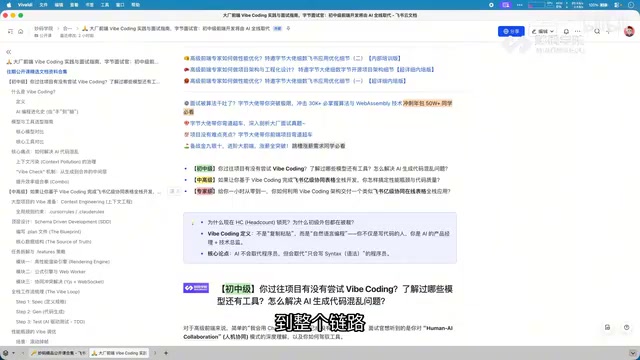
Under the traditional model, completing core full-stack features in one hour was almost unthinkable. In the Vibe Coding era, it's become practically achievable.
The interviewer noted: with tools like Cursor, Claude Code, or Codex, combined with models at the Claude Composer or GPT-5 level, completing core full-stack functionality within one hour is entirely possible — as long as you have a holistic perspective and architectural thinking.
Redefining Full-Stack Capability: Traditionally, "full-stack engineer" carried a very high barrier, requiring mastery of multiple tech stacks — large projects typically needed specialized frontend, backend, and DBA roles collaborating together. The spread of AI programming tools is redefining this concept: the specific syntax and API details of various tech stacks can increasingly be handled by models, while engineers' scarce value migrates upward to the system design level — including how to divide service boundaries (microservices vs. monolith), choosing the right database paradigm (relational vs. document vs. time-series), designing API contracts (RESTful vs. GraphQL vs. tRPC), and evaluating non-functional requirements (latency, throughput, availability). Gartner's 2025 report predicts that by 2027, over 70% of new applications will be built through low-code/AI-assisted approaches — but this doesn't mean engineers disappear. It means engineers' cognitive focus needs to shift toward systems thinking rather than syntax details.
Hands-On Case Study: Building a "Feishu Collaborative Spreadsheet" in One Hour
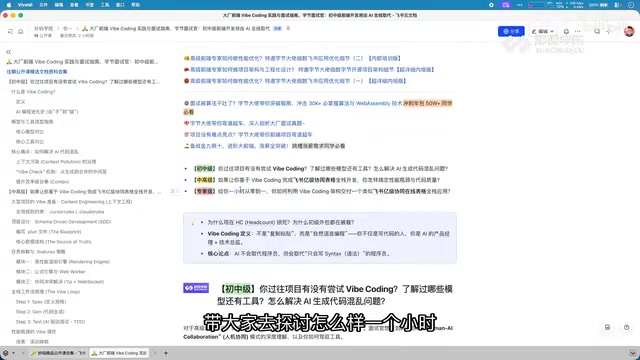
The session concluded with a highly challenging case: how to complete a full-stack collaborative spreadsheet application — similar to Feishu — in one hour using Vibe Coding.
This case clearly illustrates how the requirements for engineer capabilities have changed in the new era:
- No longer testing whether you can hand-write CRUD operations, but whether you can use architectural thinking to direct AI in rapidly building a complete system;
- No longer dwelling on elegant algorithm implementations, but focusing on the overall integrity and scalability of the system design;
- Speed and quality both matter — AI amplifies an engineer's output efficiency, but it equally amplifies the gap in architectural capability.
Closing Thoughts: Transform Instead of Worry
AI won't immediately make frontend developers "unemployed" — but it will weed out developers who refuse to adapt and only know how to do repetitive work.
The core value of future engineers will increasingly manifest in architectural design, requirement decomposition, quality assurance, and the ability to command AI tools. As AI takes over a large share of the act of writing code, human competitiveness actually returns to something more fundamental — understanding systems, designing systems, and commanding tools.
Rather than worrying about "will I be replaced," embrace Vibe Coding early and turn AI into a genuine productivity weapon. That, perhaps, is the answer this session aimed to deliver to every developer.
Key Takeaways
Related articles

WebMCP in Practice: How MakeMyTrip Is Reshaping the Travel Booking Experience
India's largest OTA platform MakeMyTrip uses WebMCP to standardize AI Agent interactions with web apps, replacing fragile DOM scraping with natural language-driven test automation and simplified complex booking scenarios.

Deep Dive into the EYG Programming Language: A New Portable Programming Paradigm Designed for Humans
Deep analysis of the EYG programming language's core design, including algebraic effects, program state persistence, and cross-platform portability, exploring how it addresses modern software fragmentation.

WebMCP in Practice: How MakeMyTrip Is Reshaping the Travel Booking Experience
India's largest OTA platform MakeMyTrip uses WebMCP to standardize AI Agent interaction with web apps, solving DOM scraping fragility, enabling natural language test automation, and simplifying complex international flight bookings.