ByteDance Releases Claude Code Chinese Manual: A Complete Guide from Zero to Mastery

ByteDance releases a comprehensive Chinese manual helping users master Claude Code from scratch.
A ByteDance team published a systematic Claude Code Chinese practical manual on Feishu (Lark), addressing pain points Chinese users face such as English documentation barriers and unstable network access. It provides full Chinese instruction from installation to advanced techniques, covering not just code development but also copywriting, data analysis, and work automation, while explaining how to integrate domestic LLMs to lower the barrier for AI programming tool adoption.
Why Do You Need a Chinese Version of the Claude Code Manual?
Claude Code is an AI programming tool launched by Anthropic that is rapidly becoming the go-to tool for developers and productivity enthusiasts. Unlike traditional IDE plugins, Claude Code adopts a terminal-native interaction approach, allowing developers to converse with AI directly in the command line to complete tasks like code generation, refactoring, and debugging. Anthropic, a leading AI company founded by former OpenAI Research VP Dario Amodei, emphasizes "Constitutional AI" as its core technical approach—using a set of principles to constrain model behavior and make it safer and more controllable. What makes Claude Code unique is its ability to understand the entire project's code context, not just the current file, making it particularly effective in large-scale projects.
However, the English-only official documentation has posed challenges for many Chinese users—struggling with installation and configuration, forgetting command syntax, and failing to grasp advanced features—all of which seriously impact the actual user experience.
Recently, a ByteDance team published a systematic Claude Code Chinese practical manual on the Feishu (Lark) platform, specifically tailored to address the use cases and common pain points of Chinese users. Covering everything from beginner basics to advanced techniques, it generated widespread attention upon release.
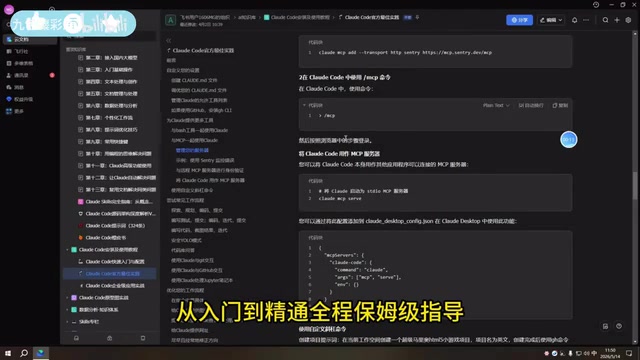
Core Highlights of the Claude Code Chinese Manual
Pure Chinese Explanations, Zero Barrier to Entry
The manual's greatest feature is its entirely Chinese instruction with no technical jargon barriers. Whether you're a programming beginner, office worker, or AI tool enthusiast, you can easily understand every step without consulting foreign-language materials. In the current AI tool tutorial ecosystem dominated by English content, this manual fills an important gap.
Seamless Integration with Domestic LLMs
Access stability for overseas AI models has long been a concern for Chinese users. The manual specifically explains how to connect Claude Code with domestic large language models, fundamentally solving network access issues and ensuring stable, smooth operation.
From a technical perspective, the core of this integration is request forwarding through an API compatibility layer. Since many domestic LLMs (such as Tongyi Qianwen, Zhipu GLM, DeepSeekAd, etc.) provide interfaces compatible with the OpenAI API format, users can redirect requests to domestic model service addresses by modifying Claude Code's API endpoint configuration. This approach typically uses intermediate proxy services or API gateways to achieve protocol conversion, solving both network access stability issues and cross-border data transmission compliance risks. Some solutions also support multi-model load balancing, allowing users to automatically switch between different underlying models based on task type.
Additionally, the manual includes a free quota usage guide, significantly lowering the cost of trying it out.
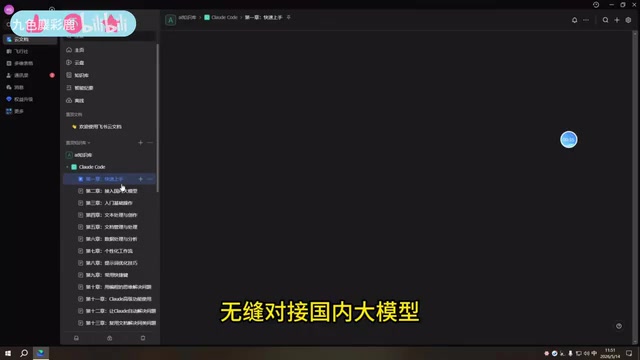
Full Scenario Coverage, Far Beyond Just Writing Code
Many people's understanding of Claude Code is limited to "writing code," but its capabilities extend far beyond that. The manual systematically covers Claude Code's practical applications in the following scenarios:
- Code Development & Debugging: Writing code, fixing bugs, code review
- Copywriting: Marketing copy, product descriptions, content planning
- Document Processing: Report generation, format conversion, content organization
- Data Analysis: Data cleaning, trend analysis, visualization
- Work Automation: Automating repetitive tasks, workflow optimization
This comprehensive scenario coverage transforms Claude Code into a truly universal productivity tool, not just an exclusive tool for programmers.
From Beginner to Expert: The Manual's Systematic Learning Path
Step-by-Step Teaching, Just Follow Along
The manual adopts a hand-holding teaching approach, starting from the most basic Claude Code installation and configuration, breaking down each step up to advanced usage techniques. Each section comes with clear operational instructions, so users don't waste time on trial and error.
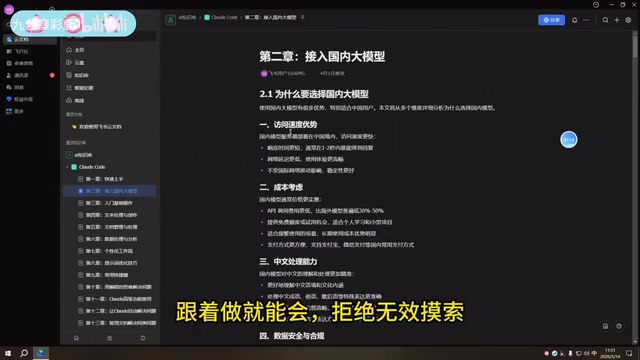
Practice-Oriented, Ready to Use After Learning
Unlike the scattered and disorganized tutorials found online, this manual is positioned as a systematic practical guide. The content consists entirely of techniques, commands, and templates that can be directly applied in real work—no redundant theoretical padding—ready for immediate implementation after learning.
The manual thoroughly organizes Claude Code's core usage methods, pitfall-avoidance tips, and efficiency techniques into a complete knowledge system. For users who previously only scratched the surface, this manual helps unlock more advanced features and truly maximize the tool's potential.
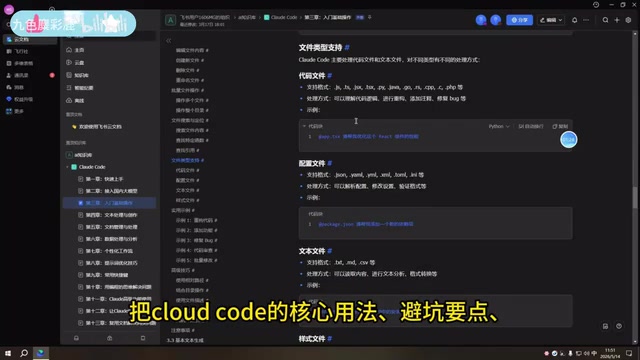
Why This Claude Code Manual Deserves Your Attention
Precisely Solving Real Pain Points for Chinese Users
Current Chinese tutorials about Claude Code on the market generally suffer from several problems: they're either entirely in English and hard to understand, only cover basic operations without depth, or have scattered content lacking structure. Leveraging Feishu's document collaboration advantages, the ByteDance team created a structured, continuously updatable tutorial system that serves as a model in the AI tool education space.
Notably, Feishu documents support real-time multi-user collaborative editing, version history tracking, comment interactions, and more, meaning the manual can be continuously iterated and updated, and community users can provide feedback and suggestions through comments. Compared to traditional PDF or blog formats, Feishu documents' structured organization capabilities (supporting multi-level directories, collapsible blocks, embedded tables, etc.) are better suited for hosting systematic tutorial content while also facilitating rapid distribution within China's tech communities.
The Inevitable Trend of AI Programming Tool Adoption
With the rapid development of AI programming tools, products like Claude Code, Cursor, and GitHub Copilot are reshaping how developers work. The current AI programming tool market has formed a multi-layered competitive landscape: GitHub Copilot, as a first mover, leverages the VS Code ecosystem and GitHub's massive code repository to hold the largest market share; Cursor has emerged as a dark horse with its AI-native IDE positioning, deeply integrating AI capabilities into every editor interaction; Claude Code takes a terminal-first approach, better suited for experienced developers accustomed to command-line workflows. Additionally, products like Windsurf (formerly Codeium), Amazon CodeWhisperer, and Google Gemini Code Assist each have their own focus areas. The common trend among these tools is evolving from simple code completion toward becoming "AI software engineers"—capable of understanding requirements, planning architecture, writing tests, executing deployments, and handling other end-to-end tasks.
But a tool's value can only be fully realized when it's used correctly. High-quality Chinese tutorials lower the learning barrier and help accelerate the adoption and deep application of AI tools in China.
Tangible Efficiency Gains
For individual users, mastering Claude Code means achieving real efficiency improvements in daily work like code development, document processing, and data analysis. The templates and commands provided in the manual can be directly reused, saving significant exploration time.
How to Access This Claude Code Chinese Manual
This Claude Code Chinese practical manual is currently published on ByteDance's Feishu platform, and users can search for and access it directly within Feishu. It's recommended to study progressively following the manual's chapter order—first complete the basic installation and configuration, then gradually explore advanced features and application scenarios.
Zero-experience users: It's recommended to spend 1-2 hours reading through the manual's core chapters to build an overall understanding before hands-on practice.
Users with some foundation: You can jump directly to the advanced techniques section to find specific feature guides you need.
Final Thoughts
In today's era of rapidly iterating AI tools, learning costs and information access efficiency directly determine who can convert new tools into productivity faster. This ByteDance-produced Claude Code Chinese manual, while essentially a tool usage guide, represents an important trend—making advanced AI tools truly accessible to the masses.
Whether you're a developer, product manager, or content creator, investing time to systematically learn an AI productivity tool is one of the most worthwhile investments you can make today.
Related articles
 Tutorials
ChatGPT Plus Subscription Guide: Are GPT-5.5, image-2, and Codex Worth the Upgrade?
A detailed look at ChatGPT Plus features — GPT-5.5, image-2, and Codex — with a Plus vs Pro comparison and a complete step-by-step subscription guide for users outside the US.
 Tutorials
Harness AI Engineering in Practice: Using Claude Code to Master Enterprise-Level E-Commerce Development
Deep dive into Harness AI Engineering: master enterprise e-commerce development with Claude Code using the Rules, Skills, Wiki, and Changes framework.
 Tutorials
Cursor + Codex Dual-IDE Collaboration: A Practical Methodology for Open-Source Project Customization
A complete methodology for open-source project customization based on real-world experience, detailing the Cursor+Codex dual-IDE workflow, seven-stage process, MVP validation, and AI source code reading techniques.