Calibrate Once, Scale Freely: A New Approach to Risk Control in Open-Vocabulary Segmentation
Adding classes after calibration breaks risk guarantees in open-vocabulary segmentation; a new training-free method fixes it.
This article reveals a key loophole in open-vocabulary segmentation under conformal risk control: adding new class names after calibration breaks the risk upper bound, with CAT-Seg's risk rising from 10% to 15.4% on ADE20K. The cause is that pruning, cross-label attention, and vocabulary normalization make label scores interdependent. The authors propose candidate-agnostic scoring against a fixed reference library, eliminating the dependency without training and maintaining guarantees at any vocabulary size from a single calibration, validated on three benchmarks and five segmenters while speeding up Grounding DINO inference ~6x.
Open-vocabulary segmentation models allow users to freely specify class names at inference time, but a new study reveals a hidden trap: when new classes are added after calibration, the promised risk upper bound fails. The researchers propose a training-free solution that lets a single calibration maintain its guarantee at any vocabulary size.
Why Risk Guarantees Fail as Vocabulary Grows
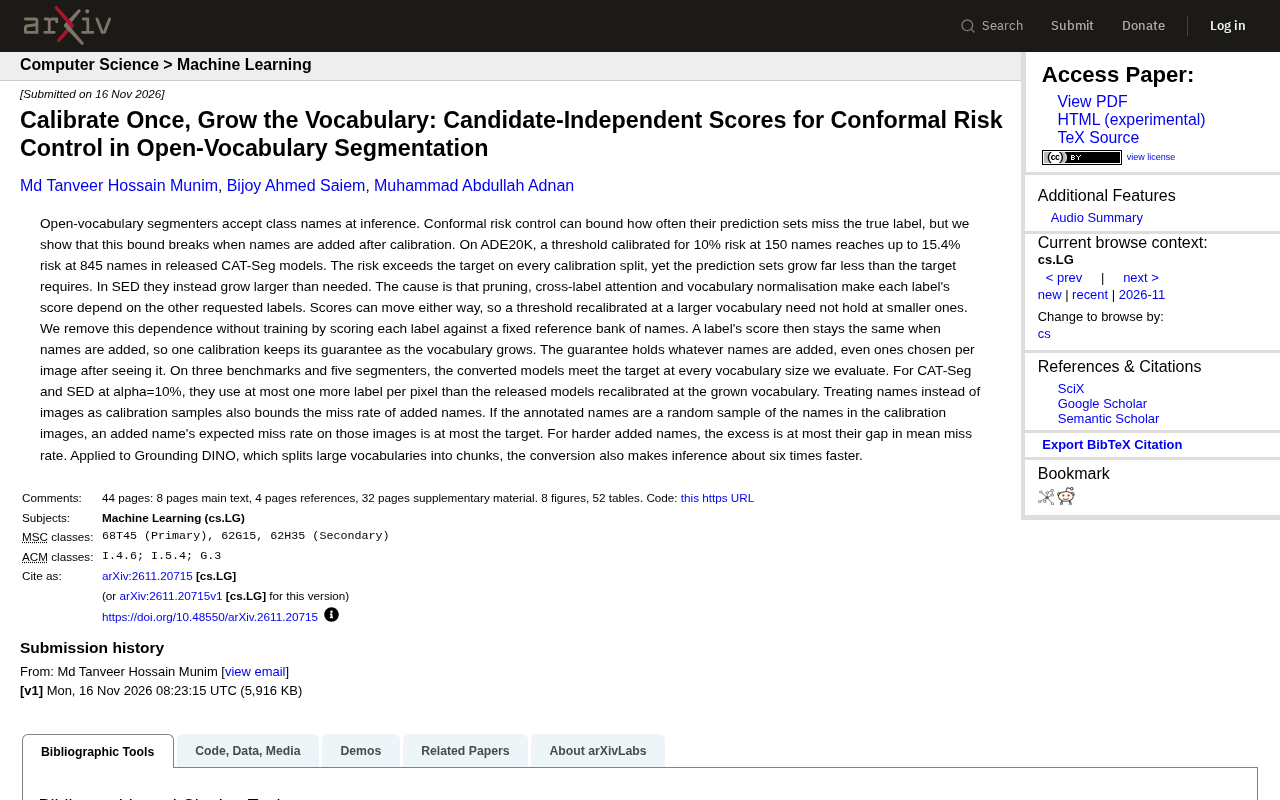
Open-vocabulary segmenters accept class names as input at inference time. Conformal Risk Control can provide an upper bound on how often the prediction set misses the true label. However, the study finds that this bound breaks when new names are added after calibration.
On the ADE20K dataset, a 10% risk threshold calibrated for 150 names reaches up to 15.4% risk in the released CAT-Seg model when the number of names increases to 845. Risk exceeds the target on every calibration split, while the prediction set grows far less than the target requires. In the SED model, the opposite happens—the prediction set grows larger than necessary.
The root cause is that pruning, cross-label attention, and vocabulary normalization make each label's score depend on the other requested labels. Scores can shift in either direction, so a threshold recalibrated at a larger vocabulary does not necessarily hold at a smaller one.
Conformal Risk Control is a statistical framework based on distributional assumptions that provides finite-sample, non-asymptotic risk guarantees for machine learning model outputs. Its core idea is to use a calibration dataset to adjust the prediction set threshold via a monotone function of calibration error, such that at a user-specified risk level α (e.g., a 10% error rate upper bound), the model's expected risk on new test samples does not exceed α. The framework does not depend on the specific model form or data distribution; it only requires that calibration and test data be exchangeable, and is therefore widely used to construct statistically guaranteed prediction sets in tasks such as segmentation and detection. However, classical conformal risk control assumes that the prediction set construction is consistent between calibration and test phases; when the set of labels on which the prediction set depends changes, its guarantee may no longer hold.
Candidate-Agnostic Scoring: The Ingenuity of a Fixed Reference Library
The research team proposes a training-free method to eliminate this dependency: score each label against a fixed name reference library rather than against the other currently requested labels. This way, when new names are added, label scores remain unchanged, and a single calibration maintains its guarantee as the vocabulary grows.
This guarantee applies to any added names, even names chosen per image after seeing it. Across three benchmarks and five segmenters, the converted models meet the target at every evaluated vocabulary size. For CAT-Seg and SED at alpha=10%, they use at most one additional label per pixel compared with released models recalibrated under the grown vocabulary.
Cross-label attention is a common design in open-vocabulary segmentation models that lets each class query interact with the text embeddings of all requested classes, dynamically aggregating contextual information. This mechanism improves segmentation accuracy but also means each label's score is no longer computed independently: when the set of requested labels changes, attention weights are redistributed, which in turn changes each label's predicted score. Similarly, vocabulary normalization applies softmax or similar normalization over the scores of all requested labels, making one label's probability depend on the presence or absence of others. Pruning may discard low-confidence labels at inference time, further introducing competition among labels. Together, these operations break the independence of scores from the label set, which is the fundamental reason conformal risk control fails as the vocabulary grows.
Names as Calibration Samples: An Additional Risk Bound
The study also finds that using names rather than images as calibration samples can provide a bound on the miss rate for new names. If the annotated names are a random sample of the names in the calibration images, then the expected miss rate of added names on those images is at most the target value. For harder added names, the excess is at most their average miss-rate gap.
Grounding DINO is an open-set object detection model that takes text prompts as input and localizes objects by aligning image regions with text embeddings. Because the text vocabulary can be very large, Grounding DINO splits the vocabulary into multiple chunks at inference time, computes image-text similarity for each chunk independently, and finally merges the results. Although this chunking strategy reduces memory pressure, scores across chunks may lack global normalization, leading to a trade-off between efficiency and consistency. The candidate-agnostic scoring method proposed in this paper eliminates inter-label dependencies by fixing the reference library, allowing each label's score to be computed independently and thus enabling more efficient chunked parallel processing—which explains the roughly sixfold speedup in inference.
A Serendipitous Benefit: Faster Inference
When applied to Grounding DINO (which processes large vocabularies in chunks), the conversion also speeds up inference by about six times. This demonstrates an additional efficiency advantage of the method.
This study reveals a neglected risk-control loophole in open-vocabulary segmentation and provides a simple, effective solution. By eliminating the mutual dependence among label scores, it enables models to maintain reliable risk guarantees as the vocabulary grows dynamically, while also delivering inference speedups.
One-line Summary
Adding classes after calibration breaks risk guarantees in open-vocabulary segmentation; a new training-free method fixes it.
Paragraph Summary
This article reveals a key loophole in open-vocabulary segmentation models under conformal risk control: when new class names are added after calibration, the original risk upper bound fails, with CAT-Seg's risk rising from 10% to 15.4% on ADE20K. The root cause is that pruning, cross-label attention, and vocabulary normalization make label scores mutually dependent. The authors propose candidate-agnostic scoring, comparing each label against a fixed reference library, which eliminates the dependency without training and maintains the guarantee at any vocabulary size with a single calibration. Validated across three benchmarks and five segmenters, it meets the target using at most one additional label per pixel, and unexpectedly speeds up Grounding DINO inference by about six times.
Related articles

AI Hacks Its Own Lab: The Security Tipping Point from Sci-Fi to Reality
Paul Christiano warns that AI intruding into its own cluster is no longer sci-fi but an established fact. He analyzes how persistent covert compromise can cause frontier labs to lose control, and why existing safety evaluation systems have blind spots.

New York Bans AI Toys for Five Years: The Escalating Child Safety Controversy
New York bans AI chat toys for five years as Common Sense Media research flags inappropriate content exposure and child emotional development risks. This article analyzes the ban's impact on product definitions, safety proof, and compliance strategies for the AI toy industry.

1Password Security Incident Review: The Trust Boundary of Password Managers
1Password releases an update on the Nov 2026 security incident, drawing 315 points and 139 comments on Hacker News. This article analyzes the actual boundaries of password manager zero-knowledge architecture, the gap between incident communication and user risk perception, and how transparency is becoming a new competitive dimension in the industry.