Calibrated Confidence Scores: The Precision Key for Document Extraction and Agentic Decision-Making

Calibrated confidence scores let AI systems quantify uncertainty honestly, enabling controlled trade-offs between precision and human review costs.
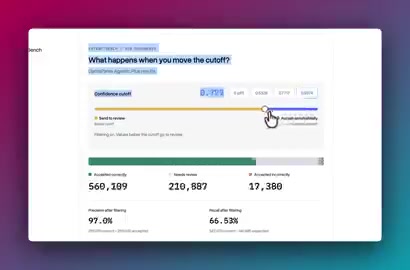
The LlamaIndex research team explores the critical role of calibrated confidence scores in production AI systems. Calibration ensures a model's reported confidence genuinely reflects actual accuracy. In document extraction, confidence thresholds enable a clear precision-vs-cost trade-off: a threshold of 0.7 yields ~95% precision while 0.9 yields ~98%, with results above the threshold auto-accepted and those below flagged for human review. The post further argues that calibrated confidence is equally vital for agentic systems — accurate uncertainty awareness helps agents decide when to act autonomously versus when to defer to humans, preventing error cascades in multi-step pipelines.
As AI-powered document extraction and agentic decision-making systems become increasingly widespread, one critical yet often overlooked question surfaces: can the confidence scores produced by these models actually be trusted? A recent blog post from the LlamaIndex research team takes a deep dive into the importance of calibrated confidence scores, offering practical insights for building reliable, production-grade AI systems.


Why Confidence Scores Need to Be "Calibrated"
Many AI models attach a confidence value to their outputs — but without proper calibration, that number is often little more than a self-congratulatory illusion. Calibration means that the confidence a model reports genuinely reflects the actual probability of being correct. When a model says it's 90% confident, its outputs in that confidence bracket should indeed be correct roughly 90% of the time.
This is especially critical in complex document extraction scenarios. Document structures vary wildly, field semantics are often ambiguous, and formatting is inconsistent — the real-world uncertainty a model faces far exceeds what's seen in standardized test sets. The LlamaIndex team emphasizes that they have invested significant engineering effort to ensure their confidence scores genuinely represent uncertainty over complex documents in production, rather than inflated numbers that look good on paper.
Calibration quality is typically measured using Calibration Error, with the most common metric being Expected Calibration Error (ECE). It's calculated by grouping all predictions into confidence buckets, comparing the average confidence against the actual accuracy within each bucket, and computing a weighted sum of the differences. The closer ECE is to 0, the more honest the model's confidence estimates are. Uncalibrated neural networks typically suffer from overconfidence — the model outputs high confidence scores while actual accuracy falls well below those values, a problem that's especially pronounced on out-of-distribution data. Common post-hoc calibration techniques include Temperature Scaling, Platt Scaling, and Isotonic Regression. These methods fit a correction function on a held-out validation set to remap raw outputs into more reliable probability estimates, without requiring the model to be retrained.
How Confidence Thresholds Balance Accuracy and Human Review Costs
The most immediate value of well-calibrated confidence scores is that they make Human-in-the-Loop (HITL) review strategies quantifiable and controllable.
The approach is straightforward: set a confidence threshold. Extraction results above the threshold are automatically accepted; those below it are flagged for human review. This allows teams to find the ideal balance between automation efficiency and output accuracy.
Higher Threshold = Higher Precision
Based on the data examples provided in the blog post, the choice of threshold directly maps to a guaranteed precision level:
- Confidence threshold of 0.7 → approximately 95% precision
- Confidence threshold of 0.9 → approximately 98% precision
This means that when a business demands extremely high accuracy — such as in financial, legal, or medical document processing — raising the threshold yields stronger precision guarantees. The trade-off is that the higher the threshold, the more results fall into the human review queue, increasing the volume of "false negatives" (correct results that get flagged unnecessarily).
The elegance of this mechanism is that it transforms the vague question of "how good is the model?" into a clear business trade-off: how much human review cost are you willing to pay for a given level of precision?
Extending Beyond Document Extraction to Agentic Decision-Making
Notably, the significance of calibrated confidence is not limited to document extraction. The LlamaIndex team points out that this capability is equally critical for broader agentic decision-making, specifically citing the context of their agent product, Jev.
In agentic systems, the AI must autonomously determine when to take action and when to pause and request human intervention. If an agent's confidence estimates are distorted, it may act rashly when uncertain, or repeatedly defer to humans when it's perfectly capable of proceeding. A well-calibrated confidence framework allows agents to make more rational decisions about "when to act independently and when to hand off to humans" — a foundational piece of infrastructure for building trustworthy autonomous systems.
In multi-step agent architectures, the importance of confidence calibration is amplified through chain effects. In a typical ReAct or Plan-and-Execute framework, an agent executes a sequence of tool calls, information retrieval steps, and reasoning steps in succession. Errors at any step can be treated as factual input by subsequent steps, propagating into an error cascade. Without accurate confidence estimates at each step, the agent cannot identify high-risk nodes early on to halt execution, nor can it produce a meaningful overall uncertainty estimate at final output. An ideal agentic system should treat confidence signals as routing conditions: when confidence falls below a threshold, trigger human confirmation, switch to a conservative fallback strategy, or explicitly declare inability to complete the task — rather than silently generating a plausible-sounding wrong answer. This is also a core topic in the AI safety field's research on known unknowns.
Implications for Production-Grade AI Systems
This post from the research team reflects a broader maturity trend in AI deployment: shifting from chasing "how smart is the model" to pursuing "how reliable is the system."
For teams building document processing or agentic applications, several practical takeaways stand out:
- Don't blindly trust the raw confidence scores a model outputs — first verify whether they've been properly calibrated;
- Work backwards from your business's actual precision requirements to determine an appropriate confidence threshold;
- Concentrate human review resources in the low-confidence range to maximize the marginal value of human effort;
- In agentic architectures, treat confidence as a core signal for triggering human intervention.
LlamaIndex has engineered these principles into products like LlamaParse, giving developers out-of-the-box capabilities to put them into practice. Ultimately, an AI that honestly reports its own uncertainty is far more worthy of production deployment than one that is perpetually and blindly overconfident.
Related articles

AI Is Not a Replacement: Human-AI Collaboration Through the Lens of Factory Root Cause Analysis
Starting from factory root cause analysis, this article explains how AI accelerates evidence chain construction rather than replacing human experts, exploring the pragmatic implementation logic and business value of 'AI supporting people rather than replacing them.'

AI Agent Decision Auditing: Building an Evidence Chain in Regulated Workflows
Starting from a Reddit discussion, this article analyzes three core issues in AI agent decision auditing within regulated workflows: what fields audit records should contain, how to handle feedback latency for erroneous decisions, and how to continuously calibrate LLM judge consistency with human judgment.

Apple Opens Multiseat Subscription Purchasing: App Subscriptions Can Now Be Sold in Bulk to Businesses and Schools
Apple opens multiseat purchasing for auto-renewable subscriptions: businesses and schools can bulk-buy via Apple Business and Apple School Manager, adding or removing seats anytime. Enabled by default in App Store Connect—developers should verify settings; group purchasing sandbox testing opens October 2026.