California Bans Waymo from All Highways Statewide: Autonomous Driving Safety Regulation Tightens Further

California DMV bans Waymo from all statewide highways after two construction-zone incidents, signaling a shift to safety-first regulation.
The California DMV's statewide interstate highway ban on Waymo took effect November 11, triggered by two high-profile Bay Area incidents in which Waymo vehicles drove into active construction zones. The ban directly hits Waymo's expansion from urban roads to highways, a key validation channel for technological maturity. The article notes this signals a regulatory shift from "innovation-first" to "safety bottom line first," with precautionary intervention becoming a new trend. Waymo can seek to restore operations through remediation, and California's policy bellwether status will influence the entire industry's highway deployment pace.
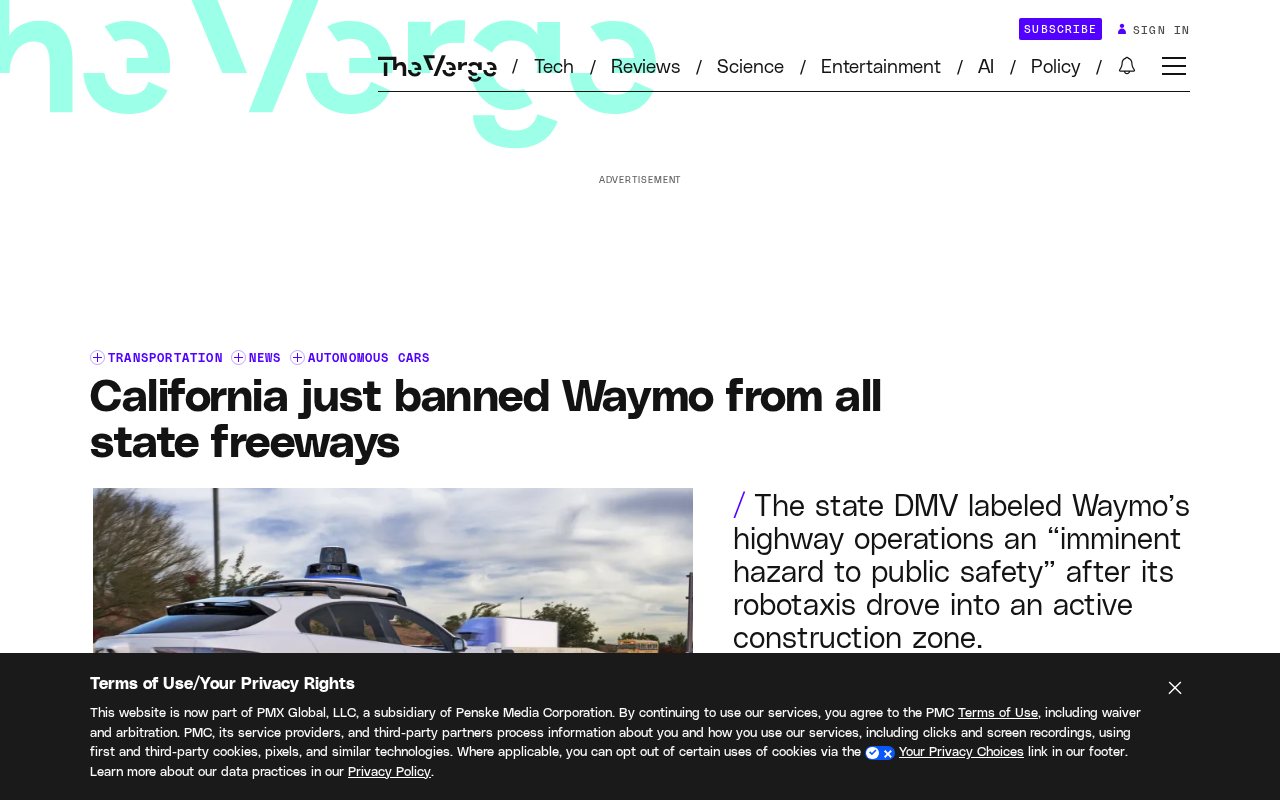
A single order from the California Department of Motor Vehicles (DMV) has stripped Waymo's robotaxis of their legal authorization to operate on all interstate highways across California. The ban took effect on November 11, and its direct trigger was two high-profile recent incidents in the San Francisco Bay Area—Waymo robotaxis driving into active construction zones. This is not the first regulatory setback for Waymo, but it is the broadest in scope and the most direct in impact.
The Two Incidents Behind the Ban
According to a statement from the California DMV, the catalyst for the statewide highway ban was two highly publicized safety incidents. Although the original reports did not disclose detailed technical specifics of the incidents, the description of "driving into active construction zones" points to shortcomings in autonomous driving systems when handling non-standard road scenarios. Construction zones typically involve complex factors such as temporary signage, lane line changes, and construction worker activity, posing severe challenges to autonomous systems that rely on HD maps and real-time perception.
The reason these two incidents prompted such a rapid regulatory response is not unrelated to their occurring in the Bay Area—one of Waymo's core operating regions. When autonomous vehicles repeatedly expose the same type of risk on real roads, the pressure on regulators quickly shifts from "observation" to "intervention."
HD maps are the prior-knowledge base that autonomous driving systems rely on, typically built from point cloud data collected by sensors such as LiDAR and cameras, containing centimeter-level precision static environment information including lane lines, traffic signs, and curbs. Their core assumption is that road structure is relatively stable and vehicles can use the map for localization and to anticipate the road ahead. Construction zones, however, break this assumption—temporary detours, newly placed cones, and moving construction equipment all conflict with what the map records. If the system relies too heavily on the map with insufficient perception redundancy, it is prone to making incorrect decisions. This is why construction zones are regarded as one of the "long-tail scenarios" of autonomous driving.
Long-tail scenarios refer to low-frequency but highly diverse extreme or non-standard driving situations that are difficult to enumerate exhaustively, such as temporary construction, accident scenes, and irregular obstacles. Autonomous driving systems perform stably in routine scenarios, but the coverage of long-tail scenarios determines their safety ceiling. The industry typically accumulates data through large-scale road testing, simulation testing, and shadow mode to gradually tackle long-tail problems, but the unpredictability of such scenarios means long validation cycles and high costs—also an important dimension regulators consider when assessing a company's technological maturity.
Scope and Impact of the Ban
This ban covers all interstate highways across California, meaning Waymo's autonomous vehicles may not provide passenger services on highways. For an autonomous driving company that is expanding its operations from urban roads to highway scenarios, this is undoubtedly a strategic blow.
Highway scenarios have always been a key part of the autonomous driving commercialization narrative. Compared with urban roads, highway scenarios involve higher speeds and smaller margins for error, but once mastered, their commercial value is also greater—longer single trips, higher vehicle utilization, and a broader service radius. Waymo's previous testing and operations in California highway scenarios were regarded as an important validation of its technological maturity. With the ban in effect, this validation channel has been temporarily closed.
A Signal of Shifting Regulatory Logic
From a broader perspective, this ban sends a clear signal: California regulators' attitude toward autonomous driving is shifting from "innovation-first encouragement" toward "safety bottom line first." The DMV's statement used the wording "potential safety hazard" rather than waiting for accident investigations to fully conclude before acting—a precautionary regulatory posture worth noting.
This is not an isolated case. In recent years, the autonomous driving industry has encountered similar regulatory tightening in multiple markets. Regulators are increasingly inclined to intervene quickly when repetitive risk patterns emerge, rather than waiting until serious accidents occur. For autonomous driving companies, this means higher compliance costs and also means that the window for technology validation may be shorter than expected.
Precautionary regulation refers to regulators taking restrictive measures based on observed risk patterns before completing a full accident investigation or before serious consequences occur. Unlike the traditional "accountability after the fact" model, precautionary regulation emphasizes proactive risk management and is common in high-risk industries such as aviation and pharmaceuticals. In the autonomous driving field, due to the black-box nature of the technology and the severity of accident consequences, regulators are increasingly inclined to intervene quickly when repetitive risk signals emerge. This model places higher demands on companies' ability to demonstrate safety and shifts compliance communication from passive response to proactive disclosure.
Waymo's Next Steps and Industry Implications
Waymo has not yet given a formal response in the original report. But based on past experience, such bans are usually not permanent—companies can seek to restore operations by submitting remediation plans, strengthening testing and validation, and communicating with regulators. The key is whether Waymo can prove to the DMV within a reasonable timeframe that its system is safe in complex scenarios such as construction zones.
For the industry, this incident is another reminder: the commercialization of autonomous driving is not just a technical issue but also a matter of regulatory trust. Every highly publicized safety incident may trigger a recalibration of regulatory rules. Companies need to establish more proactive safety communication mechanisms beyond technology iteration, rather than passively waiting for regulators to act.
As a bellwether for autonomous driving policy, California's regulatory actions are often referenced by other states and countries. The subsequent trajectory of this statewide highway ban will directly affect Waymo's expansion pace and may also serve as a cautionary tale for other autonomous driving players' highway scenario deployments.
One-line Summary
California DMV issues a statewide highway ban on Waymo following two construction-zone incidents, as regulation shifts toward safety first.
Paragraph Summary
On November 11, the California DMV's statewide interstate highway ban took effect, prohibiting Waymo robotaxis from operating on all highways in California. The trigger was two high-profile safety incidents in the San Francisco Bay Area in which Waymo vehicles drove into active construction zones, exposing shortcomings in autonomous systems' handling of non-standard scenarios such as temporary signage and lane changes. The ban directly hits Waymo's commercialization path of expanding from urban roads to highway scenarios, as highways are seen as a key validation channel for technological maturity and commercial value. The article notes that this move sends a clear signal that the regulatory posture is shifting from "innovation-first encouragement" to "safety bottom line first," with precautionary intervention becoming a new trend. Waymo can seek to restore operations through remediation and communication, and as California is a policy bellwether, its subsequent trajectory will affect the highway deployment pace of the entire industry.
Related articles

Jensen Huang Returns to Nvidia: The Power Game Behind an "Aggro Reset"
Nvidia's board reappointed Jensen Huang as CEO less than two weeks after his scandal-driven resignation. This analysis explores the board's decision-making, Trump's political intervention, media power failure, and market reaction behind the dramatic return.

Why Voice AI Can't Understand Kenyans' Everyday Conversations
Swahili speech recognition hits 3.24% error on read text, but everyday Kenyan speech mixes English, Sheng slang, and accents—leaving mainstream voice AI struggling.

Data Centers Build Their Own Natural Gas Plants: AI Compute's Breakout Around a Decade-Long Grid Wait
Grid interconnection approvals can take a decade, so xAI and others are building off-grid natural gas plants to power AI clusters. This article analyzes the drivers, costs, and impact of behind-the-meter generation on AI infrastructure.