Call Codex Directly Inside Claude Code: A Dual-AI Cross-Validation Workflow

Run Codex code reviews directly inside Claude Code without switching tools or re-explaining context.
Codex Plugin for Claude Code is an OpenAI-maintained open-source plugin that lets developers invoke Codex for code review directly within Claude Code. It supports standard code reviews, design proposal reviews (including idempotency checks), background async task delegation, and seamless context handoff — enabling a dual-AI cross-validation workflow without switching windows or re-entering project context.
As AI coding tools become increasingly widespread, developers often find themselves juggling multiple AI assistants — using one to write code and another to review it. But constantly switching between tools and repeatedly re-explaining project context and requirements creates significant friction. The officially released Codex Plugin for Claude Code (Codex Plugin CC) by OpenAI is designed to solve exactly this pain point — letting you invoke Codex for code review directly inside Claude Code, with no window-switching required.
For context: Claude Code is Anthropic's terminal-native AI coding assistant that runs directly in the command line, capable of reading and editing files and executing commands. Codex is OpenAI's family of models based on GPT, specifically optimized for coding tasks, with the latest versions capable of autonomously executing multi-step programming tasks in a sandboxed environment. The two tools come from different underlying architectures (Anthropic and OpenAI, respectively), each with its own strengths — which is precisely the technical foundation that makes cross-tool collaboration complementary.
According to a breakdown from a Bilibili content creator, the project has already earned over 28,000 stars on GitHub and is an officially maintained open-source project by OpenAI.
Why Cross-Tool Code Review Matters
Many developers know this feeling: you've just finished modifying a bunch of files in Claude Code, the tests pass, but something still feels off — does this approach have any security holes? Should caching be added? Could retries cause the same operation to execute twice? Will this change break other modules?
The usual workaround is to open Codex separately, then re-explain the project background, relevant files, and requirements from scratch. This process is both tedious and error-prone, since manually syncing context means critical information is easily lost.

This is exactly where Codex Plugin CC delivers its core value: it lets you invoke Codex to review the current project directly from within Claude Code. Codex reads from the same project files, and your local Codex model settings and project configuration are reused as-is — no new windows, no copy-pasting requirements, full context sharing.
Core Features: Two Code Review Modes
The most common use case is code review. You can have Codex examine uncommitted changes or compare the current branch against the main branch. Notably, Codex only reads code — it never directly modifies files — which keeps the review process safe. It provides suggestions, while the final decision on what to change stays with you and Claude Code.
Standard Review: Checking Code Correctness
A standard code review focuses on whether the code is written correctly — checking for syntax errors, logical completeness, and correctness. For quickly validating change quality, this approach is simple and efficient.
Proposal Review: Questioning Overall Design Decisions
Beyond standard checks, Codex Plugin CC offers a distinct review mode specifically designed to scrutinize the soundness of the overall approach — this is one of its more distinctive features.
For example: suppose you've just added caching and retry logic to an endpoint. A proposal review will go further and ask:
- Is this cache actually necessary?
- Could retries cause the same operation to execute twice (an idempotency issue)?
- Is there a smaller, more elegant change that achieves the same thing with existing code?
It's worth dwelling on idempotency here — a core concept in distributed systems and API design, meaning that executing the same operation once versus multiple times produces exactly the same result. When adding retry logic, if an endpoint isn't idempotent, retries can cause duplicate database writes, duplicate charges, or duplicate notifications. In the HTTP spec, GET, PUT, and DELETE methods are typically designed to be idempotent, while POST is not. This is a prime example of why proposal review is more valuable than pure code-level review — syntactically correct code can hide real landmines at the business logic level.

In short, proposal review evaluates whether the direction of a change is correct from a high-level perspective, rather than nitpicking individual lines. For less experienced developers, or when dealing with changes to complex systems, this higher-level AI Code Review often surfaces the most serious issues.
Task Delegation and Background Async Execution
Codex Plugin CC isn't limited to reviews — it can also take on actual investigation and development tasks. If Claude Code gets stuck on a problem, you can delegate the task to Codex:
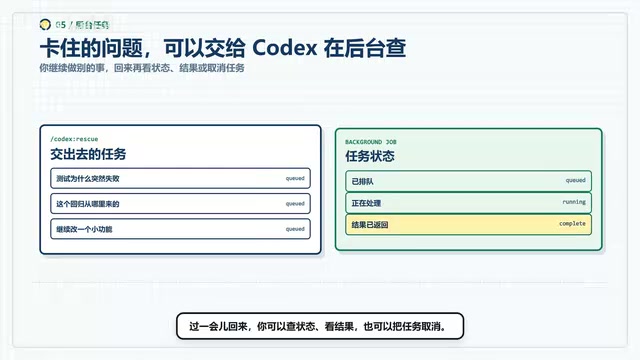
- Investigate why tests are suddenly failing
- Track down where a regression bug was introduced
- Continue implementing a small feature
More practically, these tasks can run in the background. You don't have to wait around for results — you can continue working in Claude Code on other things. Come back later to check task status, review results, or cancel at any time.
This async execution model maps to the async/non-blocking programming paradigm, where the core idea is decoupling task submission from result retrieval in time. In the context of AI coding tools, this is especially important: analyzing a large codebase or tracing a complex bug can take several minutes, and synchronous waiting severely disrupts a developer's flow state. Async mode lets developers advance multiple workstreams in parallel — highly aligned with the async collaboration culture widely adopted in modern software teams (e.g., async Code Review, async stand-ups).
Handoff: Seamlessly Passing Conversation Context
Another feature worth highlighting is the Handoff functionality.
Imagine you've been in a long conversation in Claude Code — you've discussed the tech stack, made numerous code changes, and now want Codex to take over. The handoff feature carries the full conversation context forward, so you don't need to re-explain what technologies the project uses, what was just changed, or where things are currently stuck.
This creates a very clean division of labor: Claude Code handles the current conversation and actual code changes, while Codex steps in when needed to review, identify issues, or take over a specific piece of work. Seamless context transfer significantly lowers the overhead of dual-AI collaboration.
Auto-Review Toggle: Recommended to Hold Off for Now
The latest stable release, v0.6, also introduces an auto-review toggle. When enabled, Codex automatically runs a review every time Claude Code is about to wrap up a task; if issues are found, Claude Code must continue working.
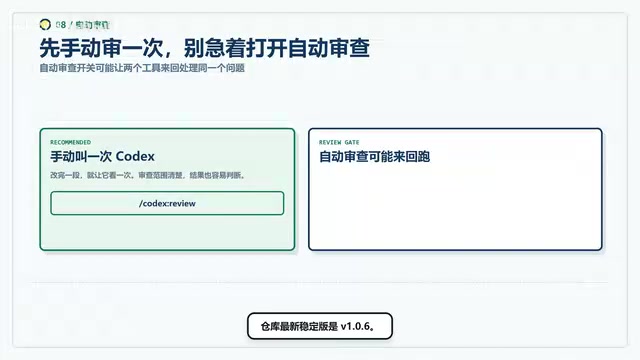
However, one important caveat: it's not recommended to enable this feature right away. The two tools may end up reviewing back and forth, slowing down overall throughput and consuming additional API credits. For most use cases, manually invoking Codex for a single review pass is sufficient. Once you're familiar with the overall workflow, you can decide whether to enable auto-review based on your actual needs.
Summary: Dual-AI Collaborative Coding Is a New Paradigm Worth Exploring
Codex Plugin CC represents a trend worth paying attention to: AI coding tools are no longer competing to replace each other — they can collaborate in a division of labor. Letting the tool that excels at writing code handle the writing, while another model acts as the reviewer, creates a dual-AI cross-validation model that, in a sense, mirrors the "write + Code Review" collaboration dynamic in human development teams.
This model has deep roots in engineering practice. The traditional "Four-Eyes Principle" in software engineering requires that significant changes be reviewed by a second person, and extensive research shows Code Review significantly reduces defect rates — Google, Meta, and other major tech companies treat it as a mandatory process. Different AI models, due to differences in training data, architecture, and alignment, often focus on different aspects of the same code. This "cognitive diversity" is precisely the technical reason cross-validation can surface blind spots that a single model might miss. As cross-model protocols like MCP (Model Context Protocol) continue to mature, multi-AI collaborative coding may well become the mainstream workflow.
For developers who care about code quality, tools like this reduce the friction of context-switching and make code review something you can do without breaking your stride. That said, in practice you'll still want to keep an eye on the balance between API credit consumption and response speed. Interested developers can search for Codex Plugin for Claude Code on GitHub to try it out.
Key Takeaways
Related articles

Researchers Claim AI Agents Being Tested by OpenAI Were Involved in a Cyberattack
Security researchers allege OpenAI-tested AI agents were involved in a cyberattack. We analyze the security risks, accountability gaps, and safeguards the industry needs.
James Webb Telescope Reveals: Extreme Star-Forming Galaxies Masquerading as Faint Quasars
JWST finds some objects mistaken for faint quasars are actually extreme star-forming galaxies, potentially revising estimates of early-universe supermassive black holes.
Why So Many AI Researchers Fear Machines Could Destroy Humanity
Why do so many AI researchers fear machines could destroy humanity? This article breaks down the alignment problem, capability leaps, and interpretability issues driving existential AI risk debates.