Cambridge's Youngest Black Professor Dies: Reflections on Academic Integrity and Mental Health

Cambridge's youngest Black professor's death after plagiarism allegations sparks debate on academic integrity and mental health.
The death of Cambridge University's youngest Black professor following academic plagiarism allegations has ignited widespread reflection across academia and tech communities. The case highlights critical tensions between rigorous academic integrity enforcement and due process protections, the extra psychological burden placed on scholars with symbolic identities, and the growing challenges of defining originality in the age of generative AI.
Event Overview
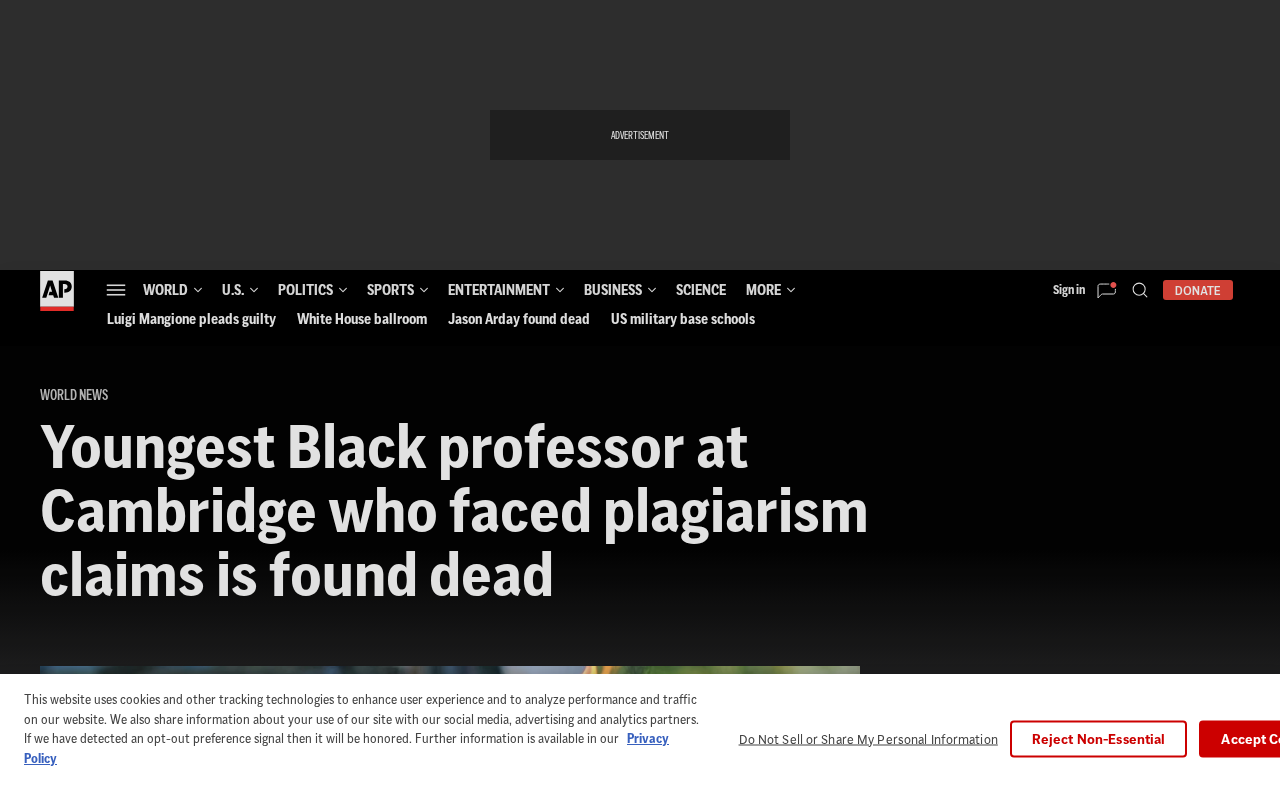
Recently, a heartbreaking piece of news has drawn widespread attention across academia and the tech community: Cambridge University's youngest Black professor was found dead after previously facing allegations of academic plagiarism. The news was reported by multiple media outlets and quickly sparked heated discussion on communities like Hacker News.
This scholar had been a landmark figure in academia — as one of Cambridge University's youngest Black professors, his career carried profound symbolic significance. Cambridge, one of the world's oldest institutions of higher learning, maintains extremely rigorous standards for awarding professorships (Chair/Professorship), typically requiring candidates to demonstrate world-class academic contributions in their field. Securing a professorial chair in this context is itself the highest recognition of scholarly ability. However, plagiarism allegations surrounding his academic work thrust him into the eye of a public storm. The tragic outcome now casts a complex and heavy shadow over the entire affair.
The Two Sides of Academic Integrity Disputes
The Pressure Mechanisms Behind Plagiarism Allegations
Plagiarism allegations have always been among the most severe criticisms in academia. Once such questions become public, the scholar in question often faces multiple layers of pressure from institutional investigations, peer scrutiny, and public opinion. This pressure can be especially crushing for young scholars in the ascent of their careers who carry multiple social expectations.
From an academic research perspective, plagiarism has a well-defined classification system, including verbatim copying, paraphrasing without attribution, self-plagiarism, and idea plagiarism — each with different levels of severity and standards of determination. Historically, many prominent scholars have experienced dramatic career upheavals due to plagiarism allegations — from former German Defense Minister zu Guttenberg resigning over doctoral thesis plagiarism, to former Harvard President Claudine Gay stepping down over academic citation issues. These cases demonstrate that once academic integrity disputes become public, their impact often extends far beyond academia itself.
One important detail: academic integrity review should be a rigorous, careful process that respects due process. From initial allegation to final determination, the process requires independent and fair investigation. In the UK higher education system, such investigations are typically handled by a university's internal Research Integrity Committee, with external experts brought in for independent assessment when necessary. The entire process can take months or even years. However, in the age of social media, academic disputes are often widely discussed in public spaces long before formal investigation conclusions are reached. Premature trial by public opinion, before conclusions are clear, can impose unbearable psychological burdens on those involved. Research shows that a significant proportion of scholars facing academic misconduct investigations develop severe anxiety, depression, and even suicidal ideation — a phenomenon known in academic ethics research as "investigation trauma."
The Extra Burden of Symbolic Identity
As Cambridge's youngest Black professor in history, this scholar's identity carried powerful symbolic significance. This "trailblazer" role, while bringing honor, can also mean greater exposure and harsher scrutiny.
The concept of "double consciousness" proposed by sociologist W.E.B. Du Bois over a century ago still finds profound real-world resonance in academia today. Minority scholars at elite academic institutions often simultaneously carry two roles: as independent academic researchers, and as figures imbued with a symbolic function of representing their entire community. This "representational burden" means their successes are amplified as collective victories, while their failures or controversies are equally over-interpreted. Data from the UK's Higher Education Statistics Agency (HESA) has long shown that the proportion of Black professors at top UK universities is extremely low, meaning every breakthrough figure is inevitably placed in the spotlight.
When academic disputes intersect with identity politics, the complexity of events and external pressures are often further amplified. Supporters may interpret the allegations as manifestations of systemic racial bias, while critics may argue that identity should not exempt anyone from scrutiny — the collision of these two positions places the individual in an even sharper bind, subjecting them to psychological pressure far exceeding that of a purely academic dispute.
Why the Tech Community Cares About This Academic Integrity Case
The fact that this event sparked discussion on Hacker News — a community primarily composed of tech professionals — reflects several deeper issues:
Universal Concern for Academic Integrity and Knowledge Production: Whether in the humanities or in computer science, artificial intelligence, and other technical fields, academic integrity is the cornerstone of knowledge production. Hacker News, as Y Combinator's tech community, has a user base primarily of software engineers, entrepreneurs, and researchers who have a natural professional sensitivity to intellectual property and originality. As AI-generated content becomes more prevalent, issues of plagiarism and originality determination grow increasingly complex, making the tech community particularly attuned to these matters. In computer science, recent years have seen numerous cases of duplicate publication, data fabrication, and code plagiarism, with platforms like Retraction Watch documenting large numbers of such cases, keeping tech professionals highly attentive to academic integrity issues.
Reflection on Academic Evaluation Systems: Tech professionals tend to have a natural interest in "evaluation mechanisms" — whether code review, contribution assessment in open-source communities, or peer review in academia, all are fundamentally institutional designs for evaluating knowledge contributions. This event prompts reflection: Do current academic review and disciplinary mechanisms provide sufficient support and protection for the individuals involved while pursuing truth? Are procedures sufficiently transparent and fair? The tech community's preference for an "open-source review" model — transparent, traceable, and community-participatory — stands in stark contrast to the relatively closed investigation processes of traditional academic institutions, and this cognitive gap is one source of the discussion's intensity.
Attention to Scholar Mental Health: Mental health issues in high-pressure environments are a shared challenge for academia and the tech industry alike. According to surveys by the UK's Higher Education Policy Institute (HEPI), anxiety and depression rates among UK academic workers are significantly higher than in the general population. Similar situations exist in the tech industry — Stack Overflow's annual survey data has long shown that a considerable proportion of developers face burnout and mental health challenges. Regardless of the final investigation conclusions, this tragedy once again reminds us to pay attention to individuals' psychological resilience in high-intensity, highly competitive environments.
Academic Originality Challenges in the AI Era
While the core of this case involves traditional plagiarism allegations, it occurs at a special juncture — generative AI is profoundly transforming knowledge production and content creation.
Today, Large Language Models (LLMs) such as GPT-4, Claude, and Gemini can generate seemingly original text in seconds, making the boundaries of "originality" unprecedentedly blurry. These models, based on the Transformer architecture, learn to generate statistically plausible text sequences through training on massive text corpora. Their output is not direct copying of training data, but rather "re-creation" based on learned patterns — a characteristic that renders traditional word-for-word comparison-based plagiarism detection methods almost entirely ineffective.
Academic institutions are being forced to re-examine and redefine what constitutes plagiarism, what constitutes fair citation, and what constitutes AI-assisted creation. Traditional plagiarism detection tools (such as Turnitin and iThenticate) primarily rely on text comparison technology, matching submitted text against their vast databases for string matching and similarity analysis. When faced with AI-generated or AI-rewritten content, these tools face entirely new technical challenges. Although platforms like Turnitin have launched AI writing detection features (based on statistical characteristics like text perplexity and burstiness to determine whether text was generated by AI), their accuracy remains disputed, with high false-positive rates still unresolved — especially for non-English text and AI-generated content that has been manually edited.
This means that future academic integrity reviews will become more complex. On one hand, technological advances provide more powerful tools for rapid detection and comparison; on the other hand, methods for evading detection are evolving in parallel. Currently, major academic institutions worldwide are developing their own AI usage policies: some completely prohibit the use of generative AI in academic writing (with some journals requiring authors to declare they did not use AI tools), while others take more flexible stances, allowing AI as an assistive tool but requiring clear disclosure. Top journals like Nature and Science have explicitly stated that AI cannot be listed as a paper's author, but allow acknowledgment of AI's assistive role. How to establish fair, transparent, and humanistic mechanisms in this "arms race" will be a challenge that academia and the tech world must face together.
Reflections and Lessons: Building a More Humane Academic Ecosystem
This tragic event leaves us with multi-layered reflections:
The Importance of Due Process: In any allegation of academic misconduct, the principles of presumption of innocence and procedural justice must be upheld, avoiding irreversible harm to individuals from premature public judgment. International academic integrity organizations (such as the European Association of Science Editors/EASE and the Committee on Publication Ethics/COPE) have all developed detailed investigation guidelines emphasizing principles of confidentiality, the right of the accused to respond, and time limits on investigations. The core philosophy behind these standards is that the purpose of academic integrity investigations is to maintain the reliability of knowledge, not to punish individuals. However, in practice, once allegations are made public through media or social networks, these procedural protections often fail to function as intended.
The Gap in Psychological Support Systems: Regardless of whether allegations are substantiated, did the scholar involved receive sufficient psychological support and help when facing enormous pressure? Do academic institutions, while pursuing accountability, also establish corresponding care mechanisms? Some pioneering institutions have begun exploring the role of "Research Integrity Support Officers," whose responsibilities include not only investigating academic misconduct but also providing psychological support and procedural guidance for all parties involved (including both the accused and the whistleblower). Universities in Australia and parts of Northern Europe have already incorporated such roles into their academic governance systems, providing a replicable practice model for other institutions.
Systemic Reflection: The high-pressure environment of academic evaluation systems, the extra burden brought by symbolic identity, and the amplifying effect of public opinion together constitute a systemic issue worthy of deep reflection. The "Publish or Perish" academic culture has long been criticized as a breeding ground for academic misconduct — when career survival is directly tied to publication volume, both temptation and pressure on scholars increase. In recent years, reform initiatives (such as the DORA Declaration/San Francisco Declaration on Research Assessment) have called for moving away from journal impact factors as the primary metric for evaluating researchers, instead placing greater emphasis on the substantive contribution and social impact of research, providing directional guidance for building a healthier academic ecosystem.
Conclusion
This event transcends a simple academic dispute, touching on deep issues across multiple dimensions: academic integrity, due process, mental health, and knowledge production amid technological transformation. As technology professionals and knowledge workers, while pursuing truth and originality, we must not neglect humanistic care for individuals.
In an era where AI is profoundly reshaping knowledge production, how to build an academic ecosystem that is both rigorous and humane may be the most thought-provoking lesson this tragedy leaves us. Knowledge production has never been a purely technical process — it is embedded in complex social relationships, power structures, and emotional realities. Acknowledging this complexity and responding to it in institutional design is the most important lesson we should draw from this event.
Related articles

Serving Markdown Content Directly to AI Agents via Accept Headers
How HTTP Accept header content negotiation can serve Markdown to AI Agents and LLM crawlers, reducing token costs and improving information extraction efficiency.
The Turbulent AI Era Has Arrived: How to Seize Opportunities and Manage Risks Amid Technological Upheaval
Deep analysis of the turbulent AI era: accelerating tech iterations, career restructuring, regulatory lag, and global competition. How practitioners can seize opportunities and manage risks.

VMs Can't Contain AI Hacker Agents: The Security Isolation Myth Is Shattered
Deep analysis of why VMs can't truly isolate AI agents with cyber attack capabilities. Covers VM isolation failures, new AI security paradigms, and defense-in-depth strategies.