Can a Fine-Tuned Model on Consumer Hardware Easily Beat Jev AI? A Hands-On Investigation
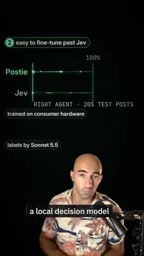
Developer fine-tunes a local model on consumer hardware, outperforming Jev AI across multiple use cases.
The article covers a developer's experiment: fine-tuning a local decision model on consumer-grade hardware that beat Jev AI in multiple use cases, with no scenario yet favoring the latter. The process was remarkably simple, with Sonnet used directly for data annotation in minimal time. This challenges the belief that matching top AI requires massive compute, showing small teams or individuals can quickly build specialized solutions. The conclusion, however, rests on a single experience and awaits validation, pointing to a broader trend of AI democratization.
Introduction: An Unexpected Discovery
Recently, a developer shared his experimental findings on YouTube: fine-tuning a local decision model on consumer-grade hardware not only surpassed Jev AI in that particular use case, but also performed better in many other scenarios. Even more surprising was how simple the entire process was—training data annotation was even done directly with Sonnet, taking very little time. This challenges the conventional wisdom that "catching up with top-tier AI requires massive computing power."
Fine-Tuning a Local Model: Surprisingly Simple
According to the developer, he has yet to encounter a scenario where Jev AI retains an advantage. While that may happen in the future, as of now, the locally fine-tuned model wins across the board. The key point is that all of this was done on consumer-grade hardware with very little time investment.

Data Annotation: Sonnet as a Capable Assistant
Annotating training datasets is typically seen as a time-consuming and labor-intensive step, but this developer used the Sonnet model directly for annotation. "I spent most of my time using Sonnet—it worked great and was very fast," he noted. This suggests that leveraging existing large models to assist with data preparation can significantly lower the barrier to fine-tuning.

Fine-tuning refers to the process of continuing to train an already pre-trained base model with a small, domain-specific dataset so that it adapts to a particular task. Compared with training from scratch, fine-tuning requires only a small amount of data and compute, typically freezing most parameters or using parameter-efficient methods such as low-rank adaptation (LoRA). What makes it feasible on consumer-grade hardware is that modern fine-tuning techniques have drastically reduced VRAM usage and training time, enabling individual developers to complete adaptation with a single consumer-grade GPU in just a few hours.
Sonnet is a version of Anthropic's Claude series of large language models, known for striking a balance between performance and cost. In this case, it was used as an "annotator": the developer fed raw samples into Sonnet, which generated classification labels or decision outputs, and these results were then used as training data. This approach is essentially a simplified form of model distillation—using a strong model to generate labels to train a smaller model. Its advantage is eliminating manual annotation costs, but note that label quality directly affects fine-tuning results, so sampling and manual verification should be done when necessary.
Implications for AI Application Development
This experience has reference value for AI application developers. In the past, customizing high-performance models often required professional teams and substantial resources; now, with consumer-grade hardware and existing AI assistants, small teams—or even individual developers—can rapidly iterate specialized solutions that outperform general-purpose models.

Limitations and Future Outlook
Of course, this conclusion is based on a single developer's experience and has not yet been validated at scale. Different tasks, data volumes, and hardware configurations may affect the results. But indeed, the barrier to fine-tuning is rapidly lowering, and more "democratized" high-performance models may emerge in the future.
AI democratization refers to the trend of high-performance AI capabilities spreading from large institutions to individual developers and small teams. In the past, training or customizing a usable model required professional teams, large-scale GPU clusters, and long-term data accumulation; today, open-source base models, parameter-efficient fine-tuning techniques, consumer-grade GPUs, and large-model-assisted annotation have collectively lowered the barrier. This trend does not mean general-purpose large models will be replaced; rather, it forms a layered landscape of "general models as the foundation, specialized fine-tuned models for deployment," making personalized, domain-specific AI applications easier to realize.
Conclusion
The case of a locally fine-tuned model surpassing Jev AI reveals the trend of AI democratization. As the toolchain matures and hardware performance improves, personalized AI will no longer be the exclusive domain of tech giants. Developers should pay attention to this direction and explore breakthroughs within their own domains.
One-line Summary
Developer fine-tunes a local model on consumer hardware, outperforming Jev AI across multiple use cases.
Paragraph Summary
The article presents a developer's experiment: fine-tuning a local decision model on consumer-grade hardware that outperforms Jev AI across multiple use cases, with no scenario yet found where the latter performs better. The fine-tuning process was surprisingly simple, with training data annotation done directly using Sonnet, requiring little time and investment. This challenges the conventional wisdom that catching up with top-tier AI requires massive computing power, and has reference value for AI application developers—small teams or even individuals can rapidly iterate specialized solutions that outperform general-purpose models. However, the conclusion is based on a single experience and still needs large-scale validation. The article sees this as revealing the trend of AI democratization, where personalized high-performance models will become more widespread.
Related articles

Driving a Lamborghini Around the World: A Reality Show of Adventure and a Proposal
Mr. Beast initiates a Lamborghini round-the-world driving challenge. Jim and Monica cross Europe, Asia, and America, facing arguments, injuries, and reconciliation, culminating in a successful proposal at the finish line.

Code-Generated Images More Practical Than Dedicated Graphics Models?
Frontier LLMs generate editable images like SVG, HTML, and 3D assets by writing code—more practical than dedicated text-to-image models for explanatory diagrams, posters, UI components, and game assets. This article analyzes the advantages and boundaries of code-driven images.

Flagship Phones Break $1,000 as Pixel 11 Pro Emerges as the Value Pick
Flagship phones now routinely break $1,000 as the RAM crisis drives up costs. We analyze the pricing trend and how the Pixel 11 Pro delivers a flagship experience at old-era prices.