Can Absolute Batman Save DC Studios?

Gunn and Safran leave DC Studios, and Absolute Batman may become a transitional firefighter option.
James Gunn and Peter Safran leaving DC Studios has thrown the recently revitalized DC cinematic universe back into uncertainty. According to RSS sources, after Skydance's acquisition of Warner Bros. Discovery, the two no longer serve as co-heads, and the universe planning built around *Superman* has lost its core driver. Although Gunn's *Man of Tomorrow* may still be released, his broader vision no longer has anyone backing it. The article argues that DC Comics' current hit title Absolute Batman, with its gritty anti-heroic setting and buzz, can maintain brand heat during a film lull and provide a ready-made sample for adaptation. But comics popularity does not automatically equal film success, and DC still needs to clarify its IP positioning and decision-making logic under new management.
The news that James Gunn and Peter Safran are leaving DC Studios has thrown the recently revitalized DC cinematic universe back into uncertainty. According to RSS sources, following Skydance's acquisition of Warner Bros. Discovery, Gunn and Safran are no longer co-heads of DC Studios, and the future of the film universe built around films like Superman is unclear—although Gunn's Man of Tomorrow may still be released, his broader vision for DC appears to have lost its driving force.
Uncertainty Brought by Leadership Changes
DC Studios' core strategy in recent years has been to have Gunn and Safran serve as "helmspersons" overseeing films, series, and animation in a unified plan. This model had just begun to show synergistic effects after the release of Superman, but the acquisition directly shook the decision-making layer. The original information explicitly states that Gunn's Man of Tomorrow project "may still be released," but the broader universe planning no longer has anyone backing it. For audiences, this means whether subsequent works belong to the same continuity and whether characters will continue are all unresolved questions.
This kind of instability on the production side often damages the brand more than the success or failure of any single film. What DC needs is not just one blockbuster, but a mechanism that can continuously provide a sense of direction.
Background of DC Studios' founding: DC Studios, formerly DC Films, is the division under Warner Bros. Discovery responsible for film and television adaptations of DC Comics. In 2022, James Gunn and Peter Safran were appointed co-heads, marking DC's attempt to emulate the Marvel Studios model, with a single creative core overseeing a shared universe spanning films, series, and animation. The core of this structure is that the "helmsperson" holds final decision-making authority from project greenlighting to character casting, thereby avoiding the continuity fractures that plagued the previous DC Extended Universe (DCEU) due to directorial style conflicts and chaotic planning. After taking office, Gunn led works such as Superman (2025), attempting to restart a younger, more unified DC universe. Therefore, the departure of the two is not merely a personnel change, but also means a temporary interruption of this centralized creative management model.
Why Absolute Batman Is Seen as a "Firefighter"
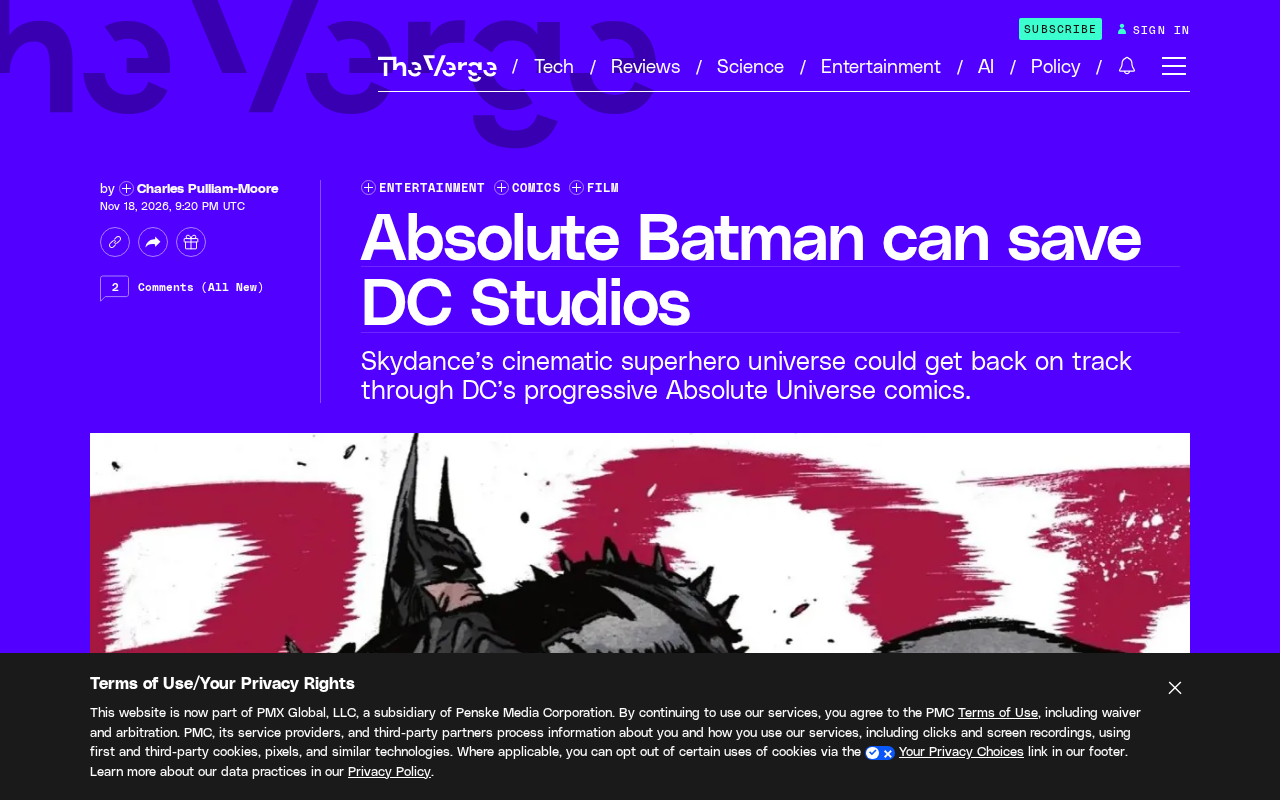
The judgment in the title is: Absolute Batman can save DC Studios. This claim is not unfounded. Absolute Batman is one of DC Comics' most closely watched current titles, placing Batman in a grittier, more anti-heroic setting, and it has accumulated acclaim and buzz among readers. Compared to relying on the grand narrative of a cinematic universe, a strong comics IP can maintain DC's brand heat faster and at lower cost.
If the film side enters a lull, highly recognizable comics content like Absolute Batman can take on the role of a "transitional figurehead," buying DC time to adjust.
Absolute Batman and DC's "Absolute" line: Absolute Batman is the flagship title under DC Comics' "Absolute Universe" sub-brand launched in 2024, written by Scott Snyder and drawn by Nick Dragotta. The series places classic characters in a darker, more resource-scarce parallel world; in this setting, Batman is not a billionaire but comes from the working class, relying on martial arts and self-made equipment to fight Gotham's corrupt forces. This "anti-heroic" and "gritty" reimagining sparked strong reactions among readers, with the first issue selling over a million copies, making it one of DC Comics' most successful commercial cases in recent years. Its success lies not only in buzz but also in providing a complete and easily adaptable worldview template—which is precisely why the article views it as the "figurehead" for DC's transitional period.
Can Comics Truly Feed Back into Film and Television?
What needs to be viewed calmly is that comics popularity does not automatically equal film and television success. The value of Absolute Batman lies in providing ready-made worldview and character reinvention samples: its setting is distinctive enough, its adaptation potential is clear, and it does not require building audience awareness from scratch. For DC Studios, eager to stabilize morale, this is more reliable than starting from scratch.
But this also means DC may need to make trade-offs on the film side—whether to continue betting on a Gunn-style grand unified universe or shift toward more independent, auteur-driven projects. Absolute Batman provides an option, not a universal cure.
Common paths and risks of adapting comics IP for film and television: Comics popularity feeding back into film and television does not happen automatically. Historically, DC Comics' Watchmen and V for Vendetta, though highly acclaimed, were difficult to integrate into a shared universe after adaptation due to their overly auteur style; while classic storylines like Batman: Year One were partially adapted but often had divided box office results due to audience cognitive barriers. Absolute Batman's adaptation potential lies in its distinctive setting, clear character relationships, and independence from the existing film universe, which can reduce "continuity baggage." However, adaptation still needs to resolve the core contradiction: whether to faithfully restore its gritty style or soften it to suit a broader audience. In addition, the overlap between comics readers and film audiences is limited, and comics popularity alone is insufficient to support the box office of a major production; supporting marketing and distribution strategies are still needed.
Conclusion: Direction Matters More Than Any Single Film
DC Studios' urgent task is not to decide what to make next, but to clarify who makes decisions and by what logic. Absolute Batman can bring attention and creative material, but what truly determines DC's direction is still the new management's positioning of the IP after the acquisition is completed. Until this is clear, any "rescue" is only temporary.
Related articles

Gemini 4 Neon Leak: A Potential Strong Contender Against Opus 5.5
A Hacker News thread suggests Gemini 4 Neon looks like an Opus 5.5 competitor. This article unpacks the product positioning behind this community signal, shifts in the top-model competitive landscape, and what it means for developers' model selection strategy.

Claude Fable 5.2's Self-Authored Short Film 'Fable' Sparks Discussion
A short film 'Fable,' credited to Claude Fable 5.2 for script, visuals, and directing, appears on Hacker News. This article analyzes the significance of full-pipeline AI creation, community reactions, and what it means for content creators.

Anthropic IPO Pricing: A Signal of AI Giants Going Public
Anthropic's IPO pricing draws attention. This article analyzes its potential impact on AI industry valuation, commercialization paths, and the competitive landscape, and highlights public-market expectations and challenges for AI companies.