Can AI "Bake" Model Geometry? A New Exploration in Training-Free Weight Editing

An analyst model uses only latent-space geometry and closed-form ridge regression to edit feedforward weights without gradients, improving category purity in most pairings.
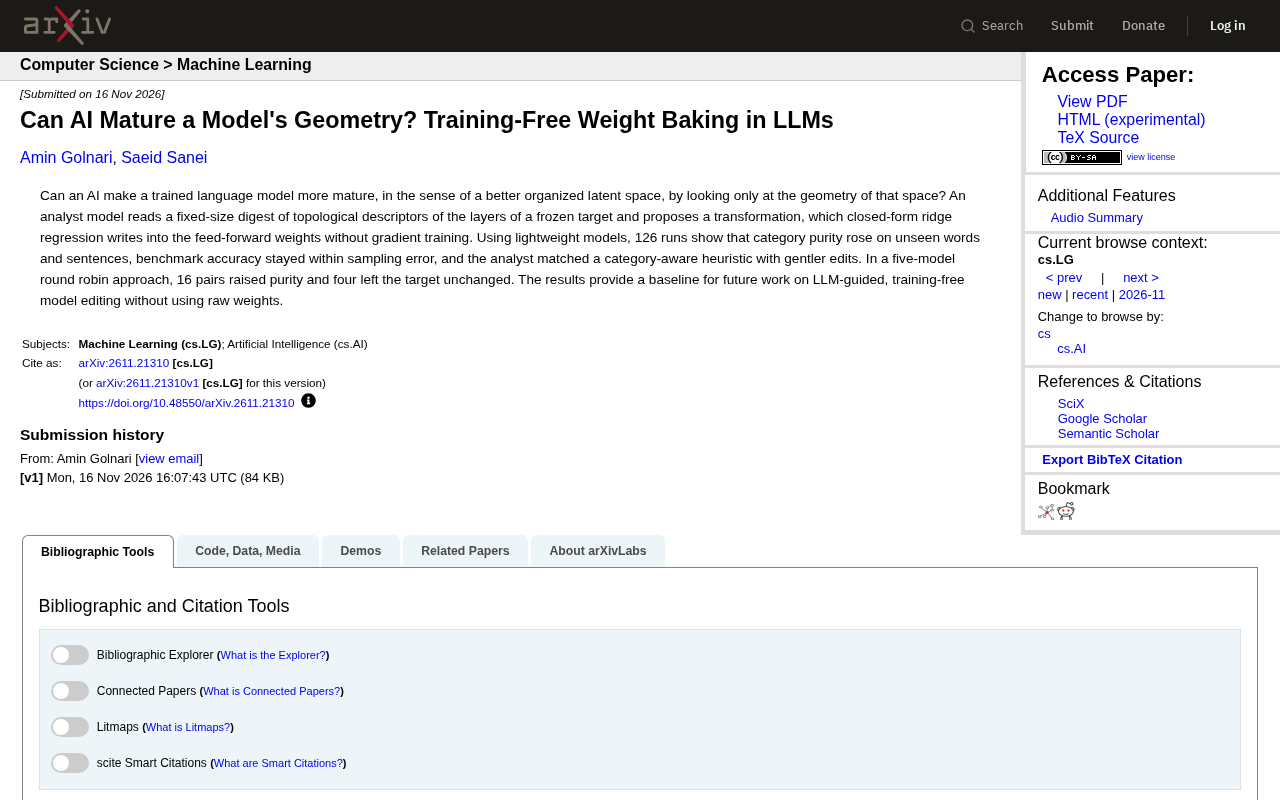
The study introduces "weight baking": an analyst model reads fixed-length summaries of a frozen target model's latent-space topological descriptors, proposes a weight transformation, and closed-form ridge regression writes it directly into feedforward weights—no gradient training. Across 126 runs on lightweight models, category purity improved on unseen samples while benchmark accuracy stayed within sampling error; the analyst matched a heuristic with gentler edits. A five-model round robin raised purity in 16 pairings and left 4 unchanged. This offers a reproducible training-free editing baseline, but scaling and downstream benefits remain open.
Introduction: When AI Learns to "Tune" Another AI's Latent Space
Large model editing typically relies on gradient training or fine-tuning, but a new study from rss proposes a counterintuitive approach: let an "analyst model" observe only the geometric structure of a target model's latent space, propose a weight transformation, and use closed-form ridge regression to write that transformation directly into the feedforward network weights—all without gradient training. Dubbed "weight baking" by the authors, this technique attempts to answer a fundamental question: Can AI make an already-trained language model more "mature" in how it organizes its latent space?
Method Breakdown: Geometric Descriptors + Closed-Form Regression
The core mechanism has two steps. First, the analyst model reads a fixed-length summary of topological descriptors from each layer of a frozen target model—it never touches the raw weights, only the geometric "shape" of the latent space. Second, the analyst proposes a transformation, and closed-form ridge regression writes that transformation into the feedforward weights, bypassing backpropagation. This design makes model editing lightweight and interpretable, since the transformation is driven by geometric signals rather than black-box gradients.
According to the original description, the experiments used lightweight models across 126 runs. Evaluation metrics included category purity and benchmark accuracy. This editing approach that "never touches the raw weights" provides a reproducible baseline for future research.
Latent space refers to the high-dimensional representation space formed by the activation values at each layer inside a model. When a language model processes input, each layer maps tokens to a high-dimensional vector, and the distribution, clustering, and manifold structure of these vectors together determine how the model distinguishes and generalizes concepts. "Geometric structure" typically refers to the relative distances between these vectors, local neighborhood relationships, and the compactness of category clusters—category purity is precisely the metric for whether samples of the same category cluster together and different categories separate in latent space. A geometric descriptor is a fixed-length vector obtained by dimensionality reduction or statistical summarization of this high-dimensional structure, allowing the analyst model to "perceive" the target model's internal organization without accessing massive raw activation values.
Closed-form ridge regression is a linear solution method that does not rely on iterative optimization. Given an input feature matrix and regression targets, ridge regression adds an L2 regularization term on top of least squares, and its analytical solution can be computed directly via matrix inversion without gradient descent. In this study, the "transformation" proposed by the analyst model is parameterized as an adjustment to the feedforward network weights, and closed-form ridge regression finds the optimal linear mapping between the given geometric descriptors and the target transformation, thereby "baking" the transformation into the weights. The advantages of this approach are determinism, low computational cost, and a regularization term that suppresses overly large changes—directly related to the original observation that "edits are gentler."
Experimental Results: Purity Gains with Stable Accuracy
The data from 126 runs yielded several key signals. On unseen words and sentences, category purity increased—meaning the category organization in latent space became clearer, and this improvement generalized to samples not seen during training. Meanwhile, benchmark accuracy remained within sampling error, with no significant degradation.
More interesting is the analyst model's performance: it matched a category-aware heuristic method but with gentler edits. In other words, the AI analyst achieved similar organizational effects with smaller changes, suggesting that geometry-guided editing may be more "precise" than brute-force heuristics.
Category purity is a common metric in cluster analysis: for each sample cluster corresponding to a category in latent space, compute the proportion of samples belonging to the majority class within the cluster, then average across all clusters. Higher purity means samples of the same semantic category are more concentrated in the same region of representation space, and boundaries between different categories are clearer. It differs from classification accuracy—purity measures the organizational quality of the representation space, not the correctness of the model's output predictions. This is why the original specifically emphasizes that "benchmark accuracy remained within sampling error," intending to show that the purity gain does not come at the cost of task performance, but rather that internal representations become more ordered while downstream behavior remains stable.
Sampling error refers to statistical fluctuation caused by evaluating only a limited sample rather than all data. The original uses "within sampling error" to describe accuracy changes, meaning the observed accuracy differences are not statistically significant and cannot be attributed to the editing operation itself. This phrasing suggests that at the experimental scale (126 runs), the confidence interval for accuracy metrics is wide, and readers should be moderately cautious about the "no degradation" conclusion—larger-scale replication is needed to confirm it.
Five-Model Round Robin: Purity Improved in Most Pairings
The study also designed a five-model round robin experiment to examine mutual editing effects between models. Of 16 pairings, 16 raised purity and 4 left the target model unchanged—the original phrasing is "16 pairs raised purity and four left the target unchanged." This result indicates that editing effects are not universally applicable; in some pairings the analyst failed to find an effective geometric transformation, but in most cases the purity improvement was reproducible.
As a note, the source material did not disclose the specific model names in the round robin, the magnitude of purity gains, or the specific benchmark accuracy values, so only qualitative judgments are possible: editing is effective in most pairings but has failure cases.
Round robin experiment here refers to a design where five models are paired two-by-two, each serving alternately as analyst and target model for cross-editing. Five models can produce $\binom{5}{2}=10$ unordered pairings; if directionality is considered (A editing B versus B editing A as distinct), up to 20 ordered pairings are possible. The original mentions 16 pairings, suggesting some directions were omitted or failed to execute. The purpose of this design is not to pursue optimal single-edit performance but to test whether "geometry-guided editing" generalizes across models—that is, whether one analyst model can propose effective transformations for different target models, and whether results are consistent when target models are edited by different analysts. The result of 16 improved and 4 unchanged indicates compatibility differences between models; failed pairings may stem from the analyst model's misinterpretation of the target model's geometric descriptors, or from the closed-form regression producing a transformation too small to cross the effective editing threshold for that pairing.
Significance and Boundaries: A Baseline for Training-Free Editing
The value of this work lies in providing a baseline for model editing that is "LLM-guided, training-free, and does not use raw weights." Traditional fine-tuning requires substantial compute and data, whereas geometry-guided closed-form editing has demonstrated feasibility on lightweight models. The finding that the analyst model matches heuristic methods but with gentler changes has reference value for model maintenance scenarios that pursue "minimal intervention."
However, the research remains at the lightweight model stage, and the scale of 126 runs and the five-model round robin is limited. Whether geometric descriptors can extend to larger models, whether purity gains translate into downstream task benefits, and the causes of failed pairings in the round robin are all open questions left for future work.
Conclusion
Having AI "tune" another model's latent space by "reading geometry" liberates model editing from the gradient optimization framework. Although the experimental scale is still small, it at least demonstrates that a path exists: without touching the raw weights, a model's internal organization can be made more orderly.
One-line Summary
An analyst model uses only latent-space geometric descriptors and closed-form ridge regression to edit feedforward weights without gradients, improving category purity in most pairings.
Paragraph Summary
This study proposes "weight baking": an analyst model reads only fixed-length summaries of topological descriptors from a frozen target model's latent space, proposes a weight transformation, and closed-form ridge regression writes the transformation directly into feedforward network weights—all without gradient training or backpropagation. Across 126 runs on lightweight models, category purity improved on unseen words and sentences while benchmark accuracy remained within sampling error; the analyst model matched a category-aware heuristic but with gentler edits. In a five-model round robin, 16 pairings raised purity and 4 left targets unchanged, showing the method works in most pairings but has failure cases. The study provides a reproducible baseline for LLM-guided, training-free model editing that does not touch raw weights, but is limited to lightweight models; scaling to larger models and translating gains downstream remain open questions.
Related articles

Gemini 4 Neon Leak: A Potential Strong Contender Against Opus 5.5
A Hacker News thread suggests Gemini 4 Neon looks like an Opus 5.5 competitor. This article unpacks the product positioning behind this community signal, shifts in the top-model competitive landscape, and what it means for developers' model selection strategy.

Claude Fable 5.2's Self-Authored Short Film 'Fable' Sparks Discussion
A short film 'Fable,' credited to Claude Fable 5.2 for script, visuals, and directing, appears on Hacker News. This article analyzes the significance of full-pipeline AI creation, community reactions, and what it means for content creators.

Anthropic IPO Pricing: A Signal of AI Giants Going Public
Anthropic's IPO pricing draws attention. This article analyzes its potential impact on AI industry valuation, commercialization paths, and the competitive landscape, and highlights public-market expectations and challenges for AI companies.