Can AI Recognize the Laughing Milk Dragon? Testing 11 Models with the Milk Frog Bench

A creator's homemade Milk Frog Bench tested 11 vision models, revealing shared weaknesses in AI meme recognition and drawing.
A Bilibili creator used a homemade "Milk Frog Bench" to evaluate 11 vision models in two parts: recognizing the meme from an image and drawing it. In recognition, only three of eight models identified "milk dragon," and none mentioned "mutated milk dragon"; GPT-6 Astra led the core leaderboard with 63 points, while Gemini 3.8 Flash came last. In drawing, ChatGPT and Gemini both scored around 30 with only names, rising to 70-80 with detailed descriptions or reference images—though reference images also caused mechanical transfer (like putting a yellow costume on a cat). Although single runs and subjective model judges introduce randomness, the evaluation exposes common shortcomings: models can describe images but struggle to grasp a meme's cultural coordinates, and can imitate appearance but easily lose structural logic.
An Evaluation Benchmark Born from a Meme
When you stumble upon that "laughing milk dragon"—bent over clutching its belly, eyes squinted, mouth wide open—you can't help but smile. But if you handed this image to an AI, would it recognize it? A Bilibili creator put together a homemade "Milk Frog Bench" and tested 11 vision models, and the results turned out to be more interesting than expected.
Some background first: the laughing milk dragon isn't an official character. It originated from an AI agent avatar named "Milk Dragon" on the Xingye platform—an AI-generated mutated milk dragon. The image later spawned a whole family of stickers and memes, also known as "mutated milk dragon" or "milk frog." The creator therefore designed a two-part evaluation: recognizing the meme from an image and drawing it. Judges were required to recuse themselves from scoring their own company's models to reduce vendor bias.
The Recognition Round: Seeing Clearly Doesn't Mean Understanding
In the first round, the laughing milk dragon was thrown at eight vision models, and the scene quickly descended into chaos. One model said it was a locust from Larva. Another nicknamed it "laughing minion." Yet another thought it resembled some Russian children's cartoon but wasn't sure. Of the eight models, only three recognized "milk dragon," and none mentioned "mutated milk dragon" or "milk frog."
This reveals a key problem: models can identify image content but lack awareness of how internet memes evolve. Meme recognition depends on how well the training data covers community context, and rapidly evolving subcultural symbols like stickers are exactly where model knowledge updates are weakest.
Core Leaderboard: Astra Takes First, but Only Scores 63
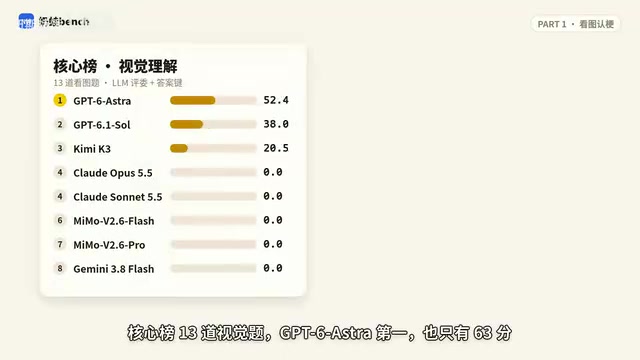
On the core leaderboard of 13 visual questions, GPT-6 Astra ranked first with 63 points; Gemini 3.8 Flash came in last. In other words, even the strongest model barely passes the bar on this kind of "meme recognition" task.
The Milk Hobb Board: High Scores Come with Question Marks
Switching to the 24-image version referenced by "Milk Hobb," the rule was to first determine whether the image is a mutated milk dragon, then correctly identify the pose and expression to get full credit. Gemini shot up to a tie for second place, and Astra scored 96. But the creator also pointed out that Astra annotated this answer key itself, so its high score deserves a question mark. The two test sets use different criteria, but at least they show one thing—seeing clearly doesn't mean understanding.
Vision-language models (VLMs) are a class of multimodal models that can process both image and text inputs, with typical examples including GPT-4V and the Gemini series. They usually use a vision encoder (such as ViT) to convert images into feature vectors, then align them to the language model's space through a projection layer, and finally have the large language model generate descriptions or answers. VLMs perform excellently on tasks like image classification, object detection, and image captioning, but their knowledge comes mainly from image-text pairs in training data. They often lack awareness of rapidly evolving internet memes they haven't seen during training. As a result, a VLM can accurately describe "a yellow cartoon character bent over laughing" but struggles to connect it to the community nickname "mutated milk dragon."
The Drawing Round: From Names to Reference Images, Where's the Gap?
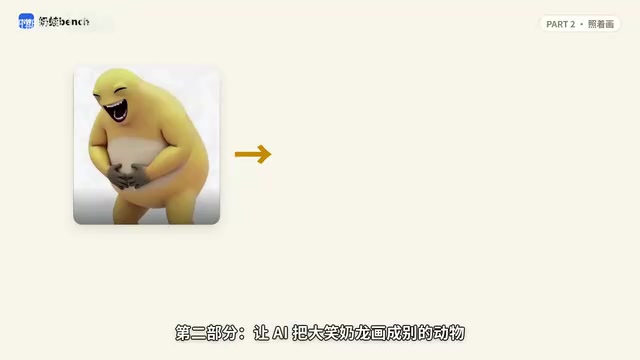
The second part asked the AI to draw the laughing milk dragon as other animals: cat, panda, frog, giraffe, octopus, elephant. Prompts came in five tiers: Chinese name, English name, brief description, detailed description, and directly providing a reference image.
Given only the Chinese name, Gemini gave the cat a pair of dragon wings; given only the English name, it produced a mishmash of memes. ChatGPT drew something quite cute when given just the name, but it looked more like an ordinary laughing small animal—both scored around 30. After adding detailed descriptions or reference images, scores rose to the 70s and 80s.
Reference Images Can Also Fail
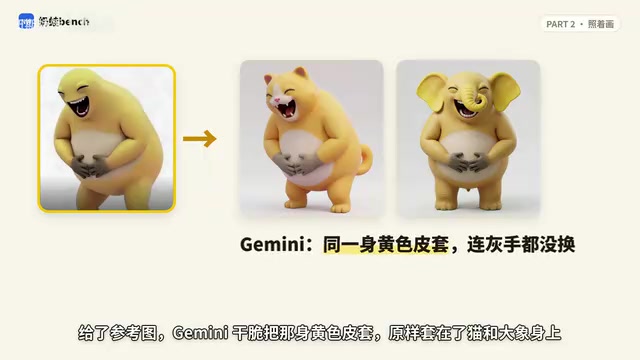
Interestingly, after being given a reference image, Gemini simply put the yellow costume onto the cat and elephant as-is—it transferred the style, but didn't truly understand the character's structure.
One of ChatGPT's images was blocked by a content service—it depicted a panda bent over laughing. The final scores were ChatGPT 60 and Gemini 56. There was also an unscored "family matters" round: transferring various milk frog expressions onto cats and frogs, which is still a draft.
Style transfer refers to applying one artistic style to another image while preserving the content structure of the original image. In generative AI, common methods include reference-image-based generation (such as IP-Adapter and ControlNet) and text-guided style control. In the evaluation, asking models to draw the "laughing milk dragon" as other animals is essentially a dual transfer of content and style: it must preserve the milk dragon's expression and pose features while integrating them into the target animal's form. Ideally, the model should understand the character's structural logic (such as the bent waist and exaggerated mouth) rather than simply copying colors or textures. Although the reference-image method can improve similarity, if the model lacks deep understanding of structure, it easily produces mechanical transfers like "yellow-costume cats."
How to Interpret This Report Card
Each cell was run only once, the judges were also large models, and differences of a few points are essentially random—the creator himself warns "don't take it too seriously." Still, this evaluation has reference value: it exposes a common weakness of current vision models in internet meme understanding and style transfer—they can describe the picture but struggle to grasp a meme's cultural coordinates; they can imitate appearance but easily lose the character's structural logic.
The code and complete evaluation results are publicly available, so if you want to verify, you can run your own model through it too.
Related articles
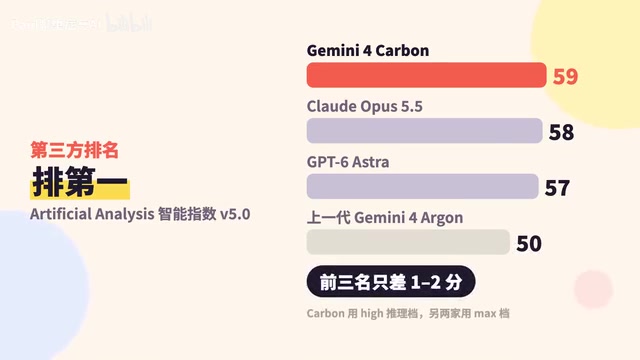
Google Releases Gemini 4 Carbon: Its Strongest Model Yet, Debuting with a Cybersecurity Focus
Google releases Gemini 4 Carbon, calling it its strongest model, with a cybersecurity focus. It tops the third-party composite ranking at 59 points but leads by only one or two. This article analyzes its security test results, staged rollout, token pricing, and the divergence between self-reported and third-party tests on hallucinations.

LangChain Adds SchemagateRetriever: On-Demand Table Retrieval Cuts Text-to-SQL Prompts by 92.9%
LangChain docs add SchemagateRetriever: retrieves only the tables needed for text-to-SQL with permission filtering, cutting median prompt size by 92.9% on Spider 2.0 large schemas via offline BM25 selection with no model calls.

Multi-Step AI Agent Guardrail in Practice: Fact-Change Detection Drives False-Alarm Rate to 0%
Developer shares first version of a multi-step AI Agent guardrail: re-verifying dependency facts before irreversible actions cut false alarms from 50% to 17% across 23 scenarios, then to 0% via conservative normalization without lowering catch rate. Runs on local qwen2.5-7b.