Can an AI Agent Rediscover Blaschke Curve Invariants? A Mathematical Rediscovery Experiment

A controlled experiment tests AI rediscovery of Blaschke curve invariants — it works, but so does a traditional baseline.
This arXiv paper designs a controlled experiment around generalized Blaschke curves: an AI agent, unaware of the target theorem, infers structure from 80 sets of numerical geometric coordinates and fits a homogeneous cubic with residuals as low as $8.88\times10^{-17}$ on 480 unseen data points. However, a deterministic degree-search baseline introduced after peer review reproduces the same cubic, a single-configuration run yields insufficient evidence, and the validation is an in-fit consistency check rather than a true blind test. The paper's core contribution is methodological: it establishes a protocol that rigorously separates conjecture, numerical validation, and proof, and candidly lists fundamental limitations including training data contamination and prior knowledge interference.
A Controlled Experiment in AI-Assisted Mathematical Discovery
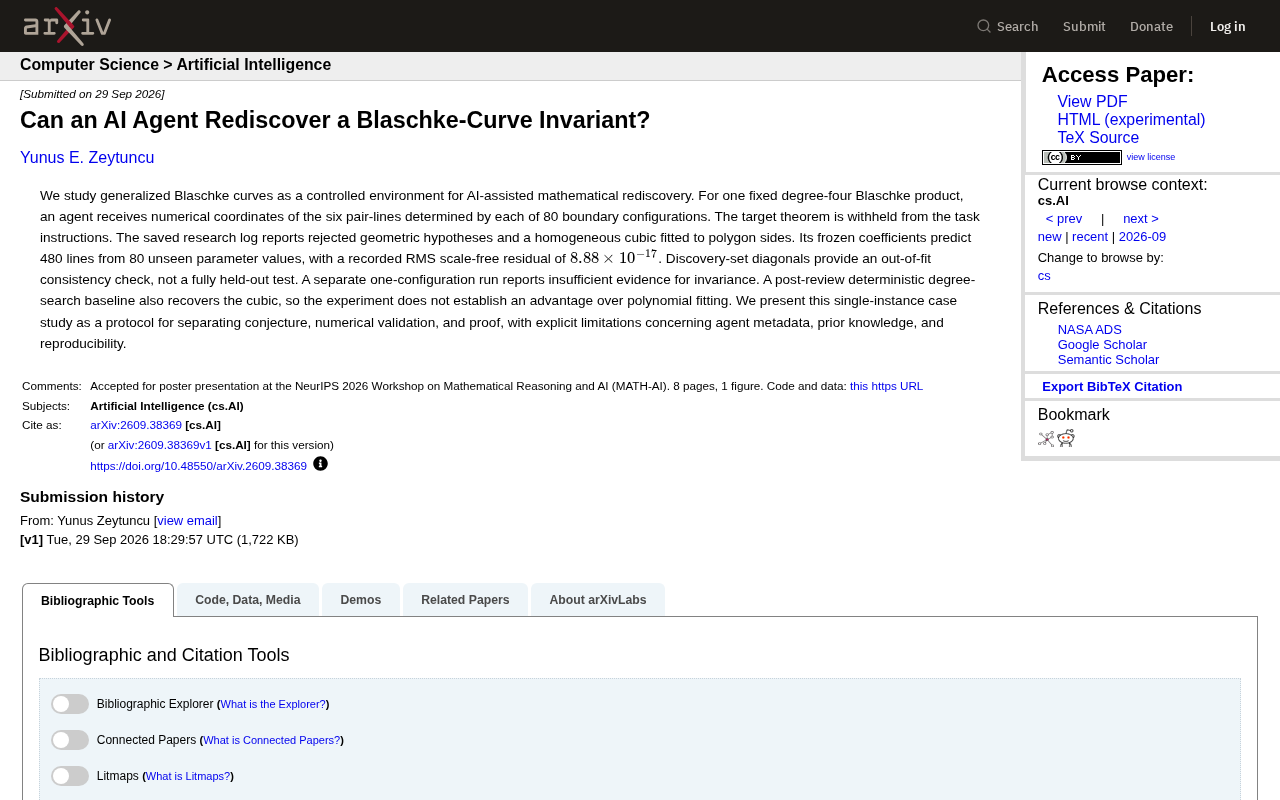
As large language models and AI agents continue pushing the boundaries of capability, a deeper question has emerged: can AI independently "rediscover" a mathematical theorem — the way a mathematician would — without being told the answer in advance? A new paper on arXiv (arXiv:2609.38369v1) attempts to answer this question within a carefully designed controlled environment, using generalized Blaschke curves as its mathematical subject.
The value of this research lies not in claiming any AI breakthrough, but in providing a protocol that separates conjecture, numerical validation, and proof — and in its rare, candid acknowledgment of the experiment's full limitations.
How the Experiment Was Designed
The researchers fixed a degree-four Blaschke product as the mathematical object for the AI agent to explore. The agent's input was purely numerical data: for 80 boundary configurations, each defined by six "pair-lines," the agent received only the numerical coordinates of those lines.
The key design choice was this — the target theorem was completely hidden from the task instructions. The AI had no idea what it was looking for; it had to independently infer latent structure from a pile of geometric coordinates. This "blind search" setup was specifically intended to test whether AI possesses genuine discovery capability, rather than simply reciting known results.
What the Agent Did
According to the preserved research logs, the agent's exploration was far from straightforward. The logs record multiple geometric hypotheses proposed and rejected before the agent ultimately fit a homogeneous cubic in the polygon's side lengths. This process itself — trial, elimination, convergence — closely mirrors the actual path of human mathematical research.
Blaschke products are classical constructions in complex analysis, formed by multiplying factors of the form $\frac{z - a_k}{1 - \bar{a}_k z}$, where $|a_k| < 1$. They map the unit disk to itself, with modulus identically equal to 1 on the unit circle boundary. "Generalized Blaschke curves" are a class of algebraic curves induced by Blaschke products, whose geometric properties are closely related to inscribed polygons, the Poncelet closure theorem, and other classical problems. The "degree-four" in this experiment means the product consists of four factors, producing a family of polygons with specific symmetry on the boundary. Because the algebraic invariants of these curves have a known mathematical ground truth to check against, they make an ideal sandbox for testing AI discovery capability.
Numerical Results: Remarkable Precision
The experimental results look impressive on paper. After the fitted cubic's coefficients were "frozen," they were used to predict 480 lines corresponding to 80 held-out parameter values not used in fitting. The reported scale-free RMS residual was just $8.88\times10^{-17}$.
This magnitude approaches double-precision floating-point machine epsilon, meaning the fitted relationship holds almost "perfectly" in numerical terms. For an agent that had no prior knowledge of the answer, converging to an invariant with this level of precision appears, on the surface, quite convincing.
Where Validation Has Its Limits
But the authors exercise rigor here. They explicitly note that the diagonal data in the discovery set provides only an out-of-fit consistency check, not a fully independent held-out test. In other words, while this form of validation is meaningful, it is weaker than a true blind test.
Furthermore, a separate run using only a single configuration reported that evidence was insufficient to support the invariance claim. This indicates strong dependence on experimental setup — a single data point cannot support a universal conclusion.
The machine epsilon for IEEE 754 double-precision floating point is approximately $2.22 \times 10^{-16}$, representing the smallest relative gap between two adjacent representable numbers. When a residual falls in the $10^{-17}$ range, the error is below the precision floor of floating-point representation itself — numerically equivalent to "exact." However, this comes with an interpretive trap: if the underlying data was generated by an exact algebraic relationship, any sufficiently flexible fitting model that selects the right degree will reproduce that relationship within machine precision. An extremely low residual therefore only confirms that the correct functional form was found — it cannot distinguish genuine discovery from numerical reconstruction of a known structure.
The Most Honest Part: AI Didn't Outperform Traditional Methods
The most commendable aspect of this paper is its refusal to avoid an unflattering result. In a post-review analysis, the researchers introduced a deterministic degree-search baseline — a conventional polynomial fitting method. The result: this baseline also recovered the cubic.
This means that in this specific experiment, the AI agent showed no advantage over traditional polynomial fitting. In other words, what the AI found, a simple automated search could also find. This is a sobering reminder amid the prevailing narrative of "AI mathematical discovery."
Deterministic degree search is a standard technique in symbolic regression and polynomial fitting: try polynomials of degree one, two, three, and so on; select the degree with the smallest residual by least squares or another criterion; then output the corresponding coefficients. This approach is computationally cheap, reproducible, and requires no large-model random sampling. In mathematical discovery tasks, it forms a natural "minimum waterline" baseline — if an AI system cannot surpass it, its incremental value is in question. Such comparisons are conspicuously absent from most AI for Science research, which is precisely why explicitly including one here has methodological value: only under controlled comparison can we determine whether AI provides expanded capability or merely added complexity.
Why This "Breakthrough-Free" Study Still Matters
Setting aside the results themselves, this study's real contribution is methodological. The authors frame it as a single-instance case study, whose core purpose is to establish a reproducible protocol for rigorously distinguishing three levels:
- Conjecture: a hypothetical pattern proposed by the AI;
- Numerical validation: testing the pattern against unseen data;
- Proof: rigorous establishment in the mathematical sense.
At a time when AI is frequently packaged as a "scientific revolution," this deliberate effort to maintain distance between conjecture and proof is particularly valuable. The paper also explicitly lists limitations regarding agent metadata, prior knowledge, and reproducibility. For instance, it is difficult to fully rule out the possibility that the agent had already "seen" related mathematical structures in its training data — which is precisely the most intractable contamination problem when evaluating AI discovery capability.
Implications for AI for Science
This work suggests that evaluating AI's scientific discovery capabilities requires more stringent standards:
- Truly held-out tests must be used, rather than within-fit consistency checks;
- Traditional automated methods must be used as baselines to confirm whether AI provides incremental value;
- The confounding effects of training data contamination and prior knowledge must be honestly confronted.
Conclusion
Returning to the original question — can an AI agent rediscover Blaschke curve invariants? This paper offers a measured and honest answer: numerically, it found the invariant, but this does not constitute a fully independent discovery, nor does it surpass traditional methods.
Compared to a triumphant "yes," this answer — laden with asterisks and qualifications — is actually closer to what science looks like in practice. It establishes a rigorous example worth emulating for AI-assisted mathematical research.
Related articles

iPhone Duo Hands-On: Is the $2,000 Small-Screen Foldable Worth It?
YouTube's Allison shares her iPhone Duo hands-on: dual-screen multitasking doubles efficiency, great video viewing, nice matte finish—but thick body, small outer screen, and a $2,000 luxury price.

Sentry's Ad Cracks Up Developers: Can On-call Actually Be Fun?
Sentry's ad short film taps into developers' on-call anxiety, using humorous dialogue to showcase its observability platform—errors, logs, traces, metrics, replays, and releases in one place.

LLM App Getting Worse With Every Change? Build an Effective Evaluation System in Three Steps
How do you know if your LLM app is getting better or worse? A Reddit-based guide to test sets, automated regression evaluation, LLM-as-judge scoring, and structured agent tracing.