Can Emotionally Rewritten Fake News Evade Detection? The LLM Explanation-Guided GCA Framework Offers a New Answer

LLM-generated explanations plus a Gated Cross-Attention framework to detect emotionally rewritten fake news.
Most fake news detectors rely on stylistic features and can be fooled by adversarial rewrites that preserve facts while changing emotional tone. This paper builds emotion-rewritten test sets, uses LLMs to generate stable explanatory content from original articles as anchor points, and introduces a Gated Cross-Attention (GCA) framework that dynamically fuses emotional text with explanations to filter out noise. Experiments on PolitiFact, GossipCop, and LUN show significant gains on the first two and competitive results on the third. A key open question is whether LLM-generated explanations remain reliable when the source article is itself fabricated.
The New Challenge in Fake News Detection: Emotional Rewriting
The serious social consequences of fake news spread are well-established. Yet most existing detection methods focus on stylistic differences in text, or incorporate external information (such as explanatory content) to aid judgment. This approach has a long-overlooked blind spot: the same piece of news can often be rewritten in different emotional tones while preserving its core factual claims.
Consider how a piece of misinformation can be presented with an angry, inflammatory tone, or retold in a calm, objective voice — without the underlying factual assertions changing at all. This "fact-preserving, emotion-altering" rewriting strategy can undermine the robustness of detection models, which may be misled by the emotional packaging rather than genuinely identifying whether the content is true or false.
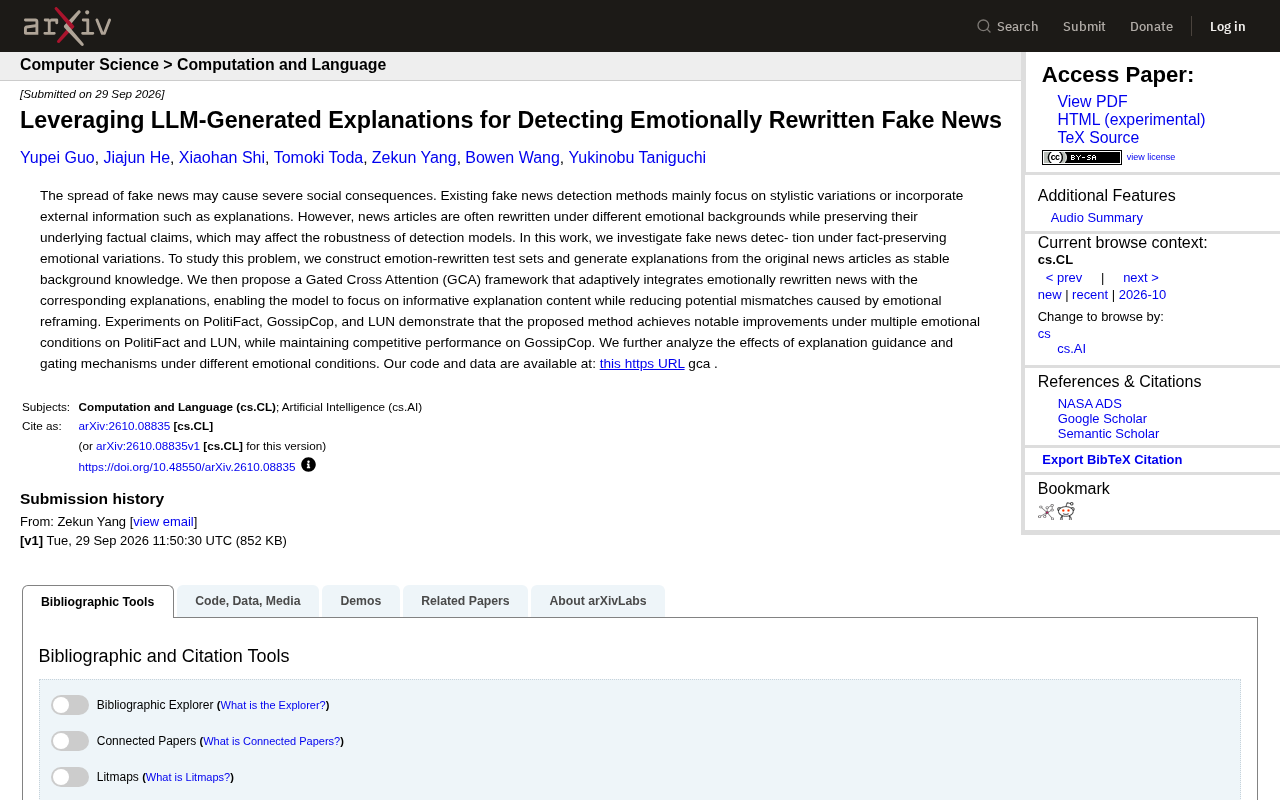
A new paper on arXiv, Leveraging LLM-Generated Explanations for Detecting Emotionally Rewritten Fake News, addresses precisely this problem. It proposes a detection framework that uses large language models to generate explanations and integrates information through a gated cross-attention mechanism.
Core Idea: Using Stable "Background Knowledge" to Counter Emotional Noise
The research team's approach is clear and targeted. They first constructed emotion-rewritten test sets to simulate real-world scenarios where the same facts are presented with different emotional colorings. The significance of these test sets lies in their ability to evaluate whether a model remains stable under emotional perturbation.
Crucially, the team generates explanatory content from original news articles and uses it as a form of "stable background knowledge." The key logic here is that while emotions can be freely rewritten, explanations distilled from original facts remain relatively stable and do not fluctuate significantly with emotional tone. These LLM-generated explanations can therefore serve as anchor points, helping models see through the emotional packaging and focus on genuinely informative content.
This design philosophy responds to a deeper question: when the surface-level features of a text (emotion, style) are deliberately manipulated, what signals should a detection model rely on? The paper's answer is — rely on explanatory content distilled from facts, which is resistant to emotional rewriting.
Technical Approach: The Gated Cross-Attention (GCA) Framework
The paper's core technical contribution is the Gated Cross-Attention (GCA) framework.
How It Works
GCA's goal is to adaptively integrate two types of information: emotionally rewritten news text and the corresponding explanatory content. Its design involves two key components:
- Cross-Attention: Enables the model to establish connections between emotionally rewritten text and explanatory content, thereby capturing the semantic correspondence between the two.
- Gating Mechanism: Dynamically adjusts the mixing ratio of the two information sources, allowing the model to focus more on information-rich explanatory content while reducing potential mismatches caused by emotional reconstruction.
In other words, when emotional rewriting causes the text to deviate from the facts, the gating mechanism can "filter out" this noise and prioritize the stable explanatory information. This adaptive fusion is what distinguishes the framework from simple concatenation or fixed-weight approaches.
The Cross-Attention mechanism originates from the Transformer architecture. Its core idea is to have the queries (Q) from one sequence retrieve key-value pairs (K-V) from another sequence, establishing dynamic associations between representations from two different sources. Unlike self-attention, which operates within a single sequence, cross-attention is naturally suited for "dual-source fusion" scenarios — such as source-target language alignment in machine translation, or image-text alignment in visual question answering. In this paper's setting, it is used to align emotionally rewritten news text with LLM-generated explanations, enabling the model to identify semantic correspondences or discrepancies between the two.
The Gating Mechanism draws on the gating concepts from LSTMs/GRUs: using learnable weights to dynamically decide "how much information passes through." Unlike fixed-weight averaging, the gated output adapts to changes in the input content, allowing the model to automatically reduce its reliance on emotional text and rely more on explanatory content when significant semantic divergence occurs between the two. The combination of these two mechanisms gives the GCA framework the ability to robustly fuse multi-source information under noisy conditions.
Experimental Validation: Performance Across Three Datasets
The research team validated their approach on three public datasets: PolitiFact, GossipCop, and LUN. These three datasets cover different domains — political fact-checking, entertainment gossip, and news corpora, respectively — providing reasonable representativeness.
The experimental results exhibit the following characteristics:
- On PolitiFact and LUN, the GCA method achieved significant improvements under multiple emotional conditions, demonstrating the effectiveness of explanation guidance and the gating mechanism in these scenarios.
- On GossipCop, the method maintained competitive performance — while the improvements were not as pronounced, there was no notable degradation either.
This "not a clean sweep" result is actually worth noting — it suggests that the impact of emotional rewriting on detection varies across domains. GossipCop's entertainment content may already carry a strong emotional charge by nature, making the marginal impact of emotional perturbation relatively limited. The paper further analyzes the roles of explanation guidance and gating mechanisms under different emotional conditions; this type of ablation analysis helps clarify the applicable boundaries of the method.
PolitiFact, GossipCop, and LUN are commonly used benchmark datasets in fake news detection, each with its own focus. PolitiFact data comes from the political fact-checking website PolitiFact.com, with labels assigned by professional fact-checkers; content is primarily political statements, typically labeled as true/false or with multi-level credibility scores. GossipCop comes from an entertainment gossip fact-checking platform covering celebrity news, which is inherently emotionally charged — explaining why emotional rewriting has a relatively limited marginal effect on this dataset. LUN (Like Us News) is a comprehensive multi-type news corpus containing various labels including satirical news and credible news, with broader domain coverage. The differences in text style, annotation sources, and emotional baselines across these three datasets provide complementary perspectives for validating the method's cross-domain robustness.
Value and Limitations
The significance of this work lies in advancing fake news detection research from "identifying style" to "resisting emotional manipulation" — a direction much closer to real-world adversarial scenarios. As large language models make text rewriting extremely cheap, malicious actors can easily generate fake content at scale with varied emotional tones but consistent factual claims. Traditional detection models that rely on surface-level features will face serious challenges.
Using LLM-generated explanations as stable anchor points is a clever approach — it leverages the comprehension capabilities of large models while avoiding the unreliability that might come from having large models directly make truth/false judgments.
Of course, the method also raises questions worth exploring: how can the quality and reliability of LLM-generated explanations be guaranteed? If the original article itself is a carefully fabricated piece of misinformation, might the explanations generated from it inherit those false premises? The paper does not fully answer these questions, leaving space for future research.
The research team has open-sourced their code and data at github.com/Flulike/fakenews_gca, available for researchers interested in reproduction or further extension.
The paradigm of using LLM-generated explanations for downstream tasks is often referred to as "explanation-enhanced learning" or "knowledge distillation-style reasoning." The underlying assumption is that large language models accumulate vast world knowledge during pretraining and can distill human-readable, semantically stable background descriptions from a piece of text. These descriptions can then be passed to smaller discriminative models as soft labels or auxiliary features. The advantage of this approach is that small models don't need to perform complex reasoning themselves — they only need to learn to "reference" the LLM's explanations. However, the risk is that the quality of LLM explanations is highly dependent on the original input. If the input itself is carefully constructed misinformation, the LLM may generate seemingly plausible but actually misleading explanations based on false premises — a problem known as "hallucination propagation." How to validate and filter low-quality explanations is an engineering challenge that requires systematic consideration when deploying this paradigm in practice.
Related articles

Reinforcement Learning Takes On Getting Over It: Distributed Training Strategies Behind 63% Progress
A developer uses deep reinforcement learning to tackle Getting Over It. The agent climbs from the bottom to 63% progress but gets stuck at the anvil. The project is open-sourced, using divide-and-conquer training and CPU-only training, seeking community collaboration to break the bottleneck.

Sigma FP2 Released: The World's Smallest Full-Frame Camera Gets Sensor and Screen Upgrades
Sigma launches the FP2 full-frame camera, retaining its smallest-and-lightest design with three key upgrades: improved sensor, articulating LCD screen, and longer battery life—built for portable video creators.

AAAI 2027 Phase 2 Decisions Imminent: Community Debates Review Fairness and Submission Ecosystem
AAAI 2027 phase 2 review results are imminent, with the Reddit community debating reviewer consistency and process transparency. This article examines pre-decision sentiment, structural tensions in top conference review, and practical strategies for authors.