Can Generalist AI Agents Understand Surgical Scenes? A New Benchmark Weighs In

A two-stage benchmark reveals generalist MLLMs' surgical understanding limits and agentic reasoning's narrow gains.
This study proposes a two-stage framework to systematically evaluate generalist MLLMs in surgical scenes. SurgKnowBench, integrating public datasets, finds models retain some visual priors but struggle with relational, procedural, and workflow understanding. SurgAgentGym lets agents do bounded knowledge search via SurgWiki and use visual grounding. Results show agentic reasoning mainly narrows perception-intensive gaps, while fine-grained localization and expert-level evaluation remain bottlenecks. The authors advise prioritizing perception-assistance features in surgical medical AI.
Multimodal large models have drawn sustained attention in healthcare, yet their true capability boundaries in surgical scenes have rarely been systematically evaluated. A recent study titled How to "train" a surgeon? Benchmarking generalist agents in surgical scene understanding benchmarks the surgical scene understanding capabilities of generalist MLLMs (multimodal large language models) through a two-stage framework, and explores whether agentic reasoning can compensate for gaps in model prior knowledge.
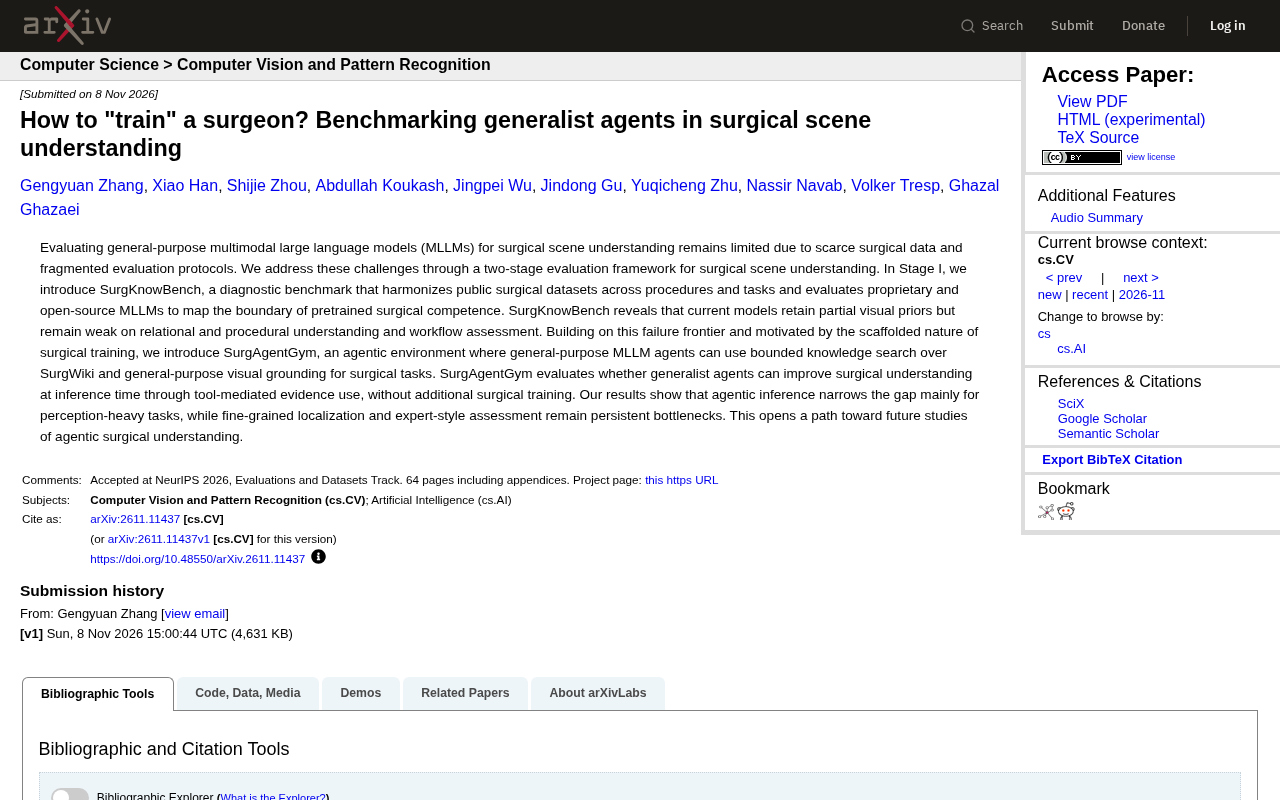
A Two-Stage Evaluation Framework: From Diagnosis to Agentic Enhancement
The research team notes that surgical scene understanding evaluation faces two major obstacles: scarce surgical data and fragmented evaluation protocols. To address this, they designed a two-stage evaluation framework.
Stage 1: SurgKnowBench diagnostic benchmark. This benchmark integrates public surgical datasets across procedure types and tasks to uniformly evaluate proprietary and open-source MLLMs, aiming to map the boundaries of pretrained surgical capability. Results show that although current models retain some visual priors, they perform weakly in relational understanding, procedural understanding, and workflow evaluation.
Stage 2: SurgAgentGym agentic environment. Inspired by "scaffolded" teaching in surgical training, the team built an agentic environment in which generalist MLLM agents can perform bounded knowledge searches via SurgWiki and leverage general visual grounding capabilities to complete surgical tasks. The core question: without additional surgical training, can generalist agents improve surgical understanding through inference-time tool use and evidence utilization alone?
Multimodal large language models (MLLMs) refer to large-scale pretrained models with both visual and language understanding capabilities, such as GPT-4V and LLaVA. Their core capabilities come from pretraining on massive image-text pairs, giving them certain general visual priors—but whether these priors transfer to highly specialized surgical scenes is precisely the question this benchmark aims to answer. Unlike unimodal models, MLLM evaluation must simultaneously assess visual recognition, spatial relational reasoning, and language generation correctness, making the evaluation protocol more complex.
Surgical scene understanding typically includes identifying instruments and anatomical structures, understanding the temporal relationships of procedural steps, and judging whether surgical workflows conform to standards. Compared with natural image understanding, surgical scenes feature similar textures, frequent occlusion, and special lighting, while public data is scarce due to privacy and ethical constraints—explaining why a dedicated SurgKnowBench is needed rather than directly reusing general vision benchmarks.
Gains and Limits of Agentic Reasoning
Experimental results show that agentic reasoning mainly narrows the gap on perception-intensive tasks, while persistent bottlenecks remain in fine-grained localization and expert-level evaluation. This means tool-augmented reasoning strategies help with "what is seen" tasks but yield limited benefit for "precise judgment" tasks.
This finding has practical significance: in high-stakes settings like surgery, the shortcomings of general AI are concentrated precisely in the areas requiring professional judgment. The team believes this opens a path for future research on agentic surgical understanding—not pursuing end-to-end training, but exploring how to more effectively invoke external knowledge and tools at inference time.
Visual grounding refers to a model's ability to localize the corresponding region or target in an image based on a text description, and is the foundation for agents to invoke general visual tools. In surgical scenes, grounding tasks require models not only to find instruments but also to precisely mark their boundaries and spatial relationships—precisely where the "fine-grained localization" bottleneck lies. General visual grounding models are mostly trained on natural images and degrade markedly when facing the elongated shapes and metallic reflections of surgical instruments.
Inference-time tool use, as opposed to end-to-end training, refers to a model acquiring external information at inference through retrieving knowledge bases, invoking vision models, and so on, without updating model parameters. This strategy is low-cost and highly interpretable, but is limited by the accuracy of the tools themselves and the coverage of knowledge retrieval; thus it yields clear gains on perception-intensive tasks but limited help for tasks requiring professional judgment.
Implications for Medical AI Development
The study sends a clear signal: the surgical capabilities of general MLLMs cannot be simply assumed and require systematic benchmarking to define their boundaries. At the same time, the agentic framework offers a low-cost enhancement approach but cannot replace the fine-grained judgment of domain experts. For medical AI product developers, this means that when deploying general models in surgical scenes, priority should be given to perception-assistance features, while caution should be exercised for localization and evaluation tasks.
The research also exposes gaps in the current evaluation ecosystem: scarce surgical data and inconsistent evaluation protocols remain key factors constraining the field's development. SurgKnowBench's integration effort provides a reusable benchmark for future research, but broader community collaboration remains essential.
Conclusion
This study does not offer a simple answer to "can general AI become a surgeon," but instead precisely delineates the boundaries of current capabilities and the applicable scope of agentic enhancement. Amid the current enthusiasm for medical AI, this kind of sober benchmarking may be more valuable than optimistic demonstrations.
One-line Summary
A two-stage benchmark reveals the capability boundaries of generalist multimodal large models in surgical understanding and the limited gains from agentic reasoning.
Paragraph Summary
Addressing the lack of systematic evaluation of generalist multimodal LLMs' true capability boundaries in surgical scenes, this study proposes a two-stage framework: Stage 1, SurgKnowBench, integrates public datasets across surgical types to uniformly evaluate proprietary and open-source MLLMs, finding that models retain some visual priors but are weak in relational understanding, procedural understanding, and workflow evaluation; Stage 2, SurgAgentGym, inspired by scaffolded teaching, enables agents to perform bounded knowledge searches via SurgWiki and invoke general visual grounding. Experiments show agentic reasoning mainly narrows gaps on perception-intensive tasks, while fine-grained localization and expert-level evaluation remain persistent bottlenecks. The study recommends that medical AI in surgical settings prioritize perception-assistance features and exercise caution for precise judgment tasks.
Related articles

Gemini 4 Neon Leak: A Potential Strong Contender Against Opus 5.5
A Hacker News thread suggests Gemini 4 Neon looks like an Opus 5.5 competitor. This article unpacks the product positioning behind this community signal, shifts in the top-model competitive landscape, and what it means for developers' model selection strategy.

Claude Fable 5.2's Self-Authored Short Film 'Fable' Sparks Discussion
A short film 'Fable,' credited to Claude Fable 5.2 for script, visuals, and directing, appears on Hacker News. This article analyzes the significance of full-pipeline AI creation, community reactions, and what it means for content creators.

Anthropic IPO Pricing: A Signal of AI Giants Going Public
Anthropic's IPO pricing draws attention. This article analyzes its potential impact on AI industry valuation, commercialization paths, and the competitive landscape, and highlights public-market expectations and challenges for AI companies.