Can LLMs Directly Edit Neural Network Weights? A New Approach to Programming Dead Neurons

LLMs can write weights into ReLU dead neurons, turning neural networks into a programmable space.
The Reddit discussion has drawn attention: LLMs appear able to edit neural network weights. The article notes that the sparsity of ReLU activation produces many "dead neurons" that retain weight slots despite not participating in current computation. LLMs can "program" small controllers into these idle positions, letting robots activate preset logic on specific inputs. This leads to the "weights as a programming language" hypothesis: LLMs can not only generate code but also directly modify a model's internal structure. Cases show complex controllers can be embedded across many weights, bypassing gradient updates. But the current scale is small, and interpretability and security remain open questions, with the community curious yet cautious.
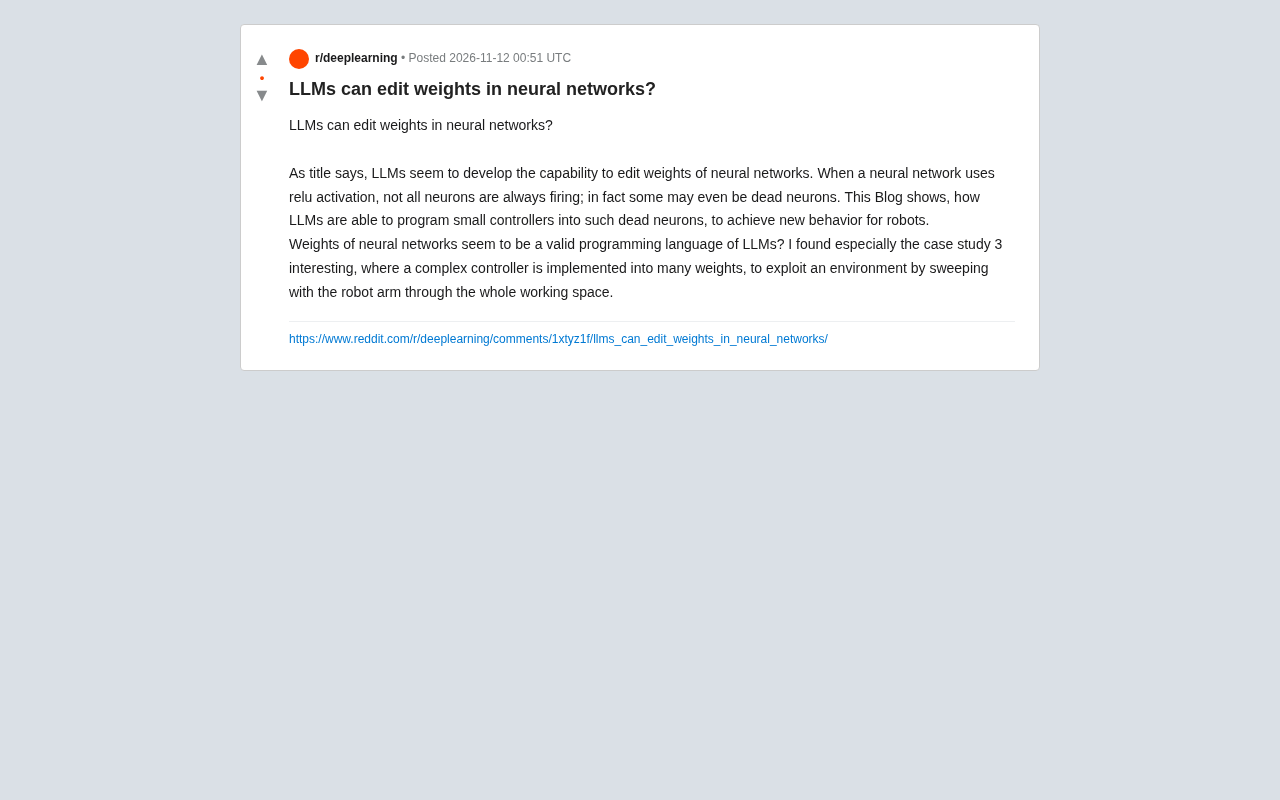
A recent Reddit discussion has drawn attention: LLMs appear to have developed the ability to edit neural network weights.
A Counterintuitive Discovery
Conventionally, large language models process text, while neural network weights are matrices of floating-point numbers—the two seem worlds apart. But this Reddit post points out that when a network uses the ReLU activation function, not all neurons are always active; some even become "dead neurons." A blog demonstrated that LLMs can "program" small controllers into these dead neurons, giving robots new behaviors.
This observation leads to a bold hypothesis: neural network weights might serve as an effective programming language for LLMs. If true, it means LLMs can not only generate code but also directly modify a model's internal structure to achieve specific functions.
Why Dead Neurons Become a Programmable Space
The sparsity of ReLU activation is the physical basis for this idea. In any forward pass, only some neurons are activated while the rest output zero. These "silent" neurons don't participate in the current computation but retain their weight slots. What the LLM needs to do is find these idle positions, fill them with carefully designed weight values, and have them activate on the next specific input to execute preset control logic.
This is essentially "parasitizing" a subroutine inside an existing network. Compared with training a controller from scratch, the advantage of this approach is that it bypasses gradient updates and directly leverages the LLM's understanding of the weight space. The post author specifically mentions being impressed by case 3—a complex controller implemented across a large number of weights, using a robotic arm to sweep across the entire workspace to explore the environment. This shows the method can handle not only simple logic but also fairly complex strategies.
ReLU and Dead Neurons: ReLU (Rectified Linear Unit) is defined as f(x)=max(0, x) and is one of the most commonly used activation functions in deep networks. Its piecewise-linear nature brings sparse activation—negative inputs are clipped to zero, while positive inputs pass through linearly. A so-called "dead neuron" refers to a neuron that, after training, outputs zero for the vast majority or even all inputs, usually because an excessively large learning rate or improper initialization causes weight updates that make the neuron's pre-activation values negative for all samples. Traditionally this is regarded as a training defect, but from the perspective of "weights as code," dead neurons happen to provide a large number of unoccupied weight slots, and because they currently don't participate in normal forward computation, writing new logic into them won't interfere with existing functions—equivalent to blank pages reserved within the network.
The Potential and Boundaries of Weights as a Programming Language
The core challenges of treating weights as a programming language lie in interpretability and stability. The LLM needs to understand which weight combinations correspond to which behaviors, which is itself a high-dimensional search problem. The cases demonstrated so far are small in scale with limited controller complexity, and there's still a distance to general-purpose scenarios.
But the direction is worth watching: if LLMs can stably edit weights, new paradigms could emerge in model fine-tuning, robot control, and even model repair. For example, instead of requiring large amounts of labeled data for fine-tuning, an LLM could directly "write in" the required skills. Of course, this also brings new security concerns—who can guarantee that the written weights won't trigger unexpected behaviors?
Judging from the Reddit discussion, the community's attitude toward this direction is curious but cautious. Some commenters see it as an extension of the "weights as code" idea, while others question the reproducibility of the cases. Either way, the perspective of turning dead neurons from a training defect into a programmable resource is itself illuminating.
High-Dimensional Search and Bypassing Gradients: Viewing weight editing as programming is essentially about finding a set of values in parameter space that make the network produce the desired output for specific inputs. This is a typical high-dimensional non-convex optimization problem, and traditional solutions rely on backpropagation and gradient descent. An LLM directly generating weights bypasses this process—leveraging its pretrained understanding of code and numerical patterns, the model "writes out" the target weights in one shot without iterative training. The advantage of this approach is extremely high sample efficiency, but the cost is the lack of the precise directional signal that gradients provide. Therefore, it can currently only handle controllers of smaller scale and relatively simple logic; complex strategies still require search or verification mechanisms to ensure correctness.
One-line Summary
LLMs can write weights into ReLU dead neurons, turning neural networks into a programmable space.
Paragraph Summary
The Reddit discussion has drawn attention: LLMs appear able to edit neural network weights. The article points out that the sparsity of ReLU activation produces large numbers of "dead neurons" that don't participate in current computation but retain weight slots. LLMs can "program" small controllers into these idle positions, letting robots activate preset logic on specific inputs to achieve new behaviors. This leads to the "weights as a programming language" hypothesis: LLMs can not only generate code but also directly modify a model's internal structure. Cases show complex controllers can be embedded across large numbers of weights, bypassing gradient updates. But current scale is small, and interpretability and security remain unresolved issues, with the community curious yet cautious.
Related articles

Incident Response in the Age of AI Attackers: A 6-Month Retrospective and the Four Pillars
AI attackers are making attacks on AI infrastructure more frequent. This article explains MarkTechPost's four-pillar incident response playbook based on a 6-month retrospective, with Fireworks AI and Klue case studies on implementation.

Abnormal Error Rate Spike in Claude Mythos 5.2 and Fable 5.2
Claude Mythos 5.2 and Claude Fable 5.2 show an abnormal spike in request error rates, marked as investigating on the official status page. This article covers the incident overview, practical impact on developers, and recommended responses.

ReAct Runtime Context Trimming: Why Claude Code Acts at 70%
A deep dive into ReAct runtime context trimming: why Claude Code compresses at ~70% usage, why tool calls dominate, why messages must be dropped in pairs, and why codebases don't need RAG.